The Papuans insist they're
pp. 26-130 · Read in the full issue
not New Guineans
From a Port Moresby correspondent It was a happening month in Papua New Guinea, where suddenly the Administration is called a “government”, the Minis terial Members are called “Ministers” and everybody talks about self-government and independence as though they will be attained next year. Notwithstanding, it’s still a safe bet that nobody has any idea where this territory is headed politically or what it will do when it gets there.
The May/June meeting of the House of Assembly reversed the recent parliamentary tendency to dullness, that has presumably been brought about by the downhill run to the gene ral elections that are due after Christ mas. There was plenty of interest this time, although as usual not a lot of worthwhile discussion on social rather than political issues.
An exception was the debate on four land bills aimed at enabling native customary land to be registered by individuals. The bills were intro duced in March for debate at this meeting, but meantime they attracted extraordinary opposition.
Roman Catholic Archbishop of Port Moresby, Dr. Virgil Copas> and the Anglican Bishop of PNG, Rt. Rev.
David Hand, appealed to the Ad ministrator, Mr. Johnson, to defer the bills until after the elections, or “even wait until full internal self-govern ment is attained”.
The church leaders said that the legislation could “drastically change and even destroy the whole pattern of life of the majority of our people . . , We are not convinced that indi vidualisation of land tenure in PNG will necessarily further economic development”.
The previous month, at the Wai gani Seminar in Port Moresby, former Chief Commissioner of Land Titles, Mr. Cyril McCubbery, now a Port Moresby solicitor, described the bills as “the most dangerous set of land legislation ever introduced”.
Dr. A. D. Ward, who is teaching this year at the University of Papua New Guinea, warned in a paper cir culated to members of the House that similar land reforms attempted among NZ Maoris had caused social disrup tion, landlessness and decline in pro ductivity.
Large areas of land passed to banks and lending institutions under forced sale and this would happen in PNG.
It was wrong to assume there was no halfway house between complex tradi
tional rights and fully negotiable free hold title.
The legislation, he said, was framed not for the simple villager “but for a populace of Melbourne businessmen who know how to play the system and can phone a Collins Street lawyer”.
These outside pressures were re flected in the House and the govern ment withdrew the bills. Deputy Ad ministrator and government leader in the House, Tony Newman, said the main problem in the House seemed to be fear brought about by the fact that nobody fully understood the pro posals.
Events that had cast their shadows before also played a part in the de velopment of a debate on the status of distinct from the New Guineans. The Papua v New Guinea argument had got an unexpected air ing at the March meeting, and in late May it was the subject of a statement about national unity issued by Ad ministrator Johnson, who strengthened the announcement by noting that he had been authorised by the Minister for External Territories to say it.
Mr. Johnson reiterated the policy of the Australian Government “to ad vance PNG to internal self-govern ment and independence as a united country”, and said he saw no other course long-term. The difference of legal status between the inhabitants of Papua [Australian citizens] and New Guinea [Australian protected persons] had been of little consequence since 1947, when the two territories began an administrative union authorised by the UN. The people of the combined territory would all be treated the same.
Without unity, the country would “inevitably break down into a col lection of tiny, hostile fragments”, and the administrator appealed to all leaders “to recognise the grave dan gers which disunity threatens”.
In the Assembly a fortnight later, Bert Counsel, Tasmanian-bom mem ber for Western and Gulf, who has
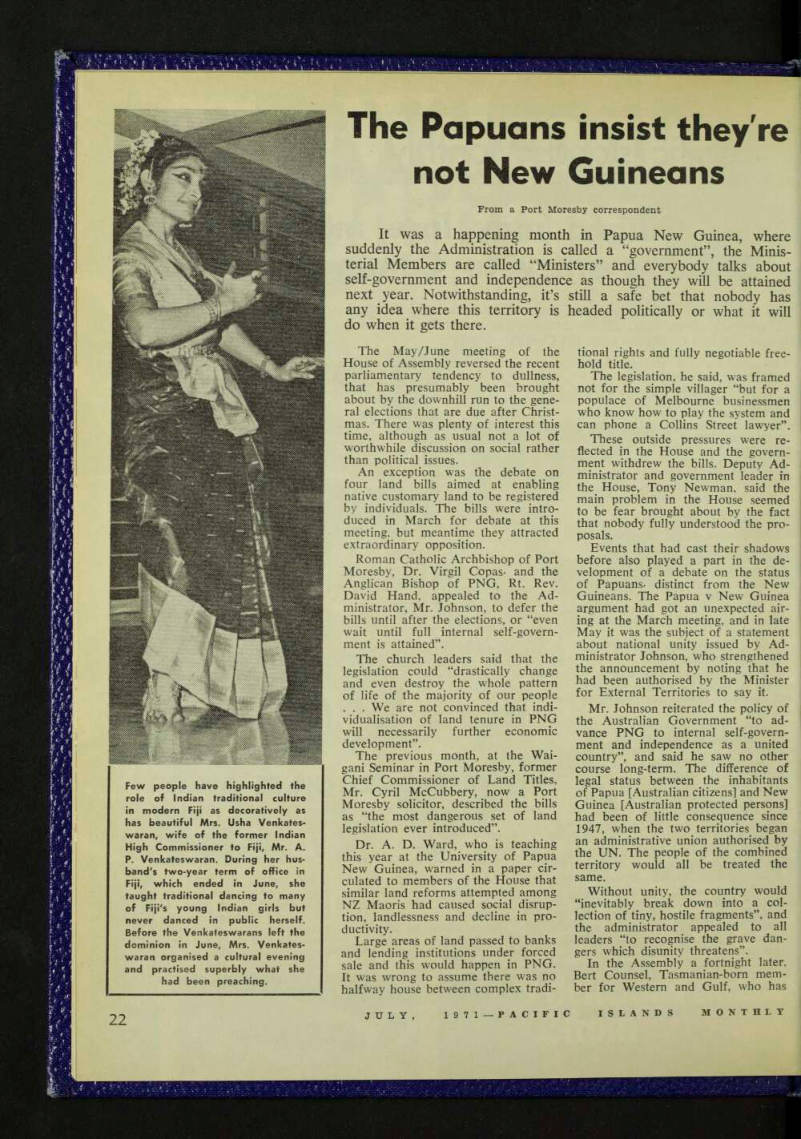
Few people have highlighted the role of Indian traditional culture in modern Fiji as decoratively as has beautiful Mrs. Usha Venkates waran, wife of the former Indian High Commissioner to Fiji, Mr. A.
P. Venkateswaran. During her hus band's two-year term of office in Fiji, which ended in June, she taught traditional dancing to many of Fiji's young Indian girls but never danced in public herself.
Before the Venkateswarans left the dominion in June, Mrs. Venkates waran organised a cultural evening and practised superbly what she had been preaching.
lived in Papua for 25 years, and has a Papuan wife and nine children, threw mud in Mr. Johnson’s eye.
First he introduced an urgency de bate on the issue of Papuan union with New Guinea, and a day or two later moved a motion virtually demanding that Papua be entitled to decide for itself whether it would join New Guinea or seek separate status.
The motion called on the Austra lian Government not to change Papua’s status “without the express approval of the Papuan people or their elected representatives”, and, sur prisingly, it was passed, 30 votes to 25.
General tenor of both debates, which were dominated by Papuans, was that Papuans opposed being forced into a union which they feared might result in them being over whelmed.
Mr. Percy Chatterton (Moresby) said Papuans and New Guineans were not one people, and the only national unity that was any good was the unity of people who came together because they wanted to come together.
“A unity imposed by the arrogant on the unwilling can only end in dis aster and misery”, he said.
There were viable alternatives be tween national unity and Mr. John son’s “tiny* hostile fragments”. There could be a group of provinces within a federal State; there could be a group of small independent States linked by a common market and joint defence agreements. But the alternatives should be considered without bullying and brainwashing.
Mr. Warren Dutton (North Fly) said the real conflict was not between Papuans and New Guineans, but be tween the people of PNG and the Australian Government.
The government members, despite their strong objections to the motion, conformed to their convention of not voting on constitutional matters.
In getting the support of the House the Papuans achieved what neither the break-away Mataungans of New Britain nor the Bougainville secession ists have been able to achieve—that is, success for separatist sentiment.
Even then the issue wouldn’t lie down. A couple of days later another Papuan-inspired motion was passed asking that an Australian all-party parliamentary committee be appointed to review the wishes of the Papuan people on their future.
Percy Chatterton remarked, “I hope if an Australian delegation does come it comes to find out what Papuans think, not to tell Papuans what Aus tralia thinks”.
Outside the House the Administra tor kept his cool. He said the govern-
Continued on p. 124
ment was devoting some thought to Papua’s problems, especially economic ones, which he thought were at the root of Papuan dissatisfaction.
“If I were a Papuan I might feel the government did not give me enough attention”, he said.
But he added that Australia did not regard separate Papuan constitutional development as a negotiable issue. In any case, he pointed out, after two tours of the territory, which had in cluded Papua, the Assembly’s select committee on constitutional develop ment had concluded that most people wanted a single, united country.
Mr. Johnson was plagued with other problems besides those high lighted by the honourable members.
He announced the territory’s cabinet—the Administrator’s executive council—was considering how to deal with the growing urban population drift and related problems of vag rancy, prostitution and VD, which had “got ahead of our capacity to cope.”
He admitted he had been under considerable pressure to try to restrict movement of people to the towns, but this sort of legislation posed big diffi culties. The government would have to decide whether the benefits of re strictions were worth the infringement of civil liberties.
Mr. Johnson said the increasing number of crimes directly attributable to drinking was “alarming”, and the territory’s liquor laws might have to be reviewed.
In case it might be thought that his strictures were reserved only for the black population, the Administra tor went into the attack on some of the whites while opening the Central District Show on June 14.
He said some people in Port Moresby lived wretchedly, and few of the rest “gave a damn”. The town was breeding discontent and violence.
“Port Moresby is a good town— for some”, he said. “It’s a good town if you are white because you’ve got a good job and a decent home and ex pensive things to play with, cars and boats and clubs. It’s a good town for some who are not white, for they have these things as well. It’s a bad town for some because it gives them neither work nor shelter”.
He said Moresby had no mobilised social conscience and he didn’t know how to mobilise it.
A few days later, the PNG Public Service Association, which is the ter ritory’s biggest trade union, made it
clear that the good life wasn’t all that good. President T. J. Jackson accused the government of having an obsessive interest in keeping wages down while making no effort to stop prices spiral ling. Price control was administered so timidly that apparently there had been no prosecution since 1956. The cost of living, for everybody, was meanwhile rising alarmingly, he said.
There were two other significant developments during a busy month. • A bill to restrict the entry of expatriates into the territory to work was introduced into the House and will be debated in August. The gov ernment wants to prohibit certain categories of work from being under taken by people brought from over seas. Other jobs will be restricted to overseas people for a limited time, while local people are trained to take over. • The Mataungan Association launched a renegade Local Govern ment Council on Rabaul’s Matupit Island, announcing that it will go its own way “until independence comes”.
The council will operate alongside the legally-recognised Gazelle Peninsula Council, which the Mataungans are seeking to destroy. The term of the legal council has been extended for another six months, because it was realised that elections for a new one would probably be boycotted by the Mataungans.