Catch-As-Catch-Can Skyways
pp. 118-120 · Read in the full issue
Accusations were flying across the Pacific in May over the air traffic between Australia and the United States.
The US Civil Aeronautics Board threatened to cut Qantas flights to America because Australia had re fused American Airlines two flights a week to Melbourne.
Australia’s Minister for Civil Avi ation, Senator Robert Cotton, coun tered CAB’s allegation that Australia had taken “unwarranted, unilateral restrictive action” by accusing the US of ignoring Australian warnings that “an excess-capacity situation was de veloping across the South Pacific”.
At CAB’s request Qantas filed com plete schedules of its flights to and from the US, and CAB explained that such an order put the board in a position to approve or disapprove schedules for Qantas services.
It complained that the Australian Government had limited American Airlines to three flights weekly to Sydney, allowed none to Melbourne and had reduced Pam Am’s frequency of flights to Australia.
CAB described its order as a move
“to defend the rights of US air car riers to operate to Australia”.
Senator Cotton said the Australian Government was deeply concerned about US applications for extra flights. If approved, the applications would intensify the over-capacity situ ation which was already resulting in poor passenger loads for the airlines.
Observers of the international air travel scene don’t see any need for a “flap” over the exchanges and expect, when the dust has cleared, that it will be seen that the US has just been “trying it on”.
LAN-Chile has
wider horizons
With ambitions to capture a big slice of the Pacific travel cake, Chile’s national airline, LAN-Chile, h** inaugurated a weekly service from Tahiti to Frankfurt in Germany via Easter Island, Santiago (Chile), Rio de Janeiro, Madrid and Paris, and also hopes to double its weekly jet service from Santiago to Papeete by August.
The Tahiti-Frankfurt service is the first direct service to Europe from the South Pacific via South America.
At present, LAN-Chile has two weekly flights between Frankfurt and Santiago but only one between Santiago and Tahiti. But LAN-Chile has asked the French authorities to allow it to make a second Santiago- Tahiti-Santiago flight which would connect with the second service to Frankfurt.
The airline hopes to take delivery of a third Boeing 707 shortly. It re placed its aged DC6Bs on the Santiago-Papeete run in February last year and claims to have an 80 per cent, seat occupancy on the Papeete- Santiago run and a 90 per cent, load ing on the return.
LAN-Chile’s ambitions in the Pacific remain two through routes from Chile. One route would be to South-east Asia (probably Japan) via Tahiti, possibly New Caledonia and another stopover (Manila?).
The other route would be to Aus tralia. Early this year the airline’s new president, Mr. Aliaga, suggested a route via the Antarctic to New Zealand—a hope which received much publicity in the Chilean Press, but little credence by the overseas travel industry.
In Australia, LAN-Chile now claims to be the most successful offline air line operator. Mr. Juan Federer, sales manager, Australia, told PIM demand was particularly high from people who were after a “different” trip to Europe, via Chile.
Things haven’t been so rosy for the airline on Easter Island, however.
Less than 10 per cent, of travellers
are stopping more than a week on the island. The rest make a dusty bus trip around the island while their jet refuels.
A Chilean Government hotel group has completed construction of a 60 air-conditioned unit hotel at Hangaroa.
Moves for local
Niue air service
Niue Island’s first airstrip is now in operation and will be officially opened this year. And there seems a possibility that the island may be served eventually by an Air Norfolk type of airline.
Air Norfolk is a one-plane affair on Norfolk Island, owned and totally operated by a New Zealander, Ben Morice. The Air Norfolk Cessna is available for training, joyriding by qualified pilots, photo-surveys and so on.
Although looked on at the start by some as a gamble, Air Norfolk has proved itself a successful venture.
Main income is from scenic flights and pilot training.
Niue Island’s situation and size are similar to Norfolk’s and as tourism develops the need for a local air service will intensify. An Auckland based group of people, including some who have already been involved in South Pacific aviation, is now investigating the possibility of start ing an air service on Niue. • UTA, reported to be toying with the idea of putting a DC9 jet on a Noumea-Tahiti run, has boosted its pure-jet Caravelle Noumea-Vila run from three to four a week. UTA is convinced the Hebrides are going to boom, and has also introduced a flight from Auckland to Vila, via Noumea; it is also opening offices in Vila.
Priority one is
inter-island trade
Shipping problems and lack of in formation on market possibilities are among major obstacles to inter-island trade in the South Pacific, according to delegates who met at the South Pacific Commission in Noumea in May, to discuss regional trade.
The talks centred on trying to de termine products, particularly food stuffs, which the Islanders could trade among themselves and common pro ducts, such as copra and handicrafts, which they could handle and market on a co-operative basis.
Islanders said they have a great need for market advice, concerning customs procedures, protective tariffs, quarantine rules and licensing systems operated by the various governments in the area. It was thus felt that with the co-operation of these governments, the SPC could help promote regional trade by circulating such data among traders.
Largest delegation to the conference was the seven-man team from Fiji, led by the Assistant Minister for Commerce, Industries and Co-opera tives, Mr. Emosi Vuakatagane. Rep resenting New Caledonia and France was a band of seven metropolitan French public servants, contrasting with the three-man delegation from Tahiti which was led by a Polynesian, departmental chief Mr. Edouard Vin cent. Spokesman for Papua-New Guinea was Mr. Angmai Bilas, Minis terial Member for Trade and In dustry.
Islanders supplied the conference with details of what they need to im port each year, and suggestions were made as to how much more of such imports could possibly be obtained within the region, rather than resort ing to supplies from further afield.
Groups such as Fiji, Papua-New Guinea and New Caledonia are build ing up important local industries, par ticularly in the mining field, and offered many openings to goods from other islands, provided shipping was available.
The Tongans were among the dele gates most interested in these possi bilities, especially in building up ship ping services and supplying foodstuffs.
Mr. John Kite, from Nukualofa, felt real headway was made in the talks when, he said, the French delegate for New Caledonia told him that Ton gan vegetables such as cucumbers, tomatoes, water melon and capsicum would be accepted on the Caledonian market, provided Tonga could secure satisfactory transport.
Such islands as Guam and Fiji,
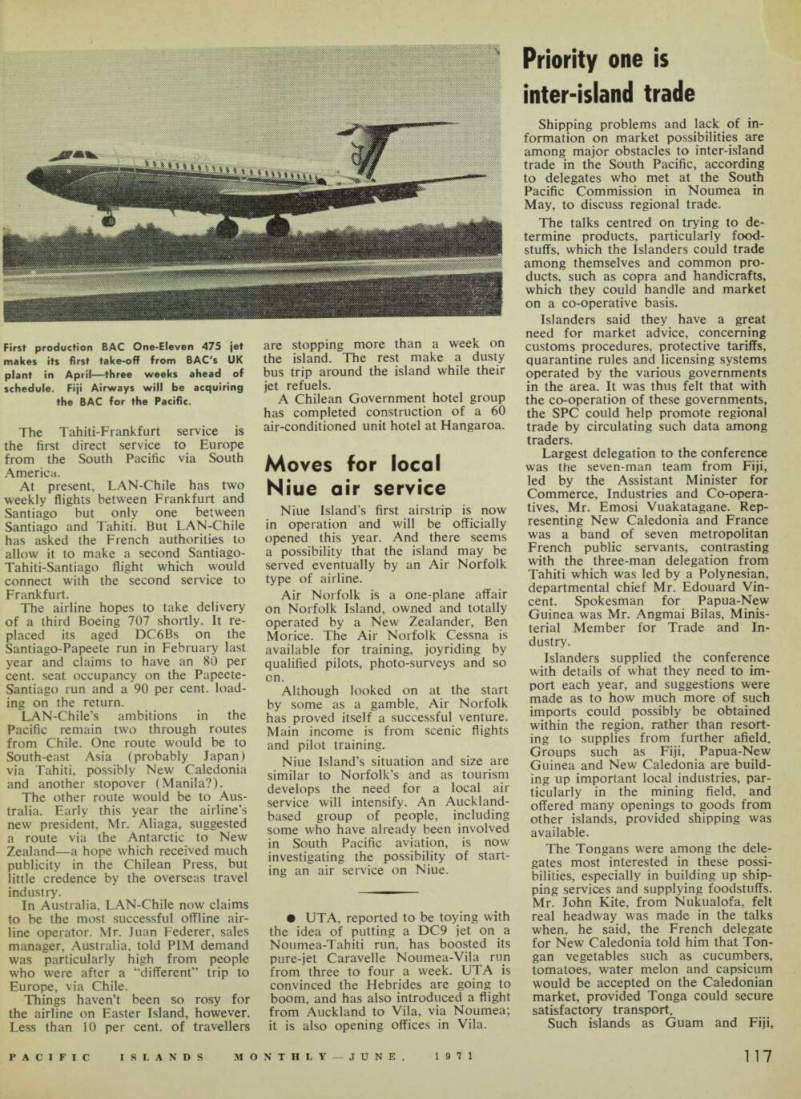
First production BAC One-Eleven 475 jet makes its first take-off from BAC's UK plant in April—three weeks ahead of schedule. Fiji Airways will be acquiring the BAC for the Pacific.
both with a growing tourist industry, were also seen as worthwhile outlets for fruit and vegetable sales from other islands. In addition, French Polynesia and Fiji both indicated possibilities for other islands to sup ply them with rice.
At the end of the two-week con ference, delegates made six principal recommendations which they thought would best help promote trade in the South Pacific region. They were aimed mainly at obtaining supplies of information related to market pos sibilities and trade procedures in the area.
The conference also urged that the UNDP team (represented in Noumea by Mr. E. G. Russell), which will shortly undertake a regional survey of transport needs around the islands, should pay particular attention to shipping facilities.
"Fruit salad
specials" pay
Qantas freight operations between Sydney and Noumea are a bright spot in what otherwise is a tale of falling revenue and belt-tightening for the big Australian airline.
Since last December Qantas has shipped more than 500 tons of freight on this sector, 2f-hour run by Boeing 707. These flights don’t have flight numbers any more; they are now called the “Fruit Salad Specials”, as 90 per cent, of all loadings are foodstuffs, mainly fresh vegetables.
Qantas’ weekly 707 trans-Pacific freighter is now regularly diverted via Noumea. In May it carried the biggest-ever load hauled by a Qantas plane—4l tons, all to Noumea.
Offloading operations at Tontouta Airport are hectic, workers swarm over the jet when it arrives to com plete unloading during a limited H hour stopover.
Qantas is charging from 22 cents a kilo to 55 cents a kilo for Sydney- Noumea cargo, depending on the size consignees offer.
Two Sydney providores, John Antico and Ernest Pardy and Sons, are preparing produce through Islands agents, W. S. Tait, C. Sullivan, Ballande Australia and A. U. Riette.
Major Noumea importers are Prisunic, Maison Barrau, L.U.C. and Berrard.
Fiji sugar timetable
South Pacific Sugar Mills Ltd., the almost completely-owned CSR Co.
Ltd. subsidiary in Fiji, will remain responsible for dealing with Fiji crops, financially and otherwise, in cluding marketing, for three seasons— -1970, 1971 and 1972—under present ownership. SPSM’s responsibility as
a CSR Co. subsidiary will end on March 31, 1973, just a few weeks before the start of the harvest for that year.
Ownership of SPSM will then pass to the Fiji Government. The govern ment has accepted the CSR Co. offer to supply SPSM salaried staff for production, technical and other services. The CSR Co. will continue to market sugar for SPSM and will continue to buy molasses from SPSM. (See PIM, Apr., p. 99, May, p. 85).
Credit restrictions
on Niue
Since April 1, it has been illegal for any trader on the island of Niue to supply a customer with goods on credit without the customer having first paid a prescribed minimum cash deposit.
The regulations came into force with the passing of the new Credit Restriction Ordinance which also lays down the maximum period for which credit is allowed.
This has been fixed at two years from the date of purchase.
Consumer goods, furniture and building materials are not covered by the restrictions.
Minimum deposits of the retail prices have been fixed as: motor vehicles, including motor cycles, 66-2/3 per cent., refrigerators and deep freezers, electric washing machines, radiograms, outboard motors and any other non-consum able goods exceeding $2OO in value 50 per cent, and tape recorders 66-2/3 per cent.
The trader has to record details of a sale on deposits and the book entry has to be signed by the customer and the trader.
Interest of 6 per cent, a year can be charged for money owing.
Copra prices drift
Mr. K. G. Oliver, general manager of the PNG Copra Marketing Board, reported on May 20:— Prices for copra continued to drift lower during the first days of May and the easing is still continuing. It has been mainly the result of con tinued selling pressures from origin with plentiful supplies available in leading world markets.
Some strengthening in the markets became apparent during the recent currency crisis, but as new measures to control this began taking effect, the drift in prices went on to further lows.
June shipment from Philippines/ Indonesia was sold at down to SUSI 92 a ton cif UK/Continent and July shipment at down to SUSI 93 a
ton. Some dealer activity took place during the second week of the month within narrow margins, but these were all restricted at around current levels.
Fishery survey
may help BSIP
Depending on the existence of large quantities of bonito and squid in Solo mon Islands waters, a new fishing in dustry may be opened in the Protec torate.
The search for the fish will be made by a Japanese fishing fleet of two 500-ton refrigeration vessels and four 40-ton catcher boats due to arrive in the Solomons this month.
The fleet belongs to the Taiyo Fish ery Company Limited, one of the world’s biggest fishing companies and acknowledged experts in the industry.
The company agreed to make an 18month survey after talks in Tokyo between its representatives and two BSIP Government representatives, David Kausimae, chairman of the Natural Resources Committee, and John Smith, the Financial Secretary, who were in Japan for negotiations connected with the Rennell bauxite deposits.
The Taiyo Company will submit progress reports to the Solomons Gov ernment every two months.
David Kausimae said the survey could be a most beneficial develop ment for the Protectorate.
Trade briefs
• Overseas companies with branches in the Cook Islands must register with the Cook Islands Registrar of Companies under the new Companies Act which came into force on April 1. All overseas com panies will have to acquire an annual licence similar to the one required in New Zealand.
Overseas companies carrying on business principally in the Cook Islands may apply to be re-in corporated, but application must be made before September 30. • Two Papuan rubber growers, Rubberlands and Kerema, suffered a decline in profit in 1970, compared with 1969, and will not pay dividends.
Kerema’s profit for 1970 was $14,843 ($39,324 in 1969), and that of Rubberland was $8,056 ($24,220).
Mr. H. D. Underwood, chairman of both companies, said that Kerema’s prospects for 1971 were not good, for the realisation price of rubber was at its lowest for some time and was about cost. Referring to Rubber lands, he said the board was very concerned about an increase in costs, the effect of which would become ap parent this year.