gracefully
pp. 117-118 · Read in the full issue
He'll be bowing out gracefully
By Ken Mcgregor
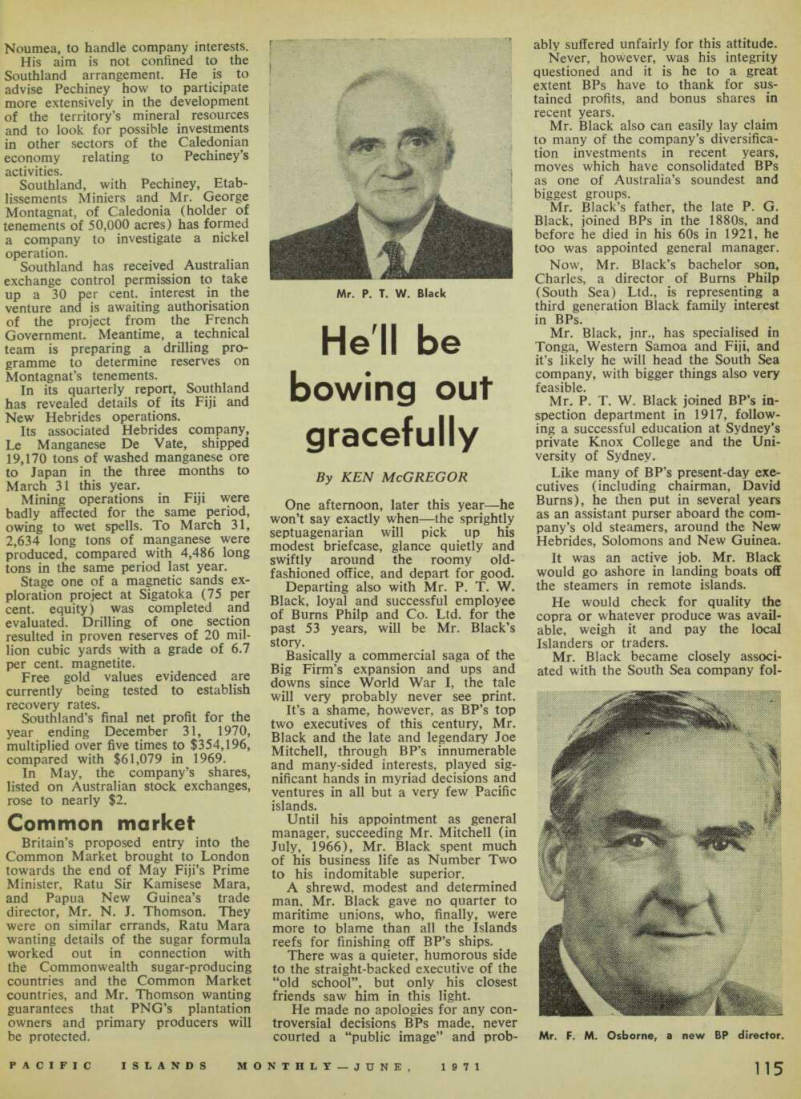
One afternoon, later this year—he won’t say exactly when —the sprightly septuagenarian will pick up his modest briefcase, glance quietly and swiftly around the roomy old fashioned office, and depart for good.
Departing also with Mr. P. T. W.
Black, loyal and successful employee of Bums Philp and Co. Ltd. for the past 53 years, will be Mr. Black’s story.
Basically a commercial saga of the Big Firm’s expansion and ups and downs since World War I, the tale will very probably never see print.
It’s a shame, however, as BP’s top two executives of this century, Mr.
Black and the late and legendary Joe Mitchell, through BP’s innumerable and many-sided interests, played sig nificant hands in myriad decisions and ventures in all but a very few Pacific islands.
Until his appointment as general manager, succeeding Mr. Mitchell (in July, 1966), Mr. Black spent much of his business life as Number Two to his indomitable superior, A shrewd, modest and determined man, Mr. Black gave no quarter to maritime unions, who, finally, were more to blame than all the Islands reefs for finishing off BP’s ships. There was a quieter, humorous side to the straight-backed executive of the “old school”, but only his closest friends saw him in this light.
He made no apologies for any con troversial decisions BPs made, never courted a “public image” and prob
ably suffered unfairly for this attitude.
Never, however, was his integrity questioned and it is he to a great extent BPs have to thank for sus tained profits, and bonus shares in recent years.
Mr. Black also can easily lay claim to many of the company’s diversifica tion investments in recent years, moves which have consolidated BPs as one of Australia’s soundest and biggest groups.
Mr. Black’s father, the late P. G.
Black, joined BPs in the 1880 s, and before he died in his 60s in 1921, he too was appointed general manager.
Now, Mr. Black’s bachelor son, Charles, a director of Bums Philp (South Sea) Ltd., is representing a third generation Black family interest in BPs.
Mr. Black, jnr., has specialised in Tonga, Western Samoa and Fiji, and it’s likely he will head the South Sea company, with bigger things also very feasible.
Mr, P. T. W. Black joined BP’s in spection department in 1917, follow ing a successful education at Sydney’s private Knox College and the Uni versity of Sydney.
Like many of BP’s present-day exe cutives (including chairman, David Burns), he then put in several years as an assistant purser aboard the com pany’s old steamers, around the New Hebrides, Solomons and New Guinea.
It was an active job. Mr. Black would go ashore in landing boats off the steamers in remote islands.
He would check for quality the copra or whatever produce was avail able, weigh it and pay the local Islanders or traders.
Mr. Black became closely associ ated with the South Sea company fol-
Mr. P. T. W. Black
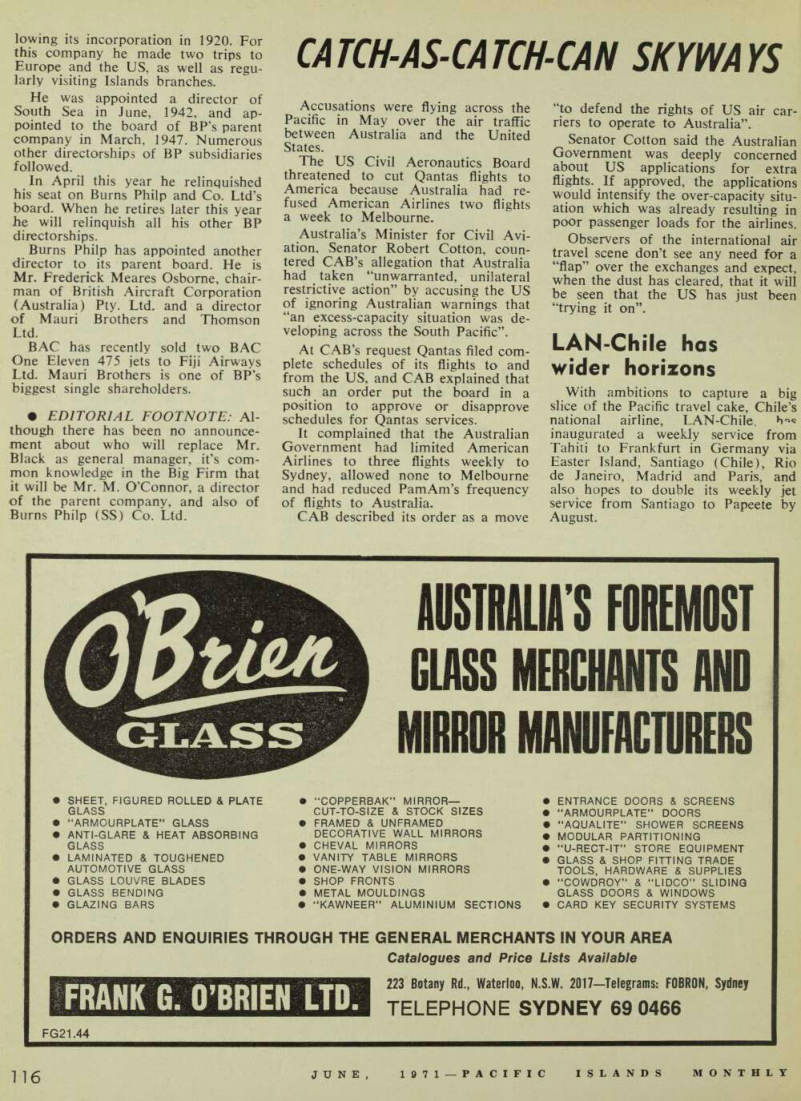
Mr. F. M. Osborne, a new BP director.
lowing its incorporation in 1920. For this company he made two trips to Europe and the US, as well as regu larly visiting Islands branches.
He was appointed a director of South Sea in June, 1942, and ap pointed to the board of BP’s parent company in March, 1947. Numerous other directorships of BP subsidiaries followed.
In April this year he relinquished his seat on Burns Philp and Co. Ltd’s board. When he retires later this year he will relinquish all his other BP directorships.
Burns Philp has appointed another director to its parent board. He is Mr. Frederick Meares Osborne, chair man of British Aircraft Corporation (Australia) Pty. Ltd. and a director of Mauri Brothers and Thomson Ltd.
BAC has recently sold two BAC One Eleven 475 jets to Fiji Airways Ltd. Mauri Brothers is one of BP’s biggest single shareholders.
• Editorial Footnote: Al
though there has been no announce ment about who will replace Mr.
Black as general manager, it’s com mon knowledge in the Big Firm that it will be Mr. M. O’Connor, a director of the parent company, and also of Burns Philp (SS) Co. Ltd.