Pacific Shipping
pp. 99-105 · Read in the full issue
Hard New Look At
An Old Fleet
A major study of the likely composition of the Papua New Guinea Administration shipping fleet for several years ahead is being undertaken by a prominent Sydney naval architect, Mr. Warwick Hood, with the help of consultants with expertise in marine and transport matters. Mr. Hood designed Dame Pattie, Australia’s challenger in the 1967 America’s Cup series, and a number of vessels for territories in the Pacific Islands.
It is possible that a start may be made on the first of a number of new ships before the end of the next fin ancial year.
In March and April, Mr. Hood and two associates, carried out an exten sive survey of the 14 coastal and islands administrative districts of P-NG. They talked to district com missioners, users of coastal ships and officers from the various depart ments which use coastal vessels. In May, Mr. Hood returned to P-NG for a further in-depth study.
The P-NG Administration at pre sent operates a fleet of 73 coastal craft, classified as trawlers and work boats, ranging from 30 to 70 ft over all length. The need for such a big fleet rises from the great length of coastline, the number of large and small islands, the lack of coastal roads and the concentration of popu lation along the coasts.
The Administration also operates many smaller craft, but for the most part they were not included in Mr.
Hood’s study.
The boats are required to carry out a variety of functions such as trans porting malaria control and medical teams, staff on transfer and leave, government stores, patrols, and in spections and surveys. Journeys may entail absence from the home port for hours or weeks. When they are away for weeks the vessels have to be used for living accommodation.
The class of passenger ranges from
Administration officers to labourers and their families.
Many ships in the existing fleet were built before 1950, and are ready to be scrapped.
Mr. Hood expects the study will reveal there is need for “60 odd’ boats. How long it would take to build them would depend on the fin ancial position of P-NG. Mr. Hood is not firm at present on the likely future number of vessels.
For example, malaria control operates only in a few of the mari time areas at present and the number of vessels required is not as high as
it would become as malaria control was extended.
Similarly, the number of vessels re quired for educational, agricultural and fisheries projects was likely to be higher several years ahead, than at present.
Mr. Hood and his associates have a tremendous amount of information and data to evaluate. In this they are being assisted by transport economists from the University of NSW.
The question of detailed design for the vessels does not rise yet. That will come after Mr. Hood’s report is dealt with by the Administration.
P-NG shipyards will be used to build as many vessels as possible, par-
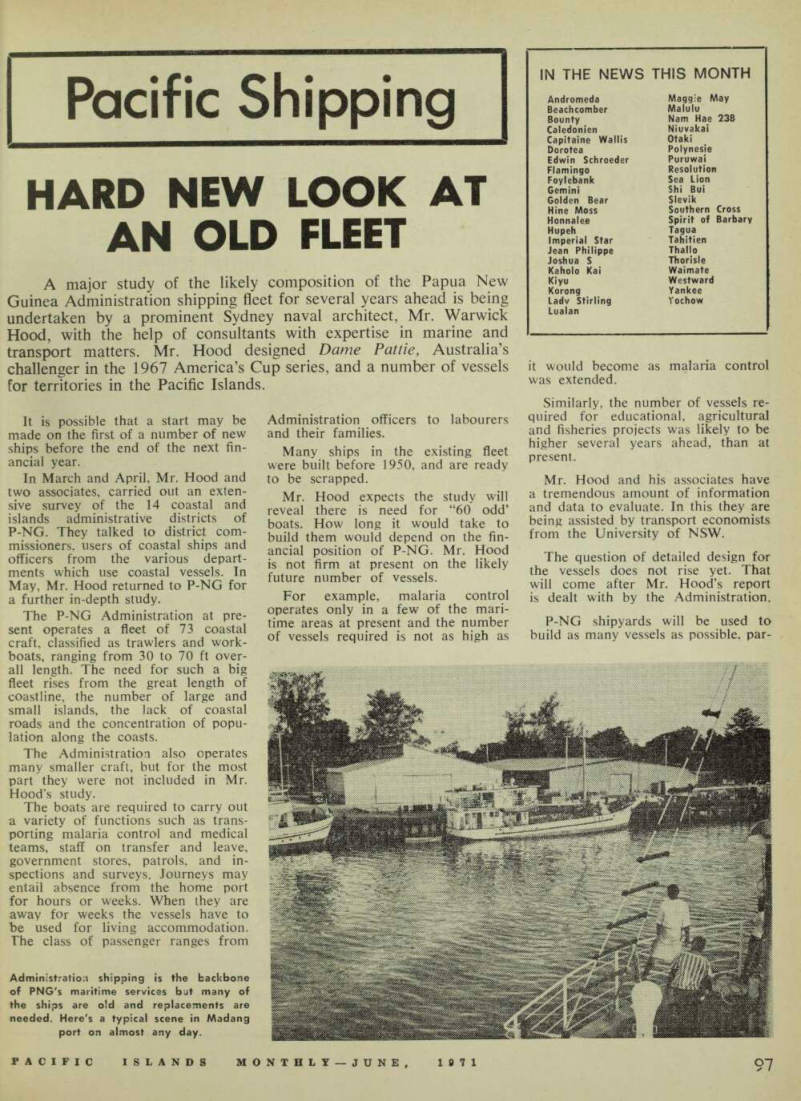
Administration shipping is the backbone of PNG's maritime services but many of the ships are old and replacements are needed. Here's a typical scene in Madang port on almost any day.
ticularly those of wooden construction Mr. Hood is required to weigh up the suitability of existing designs and methods of propulsion in light of re cent developments, such as air cushion craft, let engines and new hull forms, materials and speeds.
These are the points which will be examined: • The economics of operating the existing fleet, including running costs, manning, maintenance, depreciation, overheads, etc., in relation to the work performed; • Whether the present allocation of vessels meets the needs of the 14 coastal and islands districts and whether they are being used to the best advantage; • Current survey and mainten ance procedures, standardisation and holdings of stores and replacement parts, accounting and cost control procedures, and manning schedules; • The division and responsibility for the operation and administration of the fleet; • The annual allocation of Treas ury funds for each type of craft for operating and maintenance; • The terms and conditions of ser vice of crews as far as they relate to efficient operation and maximum use of vessels.
The Administration requires speci fic recommendations on these points: • The most suitable types of ves sels for use in the coastal and island districts, and the numbers needed. • The scheduling of vessels in each district and allocation of particular routes, tasks, and the manning of them. • Stores, maintenance, cost con trol, and accounting procedures, and the administrative and operational re sponsibility for the fleet. • A programme of forward finan cial commitments against which funds could be provided on a yearly basis. • A programme of replacements for vessels nearing the end of their economic lives. • Any interim measures which might be necessary to improve the efficiency of operations before the implementation of the principal re commendations.
Dock Strike Will
Cost A Fortune
The month-long dock strike in Fiji netted stevedores an extra 10c an hour, with the possibility of further gains through arbitration. But the strike will cost a fortune according to the shipping manager of a big Islands trading firm in Sydney.
It is likely to be months, perhaps even years, before the full effects can be assessed.
Shipping lines which service Fiji
were forced to take advantage of the let-out provision in the bills of lading for cargo, so cargo consigned to Fiji was abandoned in Sydney, Townsville, Noumea, Santo, Vila, Apia and Nuku alofa.
One big Sydney storage shed was reported to be “bulging at the seams’’ with Fiji cargo. Consignees became responsible for all abandoned cargo and costs involved. Re-sorting this cargo in a number of ports was a heart-breaking problem.
Most of this cargo had been to Fiji at least once, so at a minimum there was a double freight charge in volved. The freight charge between Sydney and Suva is $27.50 a ton. It was open to consignees to abandon cargo left at other ports and try to recover the cost from their insurers.
Some of the ships which called at Fiji and sailed away without dis charging cargo are: Otaki, Foyle bank, Thorsisle, Slevik, Imperial Star, Niuvakai, Straat Chatham, Loire Lloyd, Erwin Schroeder, Capitaine Wallis, Yochow and Hupeh.
The USS Co’s Waimate, was at Lautoka for most of the strike be cause the NZ seamen on board went on strike in sympathy with the steve dores.
While Fiji suffered from a severe shortage of many essential supplies, they were not alone in this respect.
Suva is one of the main ports in the South Pacific for re-exports, and while the strike was on nothing was re exported to several smaller groups.
When the strike was over these groups had to wait till supplies reached Suva, and then for onward shipping.
Santo Had A
Dock Strike Too
Fiji was not the only South Pacific group to experience a dock strike re cently. Dockers at Santo in the New
Hebrides went out for a day late in April. The Santo stevedores claimed pay equal to that of the Vila coun terparts.
Because of a strike the Polynesie was unable to load. Another ship was also held up.
An agreement was reached under which the stevedores will receive a temporary increase of 30c a ton. The agreement was to last for one month, pending a negotiated settlement.
Little Hope For
Reef-Bound Ship
A Korean fishing ship from Pago Pago, the Nam Hae 238, went hard aground on Minerva Reef, about 500 miles south of Fiji, early on May 8.
A RNZAF Orion, on a routine train ing flight from Auckland, picked up an SOS call from the ship and flew 1,000 miles to check the position.
It then directed another Korean fishing ship, the Nam Hae 265, to the reef. The rescue ship picked up the crew of 21 men and took them to Suva.
Reports four days later said the Nam Hae 238 was lying holed and water-logged on the reef.
Mr. Pyung Kwon Choy, of Levuka, manager of the Korea Marine Indus try Co-operative, described possible salvage as a “pretty hopeless case”.
However, he was waiting for word about this from his company’s head quarters in Seoul. He said the ship was insured for $270,000 for total loss. If his company undertook to salvage her, it would have to pay the cost of salvage, and also the repair bill.
Vila's New Wharf
Is Taking Shape
The new wharf being built at Vila, New Hebrides, is expected to be com pleted about April next year.
Construction is about one-third finished, with 40 per cent, of the piles having been driven.
The original estimate of the amount of earth to be excavated is way out. So far, 80,000 cu. yds have been shifted. This is somewhere near the figure for the whole job, but nearly as much again has to come out.
Some Tongans are included in the work force. They were recruited be cause of a shortage of skilled labour in the New Hebrides. They include tradesmen such as surveyors and welders, and some have valuable ex perience gained while working on the Nukualofa wharf.
When finished, the Vila wharf will hold two medium-sized cargo ships, or one vessel of up to 30,000 tons.
No News Yet Of
Tnt-Columbus Tie-Up
No announcements are likely before August about the rumoured partnership between Thomas Nation wide Transport Ltd., of Sydney, and the German-owned Columbus Line.
T’NT are the new owners of the Union Steam Ship Co. of New Zea land.
Columbus was an admirer of some aspects of the USS operations, and had considered previously making a tentative bid for USS.
One sidelight of the USS takeover is Holm Shipping Company. While
An overall view of construction on the new Vila wharf site. Work is about one-third completed.
Holm had long maintained USS was but a minor shareholder in its capital, it now comes to light that USS con trolled Holm.
TNT, in turn, will play a part in Holm. Not to be forgotten, Holm was Columbus’ most virulent critic when Columbus set up its wholly-owned NZ Export Line, to operate from NZ to the New Hebrides and New Caledonia over two years ago.
The expected big increase of traffic in NZ goods to these islands hasn’t eventuated, according to Columbus.
Nor have big exports of German manufactured equipment to Bougain ville.
Columbus, however, says it has done well out of European exports to New Caledonia, which, of course, come under the European Common Market trade agreement. New Cale donia is an associated “developing”
French territory.
Farewell To These Ships
The passenger-cargo ship, Cale donien, will sail from Sydney on her
last voyage to France on July 9. Her owners Messagenes Maritimes, will not replace her, nor will they replace their other passenger-cargo ship, the Tahitien, which operates over a similar route (PIM, Jan., p. 87). The Tahitien will leave Sydney on her last September 14.
Each ship earned about 1,000 tons cargo . to Tahiti on each voyage.
Messagenes Maritimes will send a cargo . shlp , to s V d ney every two months to take over this cargo trade.
The ship will probably be the one which operates between European ports and Noumea. Instead of return ing direct from Noumea, the ship will be diverted to Sydney and Papeete The Erwin Schroeder has been re turned to her owners in Germany Messageries Maritimes had char tered the ship for six months to operate a cargo service from several Australian ports to Noumea, Suva, Lautoka, Vila and Santo.
To replace the Erwin Schroeder,
The Pacific Far East's "Golden Bear", a
Mariner-type cargo
ship, which was added to PFEL's South Pacific service in May.
The ports serviced by the "Golden Bear" are Vancouver, Port land, San Francisco, Papeete, Pago Pago, Sydney, Melbourne, Burnie, Brisbane and Auckland.
Messageries Maritimes have chartered a Swedish ship, the Dorotea, from Rederi ab Frederika, of Stockholm, for six to eight months.
The Shaw Savill Albion liner, Southern Cross, 20,000 tons, will be withdrawn from service later this year. Since her first voyage 16 years ago she has become particularly well known in the South Pacific. The Southern Cross will leave England for the last time on September 2 for Sydney, vit South Africa. She will leave Sydney on October 10 to return to Southampton. Pacific ports of call on the last voyage will be Suva, Rarotonga and Papeete. She is being withdrawn because, even with a 1,000 passenger capacity, costs exceed revenue.
They're Carving
Up The "Tagua"
The Tagua is being removed, piece by piece, from the reef near the Mangaia harbour entrance. A team of four salvage men and two labourers, employed by Silk and Boyd, in early May, were cutting up the Tagua, which operated in the Cooks as an inter-island trader.
The authorities feared that heavy seas would sweep the wreck into the channel of the harbour and block the entrance. The bridge, captain’s sleep ing quarters, funnel, rails, propeller shaft and equipment on the upper deck were removed. It was planned to dump the stem in the sea.
Some of the salvaged material will be offered to local people to use in bridge construction. The mast boom and winch will be installed on the wharf for use as a heavy derrick.
Blasting Out
A Harbour
Activity is building up in Avatiu harbour, Rarotonga.
Blasting and dredging has deepened the harbour so that it can now take at the same time two of the biggest of the Island traders and the smaller oil tankers.
The MV Jean Philippe was able to berth at the eastern wharf recently and she was followed in by the 228 ft long Thallo, which has a cargo capacity of 1,000 tons and draws 11 ft 7 in.
Divers with explosives have been working for several months in the harbour in an attempt to deepen it to at least 16 ft.
O The Vila-registered Craestar will be renamed Ratna Sumatera. The change follows transfer of the ship from CRA and Conzinc Riotinto of Malaysia to the Malaysian branch of the company. Vila, however, will re main the ship’s home port.