Samoa
p. 97 · Read in the full issue
American Samoa gets it live
From a Pago correspondent
American Samoa celebrated Flag Day (April 17), one of the South Pacific's most colourful annual observances, with a new twist which took the festival into thousands of homes and enabled people on other islands to see the events as they happened.
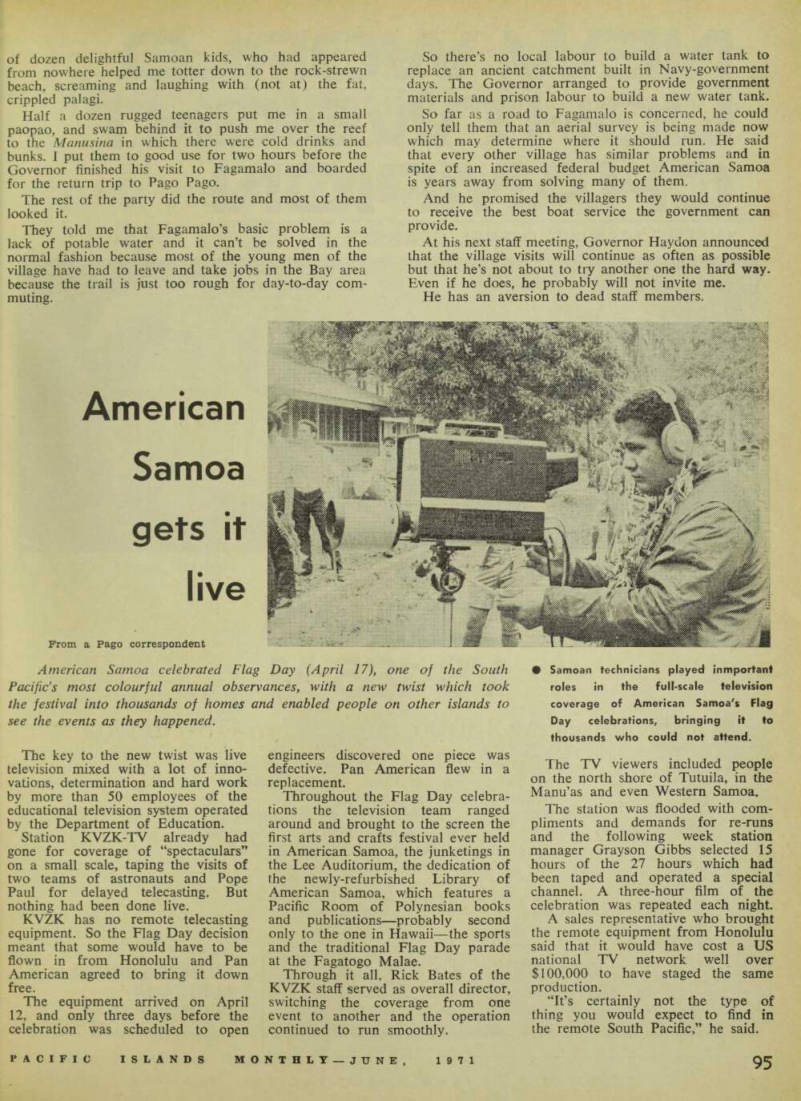
The key to the new twist was live television mixed with a lot of inno vations, determination and hard work by more than 50 employees of the educational television system operated by the Department of Education.
Station KVZK-TV already had gone for coverage of “spectaculars” on a small scale, taping the visits of two teams of astronauts and Pope Paul for delayed telecasting. But nothing had been done live.
KVZK has no remote telecasting equipment. So the Flag Day decision meant that some would have to be flown in from Honolulu and Pan American agreed to bring it down free.
The equipment arrived on April 12, and only three days before the celebration was scheduled to open
engineers discovered one piece was defective. Pan American flew in a replacement.
Throughout the Flag Day celebra tions the television team ranged around and brought to the screen the first arts and crafts festival ever held in American Samoa, the junketings in the Lee Auditorium, the dedication of the newly-refurbished Library of American Samoa, which features a Pacific Room of Polynesian books and publications—probably second only to the one in Hawaii—the sports and the traditional Flag Day parade at the Fagatogo Malae.
Through it all, Rick Bates of the KVZK staff served as overall director, switching the coverage from one event to another and the operation continued to run smoothly.
, TV viewers included people nort h s^lore Tutuila, in the Manu as and even Western Samoa, The station was flooded with com pliments and demands for re-runs and the following week station manager Grayson Gibbs selected 15 hours of the 27 hours which had been taped and operated a special channel. A three-hour film of the celebration was repeated each night.
A sales representative who brought the remote equipment from Honolulu said that it would have cost a US national TV network well over $lOO,OOO to have staged the same production.
“It’s certainly not the type of thing you would expect to find in the remote South Pacific,” he said.
Samoan technicians played inmportant roles in the full-scale television coverage of American Samoa's Flag Day celebrations, bringing it to thousands who could not attend.