'ageless adventurer'
p. 79 · Read in the full issue
Samoan shrine tor the 'ageless adventurer'
Raftman William Willis, who completed in his 60's and 70's two solo voyages across thousands of miles of the Pacific and then disappeared from his raft while attempting an Atlantic crossing, now has his own niche in the new museum in Pago Pago—the canoe which was his "lifeboat" on the "Seven Little Sisters" raft. Sadly, the raft itself is not there, and this story tells why.
A German who became a nationalised American, William Willis had been a “cowboy” in Texas, a cartoonist in New York and San Francisco, a lumberjack in Washington State and an odd-job man in Alaska before, at the age of 61, he embarked on his first raft voyage across the Pacific.
On June 22, 1954, Willis left Calloa, Peru, on a 35 ft balsa log raft which he called Seven Little Sisters. His only crewmen were a cat named Mickey and a parrot named Ickey. They confidently listed their destination as Pago Pago, 6,500 miles to the west.
One hundred and fifteen days later the balsa raft, rigged with a bowsprit, mainmast and aftermast, was spotted in the Samoan Islands. American Samoa Governor Richard Lowe led the search which located the Seven Little Sisters and towed her into Pago Pago Harbour on October 14.
Only an ironic twist of fate dampened the enthusiasm of Willis for the tumultuous welcome he received. The three-way companion ship which had endured 112 days of hardship and loneliness came to a tragic end when Mickey killed Ickey within sight of the lush green hills of Tutuila.
Nine years later, on July 4, 1963, Willis left Peru again, “to show that a man past 65 is still in the running, if he wants to be.” He was then 71.
This voyage was plagued by hard ship and near-tragedy from the begin-
ning, but Willis and his Age Un limited put into Western Samoa in 130 days. The raft was battered, and the ageing adventurer was seriously injured.
He was flown to San Francisco where doctors recommended an operation for severe hernia, but Willis declined, returned to Samoa, and cast off again.
Seventy-four days later, after a
two-part voyage of just less than 11,000 miles, he completed his trip on the Queensland Coast, 1,150 miles north of Brisbane.
He started his third voyage, this time across the Atlantic, at the age of 75—but he never finished it. His raft, along with his passport and other personal belongings, was found drifting in the ocean. Of Willis, there was no trace.
Although the second voyage was far more spectacular, the first trip and the Seven Little Sisters were Willis’ sentimental favourites. Gov ernor Lowe and the chiefs of Ameri can Samoa suggested that his original raft be housed in a Samoan museum, which would be created especially for it. Willis agreed enthusiastically.
“It seems to me appropriate that the Seven Little Sisters, the balsa log raft that carried me so far, should remain in Samoa, where she success fully ended the one journey she had been designed to make,” he said at that time.
But, it seems that enthusiasm, like the fame which comes with fantastic accomplishment, is a fleeting thing.
When Mrs. John M. Haydon, wife of the present Governor of American Samoa, started the Government House Museum a year ago—l 6 years after the Willis voyage—a search for the Seven Little Sisters began.
Pago librarian Betty Lunnon checked with a retired naval officer, who served with the Navy admin istration of American Samoa in 1954.
He recalled that the raft was stored in a former water tank in the village of Fagatogo.
An attendant at the tank, which was tom down last year, said some of the balsa logs were given away years ago. The others had deteriorated in the tropical climate. All that re mained was a 20 ft canoe of Peruvian cedar, which Willis had kept lashed to the deck of his raft.
That canoe now holds an honoured spot in Government House Museum —as a shrine to an ageless adventurer who was claimed, probably with reluctance and respect, by a sea which he had eluded so many times before.
If Samoa had had its museum earlier, no doubt the famous raft itself would have survived.
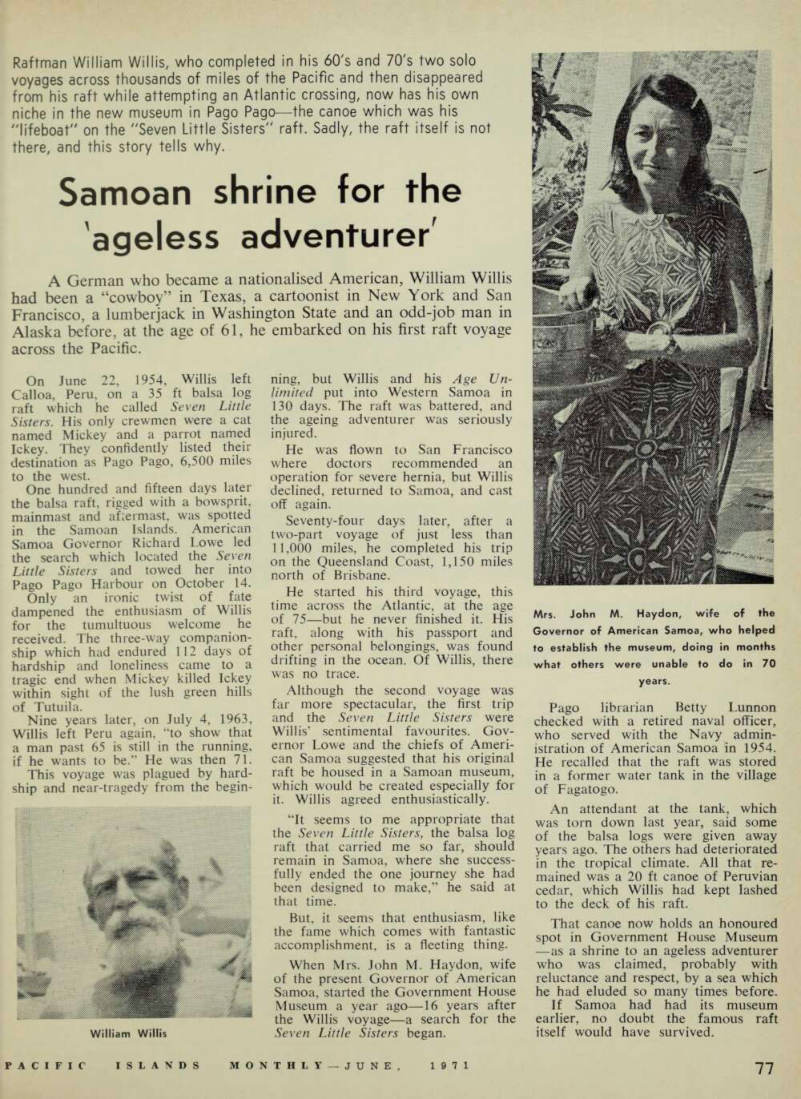
William Willis
Mrs. John M. Haydon, wife of the Governor of American Samoa, who helped to establish the museum, doing in months what others were unable to do in 70 years.