Magazine Section
pp. 75-77 · Read in the full issue
IT WAS A LONG JOURNEY HOME FOR
Gilbertese Blackbirding Victims
By Robert Langdon
In May, 1878, when Dr. G. A. Turner, of the London Missionary Society, was on his way from Samoa in the ship "John Williams" for a tour of the Tokelau, Ellice and Gilbert Islands, he had the unusual experience of seeing large quantities of pumice floating on the surface of the sea.
The pumice was first noticed when the John Williams was about 120 miles east of Nukulaelae, one of the southerly islands of the Ellice Group; and it was subsequently found that the shores of all the Ellice Islands from Nukulaelae to Niutao were thickly covered with it.
On some islands, stumps of trees and thick bamboos had also been thrown up.
At Vaitupu, a week or two before the John Williams arrived there, the Sydney brig Isabelle, Captain Evers, had left the news that a volcanic eruption had occurred in the Society Islands, and that Raiatea and Bora Bora had been destroyed with the loss of 2,000 lives.
“We hope to get news at Apia, as to the truth or otherwise of this,”
Dr. Turner wrote in his journal.
“Meantime, the islands to which the pumice stone has been drifted and the time of its arrival there will be interesting to those who study the question of ocean currents.
“We have also passed, while beat ing back between Nukulaelae and Fakaofo, one malili tree about 80 feet long, one coconut tree, and four other large trees —all evidently proof that the story of Capt. Evers is probably only too true.
“The pumice stone began to arrive on the Ellice Islands about the middle of April and continued till the middle of June. There is no trace of it in the Gilbert Group nor in the Union [Tokelau] Group.
“At Peru [Bern Island in the Gilberts] however, I found on inquiry that pumice stone was thrown up there about August, 1877.
Could this have been from the subterranean explosions in South America in May of that year? It was only in small quantity, not like the enormous quantities thrown up in the Ellice Group this year.”
The journal from which the above information was taken is one of two such documents contained in an exercise book which was recently lent to the Pacific Manuscripts Bureau for copying by the Rev. J. M. Stuckey, general secretary of the Australian Presbyterian Board of Missions in Sydney.
The first journal covers a voyage which Dr. Turner made to the Tokelau, Ellice and Gilbert Groups from May 26 to August 2, 1874; the other covers a similar voyage from May 11 to July 21, 1878. Both were made in the LMS mission vessel John Williams.
Dr. Turner (son of the Rev. Dr.
George Turner, author of Samoa A Hundred Years Ago and Long Before,
"ln 1863, 247 men, women and children were kidnapped by the Peruvian slavers. . . .
Only one has returned from Peru. He died some time after of consumption, and from his reports of cruelty, disease and death the Tokelau people do not expect ever to see any more of them/'
London, 1884) was a medical mis sionary in Samoa from 1868 to 1879.
The two voyages described in his journals were tours of inspection of the mission stations which the LMS, using Samoan pastors and teachers, had established in the Tokelaus, Ellice and Gilberts over the preceding dozen or so years.
Much of the material in the journals is exclusively on mission matters, but every now and then there are snip pets of information, a few lines or even a page or two on other topics.
For example, on his first voyage, Dr. Turner called at Swain’s Island (then called Quiros’ Island, and now part of American Samoa) where he met Eli Jennings, a New Yorker, who had settled there with a Samoan wife in 1856.
The local LMS teacher told Turner that Jennings, his wife, two daughters and one of his sons-in-law had long been candidates for admission to the church and that he could confidently recommend all of them.
However, when Turner talked to Jennings about this he declined to join for the time being.
“He seems a sincere Christian,*’
Turner noted in his journal, “but very diffident and afraid he might fall again, and thus be a stumbling block to others.”
On leaving Swain’s Island, Dr.
Turner called at Fakaofo and Atafu, two of the three islands in the Tokelaus. Of these islands he wrote: “In 1863, 247 men, women and children were kidnapped by the Peruvian slavers. . . , Only one has returned from Peru.
“He died some time after of con-
Fakaofo was 'the group's Jerusalem'
sumption and from his reports of cruelty, disease and death the Tokelau people do not expect ever to see any more of them. . . .
“Fakaofo is triangular—3o islets— population live on one of the smaller ones abt. 20 ft high and 500 yds. in diameter. F. was the Jerusalem of the group, and to it Nukunono [the third island in the group] and Atafu used to congregate for circumcision and offerings to the god Tuitokelau.
“There is a king on each of the Tokelau islets whose rule is regulated by his brother chiefs.
“Atafu—pop. increased 70 since slavers—no old men or women: all that generation kidnapped. 20 islets in a triangular shape 15 to 20 ft high.
Tradition says the first man sprang from a stone. His name was Vase fanua. He made an earth model of a woman and inserted one of his ribs —hence the first woman.”
On going on to the Ellice Islands, Dr. Turner called at Nukulaelae, Funafuti, Vaitupu, Nugufetau and Niutao.
At Nukulaelae, he learned that the LMS teacher had left the island seven months earlier in Captain Bully Hayes’ vessel Leonora; and at Funa futi he discovered that “Mr. Thomson, Capt. Hayes’ agent” had 7,335 coco nuts which local church members had contributed to the LMS, and which the agent was to pay for in cash when Hayes next visited the island.
In a note on Nukulaelae, Dr.
Turner said that 250 people had been kidnapped by the Peruvians and that only 65 had escaped.
Christianity had been introduced to the island by a man from Manihiki, Cook Islands, who had drifted 1,200 miles on a canoe voyage of nine weeks.
Writing of Niutao, Dr. Turner said: “Abt. 22 years ago when all were heathen, 2 white men with 2 native wives each and a Peru [Bern] islander and wife—B in all, were put ashore from a vessel.
“They were armed with guns, pistols, swords, etc. and virtually took possession of the island. They demanded pigs, fowls, taro and c-nuts —took such things off to sell when a vessel came in sight—washed their clothes in the drinking water, fired guns among a crowd met to pray to the gods, and told them to come with offerings to them.
“The natives bore it for 5 mos. and then laid their plot. The leader was first struck senseless, and he with all the rest were bound hand and foot, weighted with heavy stones and thrown outside the reef.
“Some white men abt. 15 years ago, who had heard the story, frightened the Niutao people and made them pay 60 large casks of C.nut oil.
“The people were a few years ago again alarmed by a report that one of H.M’s vessels was coming to investigate and punish. But if H.M’s High Com. does look into the matter the issue will doubtless be only the marvel that the people bore with such rascals 5 mos. instead of 5 days.”
In the Gilbert Islands, the John Williams called at Arorae, Nikunau, Bern, Onotoa and Tamana and returned to Samoa via Nanumea and Nui in the Ellice Group.
Arorae, Dr. Turner found, was just recovering from a severe drought
"All the Christian party are now clothed. All heathen cus toms have been given up.
Schools are held morning and afternoon at which men, women and children attend.
Those who still cling to heathen practices only wor ship their deities in secret."
which had resulted in famine and many deaths. Houses seemed to out number people by 10 to one.
The return of better times had been ascribed by many of the people to their return to the old gods, and this, with the “evil influence” of returned labourers from Fiji, Tahiti and Samoa, had caused a “retrograde movement among the majority of the inhabitants,” according to Dr. Turner.
In writing of Onotoa, Dr. Turner provided a tantalising snippet that would have been of interest to A. C.
Haddon and James Hornell for their celebrated study, Canoes of Oceania.
“The canoes of this island,” he wrote, “are superior to those of any of the rest of the islands of this group that we visit, and their speed and the ease with which the natives handle them is amazing.”
Dr. Turner arrived at Nanumea on July 7, 1874—only a few weeks after a major event had occurred there.
“The two kings, eleven of the rulers and about half the population have embraced Christianity,” he wrote.
“In the month of May last the principal idols were destroyed by the teachers and over 200 skulls (formerly worshipped) were buried.
“All the Christian party are now clothed. All heathen customs have been given up. Schools are held morning and afternoon at which men, women and children attend. Those who still cling to heathen practices only worship their deities in secret . .
Dr. Turner said that, formerly, canoes used often to go from Nanumea to Nanumaga, the next atoll to the SSW. However, this practice had been abandoned because many canoes had drifted away and were lost. As a result, the Nanumea people had not fulfilled their part of a pact with those of Nanumaga, which was to inform them, as soon as possible, if they adopted Christ ianity.
In the circumstances, Dr. Turner proposed that a strong deputation from the island should go immediately to Nanumaga in the John Williams to carry the glad tidings.
This proposal was at first agreed to enthusiastically by the Christian party on the island, but on thinking it over they decided against it because they feared that, during their absence, “the heathen party might pluck up courage and be induced to cause fresh trouble.”
Following this decision, one of the Christian chiefs presented Turner with what Turner described as “a great curosity”—“the tootoo [staff of office] of the father of the Nanu means.”
“According to their tradition,”
Turner wrote, “they are sprung from a man called Folasa, a Samoan, who was drifted away from his home and reached Nanumea.
“Shortly afterwards a party of Tongans, who had also drifted away, reached the island. Folasa married one of the Tongan women and hence the mixed race and language.
“They say the present generation is the 31st from Folasa. The said tootoo is like a regular Samoan tulafale’s [village chiefs] tootoo and is made of toa, a wood which does not exist on Nanumea. It is very much decayed and has been partially patched.”
On his second voyage to the Tokelau, Ellice and Gilbert Islands
in 1878, Dr. Turner recorded some especially useful information on Fakaofo, Tamana and Onotoa.
“In the course of a talk I had with the chiefs [of Fakaofo],” he wrote, “I accidentally discovered that a portion of the inhabitants . . . are descended from a party who drifted here many years ago from Nanumaga.
“This is a good illustration how people have been drifted many hundred miles right in the teeth of the prevailing winds,”
Writing of Tamana, Dr. Turner said that the island presented a great contrast to what it did when he had last seen it. Then everything had been “brown and dried up”; now it was fresh and green.
Even so, 216 people had died of starvation during the previous year, while 121 had left the island to work in Samoa or Fiji or had shipped out on whaling vessels. Thus, in the course of 1877, the population had been reduced by 337 to 282.
In his report on Onotoa, Dr. Turner added an appendix to a little-known episode in Pacific history—the kidnap ping and transportation to Tahiti in 1869 of several hundred islanders from the southern Gilbert Islands to work on a cotton plantation run by an Irishman, William Stewart.
The plantation collapsed in Sep tember, 1873, after the death of Stewart, who had been declared bankrupt; and the Gilbertese who
had laboured for him had no means of getting home.
It was not until February, 1878, that a French warship, Le Limier, was ordered to return the Gilbertese to their homes. Miss Constance Gordon Gumming, who was in Tahiti at the time of Le Limier’s departure, recorded details of that episode in her book A Lady’s Cruise in a French Man of War.
She said that when the Gilbertese saw how big Le Limier was, some refused to go in her for fear that “so large a ship would not dare to risk the dangerous navigation between their little isles”.
Those who did go—about 200— were “huddled together on the main deck,” each labourer with his trade box containing a few clothes, a good deal of tobacco and some cheap toys, the only fruit of “nine years of ceaseless toil in a far country.”
But what happened at the other end? It is here that Dr. Turner takes up the story.
Writing on June 19, 1878, he said: “When we were at Tamana, Arorae and Peru, we heard of a lot of natives having been brought in the early part of the year from Tahiti in a French ship-of-war and landed on Onotoa.
“The people belonged to the various islands of this group, and we had requests from the people of the above mentioned islands to take their people home. When we arrived at Onotoa
we found that over 200 people were landed in Febry. last belonging to Tamana (37), Peru (25), Arorae (26), Nikunau (4), Nuitao (5), Tapiteuea, Nonouti, Kora [Kuria] and Onotoa (abt, 100).
“They were all put ashore at Ono toa and told to apply to the J.W. when she arrived to take them home!
This, too, by a big steam ship which had passed close to Arorae!
“When we arrived these people came from all directions with their boxes, evidently expecting that we would take them home; and even offering to pay us in money if we would do so. Of course, we could only give them the same answer that we did to the requests of their friends previously made to us on Arorae, etc. that we bring them home, viz:—that it was quite impossible to finish the work which the French ship had left undone. . . .”
This is the end of the story as far as Dr. Turner’s journal is con cerned, which leaves us wondering if those Gilbertese ever did get home, and, if so, how.
As for those who refused to sail in Le Limier, they apparently re mained in Tahiti permanently.
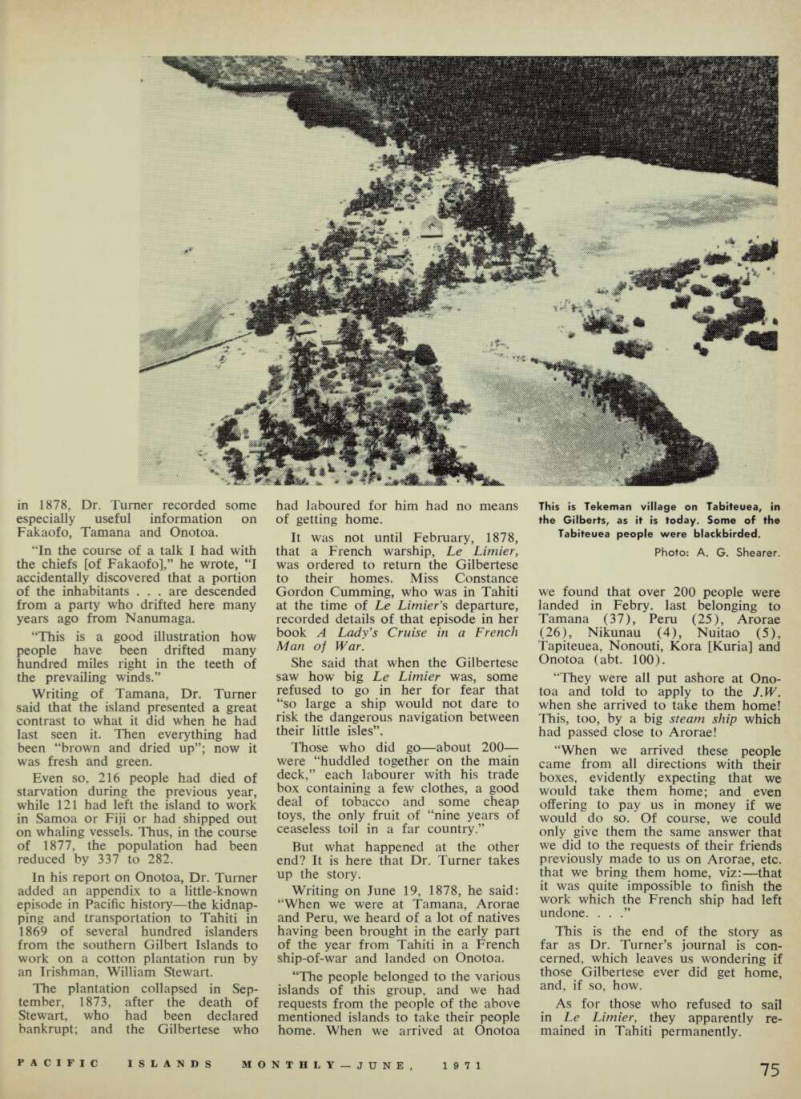
This is Tekeman village on Tabiteuea, in the Gilberts, as it is today. Some of the Tabiteuea people were blackbirded.
Photo: A. G. Shearer.