Pacific Shipping
pp. 75-77 · Read in the full issue
Another view on that regional shipping idea
At the Pacific Islands Producers’
Association conference in Nukualofa in late April the member govern ments set up a working committee to investigate the formation of a regional shipping line in the Pacific. Details are given elsewhere in this issue.
The idea had been kicked about be tween Samoa, Fiji, the Cooks and Tonga for some months, and in Suva a week or two before the Nukualofa decision, economist John Baker had addressed a meeting of the Economics Association of Fiji on the scheme.
The regional idea originally got an airing earlier this year when Western Samoa Prime Minister, Tupua Tamasese Lealofi, proposed setting one up and claimed support from Nauru and the Cooks (PIM, Mar., p. 96).
Tamasese’s concept didn’t win any support from Mr. Baker, who was formerly closely associated with the management of the Tonga Shipping Agency, and helped prepare Tonga’s latest five-year plan.
He said the idea of regional ship ping was not new. Tonga had been in the shipping business for some years and Nauru at present owned three cargo ships. But because of managerial problems the Tongan venture had in the past run at heavy losses and the Niuvakai at one point had been losing about $60,000 a year.
He emphasised that any new line would have to compete with rivals who were willing to stand losses if they thought long-term prospects warranted this. New services recently established between Fiji and Australia had entailed losses for the companies concerned, but they had the resources to bear them. It was unlikely that the proposed regional line would have the financial backing needed for such a policy.
Mr. Baker also pointed out that: • Despite constant criticism, exist
ing services were geared to the economic needs of the Islands and current freight rates were “reason able”. There was hardly any point in duplicating services when there was hardly enough cargo for existing services. • A regional shipping line would not generate more trade between the territories because, through a lack of resources, some had hardly anything to export. For instance, in 1969 Fiji exported or re-exported more than Si million worth of goods to Tonga, but the value of goods from Tonga to Fiji was only $lO,OOO. • If, say, the Union Steam Ship Company lost cargo to a regional line, its costs would go up and it would be forced to put up freight rates or cut back schedules. He could not see how a regional line could avoid the USS’s problems, oarticu larly labour holdups in New Zealand.
In his opinion: • The line would save little foreign exchange. Ships would have to be bought abroad, slipped abroad, insured abroad and bunkered with imported oil. • The 40 or 50 jobs created for Islands’ seamen could not warrant the buying of a ship. Pay earned by
crews was of dubious economic va , ue; experience with the Tongan Niuvakai showed that crew spent 80 to per cen t. of their pay in Sydney eacb t j me tbe s hip docked there, Crew costs would be lower, but this WO uld be offset by inefficiency caused by mana g e rial inexperience.
' . bl Mr Baker regional line would receive any par ticular share of the business avail able. Governments would do better to concentrate on cutting freight ra tes within their own territories by building more roads and jetties. Also, dialogue between territories and ship ping companies to improve existing services could bear improvement.
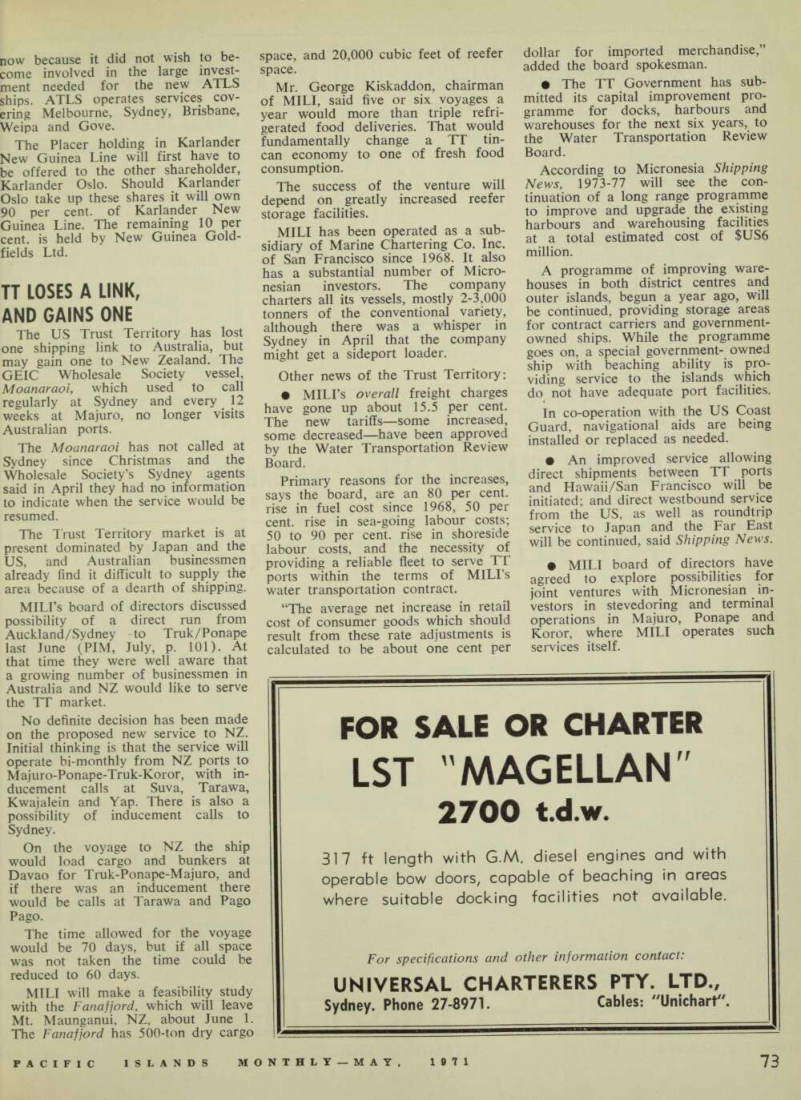
The massive "Columbus New Zealand' heading for Australia in April via the US. She's been ordered from Hamburg shipyards by Columbus Line. Full story p. 75.
Just Everybody Will
Own Uss Co.
Thomas Nationwide Transport of Sydney, and a New Zealand consor tium yet to be organised, will def initely take over the Union Steam Ship Co. of New Zealand, following NZ Government approval of the deal on April 6.
And in April it was also confirm ed by a TNT spokesman that the company was negotiating a tie-up with the German-owned Columbus Line.
A joint interest between TNT and the German firm would give TNT a comprehensive road and sea trans port network in the South Pacific.
Columbus (see article, p. 75), has extensive Pacific interests, while TNT has land transport interests in NZ and similar connections in the US and Canada.
TNT’s takeover of the USS Co. has certain conditions imposed by the NZ Government. The company is not to be split up in three parts, as TNT originally envisaged. No changes must be made in USS ship ping services for the first 12 months of the takeover, and TNT will give the NZ Government advance notice should it decide to terminate a ser vice.
TNT also plans to sell a number of ships of the USS fleet and re place them with modern vessels.
Placer May Sell Its
Karlander Interests
Placer Development Ltd is con sidering selling its 45 per cent, in terest in Karlander New Guinea Line Ltd, because of Karlander’s plans to invest in new ships for Australian Territory Liner Services Pty Ltd.
Karlander owns a 50 per cent, share in ATLS, and the other half is owned by Swiss Aluminium (Aust.) Pty Ltd. Placer’s share in Karlander is worth about $500,000.
The Placer Development annual report says that Karlander’s 50 per cent, share in ATLS has been rea sonably successful and has supplied a much needed service to the alu minium projects in which Swiss Alu minium is a major participant.
It would be some years before Swiss Aluminium could develop a cash flow to Placer. Karlander New Guinea was originally formed to ship plywood from New Guinea to Australian markets. Now, other shipping could provide an equally effective and competitive service.
Mr. H, Costello, managing direc tor of Karlander New Guinea Line, said Placer had decided to pull out
now because it did not wish to be come involved in the large invest ment needed for the new ATLS ships. ATLS operates services cov ering Melbourne, Sydney, Brisbane, Weipa and Gove.
The Placer holding in Karlander New Guinea Line will first have to be offered to the other shareholder, Karlander Oslo. Should Karlander Oslo take up these shares it will own 90 per cent, of Karlander New Guinea Line. The remaining 10 per cent, is held by New Guinea Gold fields Ltd.
Tt Loses A Link,
And Gains One
The US Trust Territory has lost one shipping link to Australia, but may gain one to New Zealand. The GEIC Wholesale Society vessel, Moanaraoi, which used to call regularly at Sydney and every 12 weeks at Majuro, no longer visits Australian ports.
The Moanaraoi has not called at Sydney since Christmas and the Wholesale Society’s Sydney agents said in April they had no information to indicate when the service would be resumed.
The Trust Territory market is at present dominated by Japan and the US, and Australian businessmen already find it difficult to supply the area because of a dearth of shipping.
MILTs board of directors discussed possibility of a direct run from Auckland/Sydney to Truk/Ponape last June (PIM, July, p. 101). At that time they were well aware that a growing number of businessmen in Australia and NZ would like to serve the TT market.
No definite decision has been made on the proposed new service to NZ.
Initial thinking is that the service will operate bi-monthly from NZ ports to Majuro-Ponape-Truk-Koror, with in ducement calls at Suva, Tarawa, Kwajalein and Yap. There is also a possibility of inducement calls to Sydney.
On the voyage to NZ the ship would load cargo and bunkers at Davao for Truk-Ponape-Majuro, and if there was an inducement there would be calls at Tarawa and Pago Pago.
The time allowed for the voyage would be 70 days, but if all space was not taken the time could be reduced to 60 days.
MILI will make a feasibility study with the Fanafjord, which will leave Mt. Maunganui, NZ, about June 1.
The Fanafjord has 500-ton dry cargo
space, and 20,000 cubic feet of reefer space Mr. George Kiskaddon, chairman of MILI, said five or six voyages a year would more than triple refrigerated food deliveries. That would fundamentally change a TT tincan economy to one of fresh food consumption.
The success of the venture will depend on greatly increased reefer storage facilities.
WT tt U U 0 cll u MILI has been operated as a subsidiary of Marine Chartering Co. Inc. of San Francisco since 1968. It also has a substantial number of Micronesian investors. The company charters all its vessels, mostly 2-3,000 tonners of the conventional variety, although there was a whisper in Sydney in April that the company might get a sideport loader. , .
Other news of the Trust Territory; • MILTs overall freight charges have gone up about 15.5 per cent.
The new tariffs—some increased, some decreased—have been approved by the Water Transportation Review B oar( i Primary reasonsfor the increases, says hef |QfiR P sfi ner
cent.’^ise^in°sea-going labour coL;
labour costs' and' the" necessity S 'of providing a reliable fleet to serve TT' ports within the terms of MILTs water transportation contract.
“The average net increase in retail cost of consumer goods which should result from these rate adjustments is calculated to be about one cent per
dollar for imported merchandise,” added the board spokesman. • The TT Government has sub mitted its capital improvement pro gramme for docks, harbours and warehouses for the next six years, to the Water Transportation Review Board.
According to Micronesia Shipping News, 1973-77 will see the con tinuation of a long range programme to improve and upgrade the existing harbours and warehousing facilities total estimated cost of SUS 6 1 .
A programme of improving ware houses in both district centres and outer islands, begun a year ago, will be continued, providing storage areas for contract carriers and govemment owned ships. While the programme goes on, a special government- owned ship with beaching ability is pro viding service to the islands which do not have adequate port facilities, j n co . ope ration with the US Coast Guard, navigational aids are being installed or replaced as needed, F • An improved service allowing . ports initiated; and direct westbound service
"to "apan 5 and"the fTeSS
will be continued, said Shipping Ne W s. MILI board of directors have a g re ed to explore possibilities for j Q i nt ventures with Micronesian in vestors in stevedoring and terminal operations in Majuro, Ponape and Koror, where MILI operates such services itself.