The Editor's Mailbag
pp. 70-73 · Read in the full issue
The French Presence
Sir, —Allow me, as a subscriber, to express my continued surprise at the apparent ignorance displayed by PlM’s editorial writers as regards the French publications of the South Pacific.
True, this attitude corresponds to the general outlook of those (all too numerous) Anglo-Saxons who have no time for people of other countries where the native languages differ from English.
However, within the South Pacific area, a French Press does exist, with an importance and circulation worth quoting. It consists of four daily newspapers, 11 weeklies (one of which is published in Sydney), several fortnightlies and at least four regular monthlies. In the territories covered by those publications, there live approximately 280,000 persons whose vernacular is the French lan guage.
Yet I do not remember of late years many instances, if indeed any at all, where PIM has quoted the French Press of the Pacific.
I believe that you currently have two permanent correspondents, one located in Noumea and the other in Papeete. Only their opinions can but present your readers with per sonal appreciations of the facts. Too often it has happened that the infor mation you published did not reflect a balanced view of events, particu larly with regard to Tahiti.
In the course of contemporary history we are unfortunately apt to find that a monumental incompre hension has loomed large at times between the English-speaking and the French-speaking peoples. Concili atory efforts—in both directions— being insufficient, have so far re sulted in an indifferent relationship, when it has not been a sheer refusal to understand one another, therefore negating mutual esteem. PIM, surely, could have contributed more.
To deny a French presence in the South Pacific through a refusal to acknowledge the French language would, incidentally, explain simply what is happening to French Quebec within Canada. Seven million French Canadians are tired of the contempt that confronts them in their own country . . . Can you blame them?
If you do not wish to see the ad vent of a similar situation in our region of the world, then I hope
you will agree that a major effort towards mutual understanding must be promoted, in the first place on the part of those whose duty it is to inform public opinion.
Should PIM fail to concur, and thereby refuse to acknowledge a French presence in the South Pacific, then your publication in fairness should change its name for such a one as “English Pacific Islands Monthly”.
The Commonwealth Government’s commercial services have discovered (recently, it seems) that there exist in fact in our area 280,000 persons who are French-speaking and whose standard of living is well above that of many Islanders where English is spoken. New Zealand, for its part, is now adapting so well as to supply goods carrying French-worded labels to New Caledonia and Tahiti. Re grettably, Australia has not yet seen fit to follow suit!
Daniel Tardieu.
Noumea and Sydney. • Of course PIM is aware that a French Press exists in the South Pacific, and it quite frequently quotes from it. But PIM is published in English, for readers of the English language, and prefers to rely on French-speaking correspondents in French territories to express a balanced view of events. This in fact is how we also cover the “American presence” in the South Pacific, the West Samoan presence, the Fiji presence, the New Zealand presence, the Nauruan presence, et cetera.
Our yardstick is whether a develop ment, in any territory anywhere, is of interest and of significance to the wide cross section of people inside and outside the Pacific who want an overall Pacific picture and depend on us for it. Those people interested in detailed news of the French Pacific, or of big territories such as New Guinea and Fiji for that matter, have to refer to the local press. We don’t claim to do their job for them. Our method works for the French ter ritories as for others, because last August PIM published a letter of congratulations on its coverage of Caledonian problems from the Vice- President of the New Caledonian Territorial Assembly. We hope that Mr. Tardieu, a settler in the Pacific from Europe and ex-owner of
Noumea’s “Le Journal Caledonien” (which he sold to Senator Lafleur) will understand our position.
Dominic Otuana
Sir, —So Dominic Otuana has left the Solomons Department of Geo logical Surveys. His cheerful sense of responsibility was such that any org anisation or community must be the poorer for his going.
My sense of disappointment is not so much due to his leaving as to what must be a failure to appreciate his potential and encourage him. His sound and sensible background and specialised training will make him difficult to replace [lt’s understood he has not yet taken a new job].
Many years ago Dominic and I met in a dugout canoe in the Shortland Islands, his homeland. He was train ing to be a priest. I said to him as we parted that, should he not quite make the grade as a priest, I hoped he would join me in the Geological Survey Branch. A decade or so later he came, in February, 1964. We were glad to have him in because he had an education to matriculation stand ard and a character to go with it.
Dominic and Deni Tuni had a simi lar background with different churches—they trained under seismo logical technician led Beilis, learning how to operate the World Standard Seismological Station HNR. which was a free gift to the Solomons people from the American Govern ment.
The Solomon Islanders kept the sta tion going and marked cards with earthquake times of arrival. These later were processed by computers in Edinburgh, Scotland, at the Interna tional Seismological Centre.
Then Dominic went to the Philip pines for several months in 1966 to do seismological training under the Jesuit Fathers at the observatory. Visiting him there, en route to Japan, I found that he had created a great impres sion on many students, teaching them to play soccer among other things.
He was referred to by the students as “our Englishman”.
Two chartered busloads came to see him off when he returned by plane to the Solomons. (We then sent E)eni Tuni to New Zealand to finish his seismological education.) A small ceremony in 1967 marked the formal handover of responsibility from the outgoing European techni cian to Dominic Otuana and Deni Tuni. They operated the station and recorded the data for American, Bri tish and world-wide information centres on earthquakes. Their accur acy was noted overseas, and I re ceived favourable comments when I arrived in Edinburgh later in 1967.
Thus an efficient operation was be
ing undertaken by competent trained Solomon Islanders in their own land at very modest cost. They were proud of it and so was 1.
While in Britain I worked partly at the atomic energy station at Edinburgh, where I arrived one day, to be greeted by a number of cards from the Solomons; they had just been rejected by the computer.
Earthquake times were going wrong. Beginning with a few seconds, then a few minutes, then an hour or two, later even the dates were wrong.
Dominic was teetotal; it could only be one other thing, so I wrote to him— “ Dear Dominic, the computer in Edinburgh has begun rejecting your earthquake data undoubtedly havting worse m Yoii areartic mg an ®™° tl °" al w^P erl ®“fd Tnowt woman and the wholeworld .knows that something IS wrong. . .
It was quite true. Dominic learned , . , j There his lesson ne jj were no more rejected Salomons cards in the Edinburgh computer.
Since 1967 there have been no more visits by outside experts from America. The two have had to restore all breakdowns themselves and make the necessary adjustments and changes. They have installed seismographs at Aruligo and Savo to wajxh during times of potential danger. This service calls for men with at least five years secondary education and a sense of real responsibility.
It cannot be done by men with less background. Should Deni Tuni also leave, the station could not be run in accordance with assurances given to the American Government—unless a European technician is again recruited to do the job. This would be a step backwards.
Dominic Otuana’s tireless energy is
a by-word. After a game of rugby he would go on to play soccer without a rest. He did much civic and church work. He was chairman of the Honi ara Jaycees, gave live broadcasts of various sporting events, and held the Captain’s Cup 1967 for his “Govern ment” rugby team, Above all he is firstly a Solomon Islander and was proud of the con tribution he was making. A man like this will certainly be missed,
John Grover,
Former Director of Geological Surveys in the Solomons.
Sydney.
No Palm, Now
Sir, —Referring to that coconut palm article headed “Was It A Rhino?” in PIM (March, p. 36). I received a report of this palm from Captain Shearer of Fiji Airways towards the end of last year. It was all the more interesting that the palm was sited within a quarter of a mile of the De partment of Agriculture Office. As is our practice with such reports, an im mediate investigation was made by a member of staff climbing the palm and examining the crown, and it was decided that the cause was not rhino ceros beetle.
In view of the publication of this matter in PIM it was considered that the department would be inundated with questions regarding the palm, and therefore the decision was made to fell it and make a post mortem examination. The damage was quite definitely not caused by the rhino ceros beetle, and the ragged edge to the cut leaflets indicated that the fronds were eaten at a much later stage of development than is the case in rhinoceros damage.
The palm was of the sweet husked
variety, a great favourite of rats and we can only conclude that the damage was caused by rats gnawing the fronds. It’s of interest that no fronds produced in the last nine months have any signs of damage, that is since rodent control measures were taken on South Tarawa.
R. T. Harberd.
Director of Agriculture, Tarawa. • Mr. Harberd’s letter refers to a suspicion by PIM that the rhino beetle might have invaded Tarawa, and naturally we rejoice with him that no such invasion has taken place. We are at the same time chastened by the sad news that as a result of our intervention an innocent coconut palm met an un timely death. Requiescat in pace.
Samoa's Past
I was never happier than after reading Judy Tudor’s article “They are dusting off Samoa’s colourful past” (PIM, March, p. 61). I had the same experience she and Mr. R.
W. Robson had trying to locate the plaque of J. Cesar Godeffroy [in the Casino Hotel garden, Apia], which I had photographed on a previous occa sion. I was very disappointed on my last visit to find that it had disap peared. Turning from Pontius to Pilate, I found that nobody had ever seen the plaque and did not know what I was talking about.
Unfortunately no one steered me to Mr. Kelly, whom I had met on a previous occasion. I also missed another memento. In front of the German memorial to the men lost in in hurricane there was a heavy cop per cross in the form of a typical German Iron Cross. On it was the inscription: De Helden von Apia Die Kameraden S.M.S. “Scharnhorsf * August 1910 (In Memory of the Heroes of Apia —The Comrades of the S.M.S.
“Scharnhorst” August 1910).
This cross had disappeared on my last visit. I wonder if Mr. Kelly, or anyone else, knows its whereabouts?
I have been in Western Samoa at least half a dozen times and shall visit it again this summer. Nobody had told me about the steering wheel of HMS Calliope [erected in Apia Court House], but I came across a beautiful old German bookcase in “Vailima”, the official residence of the Head of State, originally built by Robert Louis Stevenson. It had an inscription on it in German, which translated meant, “Books are your best friends”. I hope that it has been preserved.
I am sorry that the wreck of the
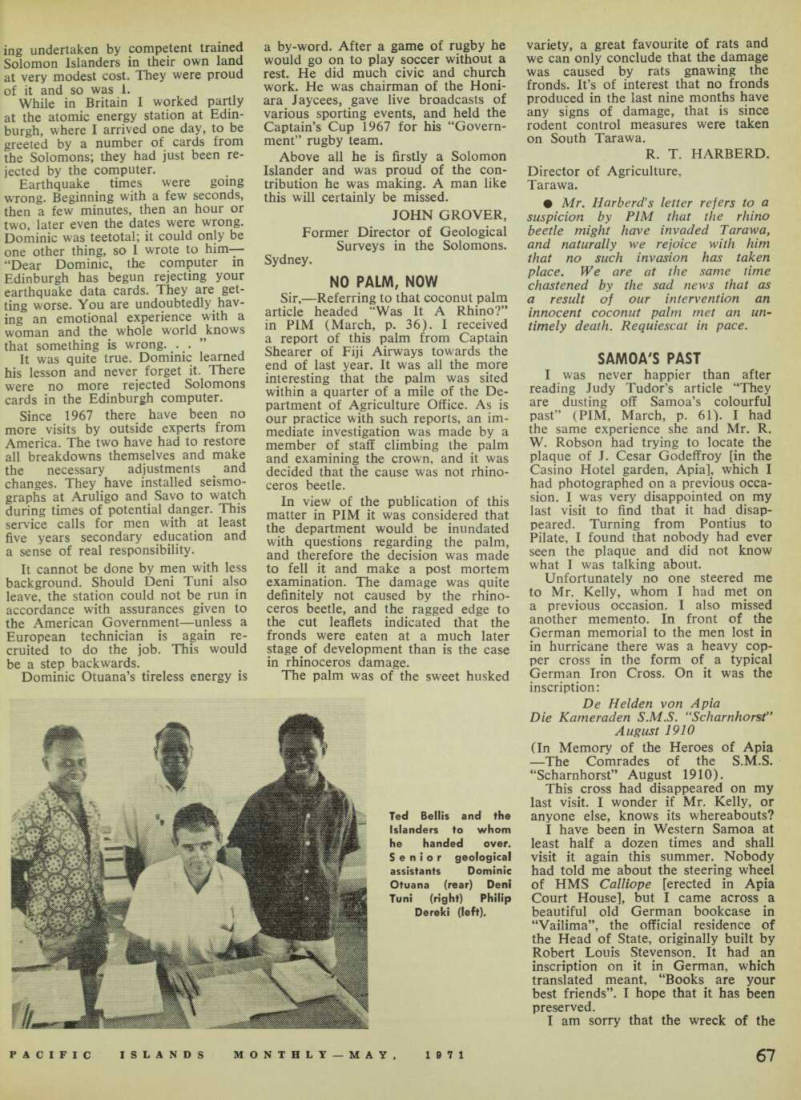
Ted Beilis and the Islanders to whom he handed over.
Senior geological
assistants Dominic Otuana (rear) Deni Tuni (right) Philip Dereki (left).
German Adler, which could be seen until the recent reclamation of that part of the harbour, has also been completely forgotten. I think that if there were no other way of financing it, the German Government would be prepared to foot the bill for a simple marker and inscription directly above the now buried wreck.
It might be of interest to know that John Cesar Godeffroy’s mansion is still standing in my hometown of Blankenese on the River Elbe, near Hamburg. It is considered one of the most beautiful homes in the whole area. A street in Blankenese, Godef froy Strasse, still bears the name of the one-time King of the South Seas.
Herbert Stein.
Staten Is., New York.
Judy Tudor comments: • Mr. Stein is editor/publisher of the German language weekly Platt dutsche Post, in Staten Island. He would like to know what happened to that German cross and so would we. If any reader has any clues about this or about any other hidden his torical relics of the 19th and early 20th centuries in Western Samoa, let’s know about them. Some present in habitants short-sightedly believe that such reminders of the past are best forgotten. But visitors are interested in the past as well as the present and as Western Samoa is in the market for the honest tourist dollar, anything that will make the visitor’s stay more interesting is worth preserving.
Sir, —In Judy Tudor’s article about the WS Trust Estates, it says that only 11 men had sat in the front office, and gives their names; but I sat in that office, first as Receiver, then Liquidator, of the D.H. & P.G., from 1915 to early 1918 when I resigned and returned to New Zea land to re-enlist in the NZEF. I was followed by my accountant Mr. P. E.
Pattrick, who came from Wellington and was there when the Spanish ’flu epidemic hit Samoa. He in turn, was followed by another New Zealander, whose name eludes me.
My connection with Western Samoa commenced with my arrival in Apia in August, 1914, as a sergeant in the sth Wellington Regt. When the Ger man officials refused to carry on their jobs, a number of men in the NZEF were appointed, and, I was one of those. The office I took on was that of the Chinese Commissioner, and later I had the assistance of another from our regiment namely John Pye- Smith.
In 1915, along with Wilfred Sim, now Sir Wilfred Sim, QC, who was Crown Prosecutor and Commissioner of Police, we resigned and returned to NZ where we again enlisted and
I was posted to the 9th Reinforcement NCO’s for extra training in Trentham Camp. While there I was sent for by the NZ Minister of Defence, Sir James Allan, and asked to return to Samoa as Receiver for the D.H. & P.G. He said that the British Govern ment wanted this to be done, and I decided to take on the job.
Since then I have always been very interested in South Pacific affairs and have been a regular reader of your monthly, which I get posted to me to my home in the Highlands of Scotland, where I now officially reside, though I come out to NZ every other year to see the bowls and dodge a UK winter. I should add that it is through the kindness of my sister-in-law, Mrs. Farquhar Matheson of Vava’u, Tonga, that I get your monthly.
W. M. Matheson.
Auckland, NZ.
The War Returns
Sir, —For me the article in PIM (Jan., p. 45) entitled “The War Re turns To Bougainville” proved most interesting; and it was also of interest to find my old station correctly spelled as Kihili, and not as people following map errors call it, Kahili.
There is much in the jungles of Buin surrounding Kihili that could prove of interest to the war museum.
One error crept into the article, where it stated that “Siwai is the home of the wrongly named ‘Buka’ baskets”. Actually Buin was originally the home of such—and in particular the south-eastern end of Buin. Mrs.
Voyce learned the art of weaving the simple forms of Buin basketry, and taught it to the school at Tonu in the early 19305. From then on the Siwai people have taken it up, and today are equally good at weaving all types of elaborate basketware, as are the Buin people.
It may be of interest to record that at Kihili, there was dedicated on Anzac Day, 1958, a war memorial, which in itself is something of a war museum. Part of the Japanese airfield built on Kihili was set apart and dedi cated as a memorial field, and planted with gardens. In this area was un veiled the actual memorial—a large prostrate concrete cross, with an in scription in shells: Lest We Forget The Fallen. From the centre of that cross there rises an upright cross of remembrance.
At the base of the cross, and sepa rated from it, there is a concrete slab inscribed again with shells; In Memo riam—Natives And Civilians, Armed Forces, Aust., NZ, Fiji, USA, Japan; Prisoners, British, Indian, Korean.
Rev. A. H. Voyce.
Auckland,