'Olovaha' makes a splash
pp. 97-98 · Read in the full issue
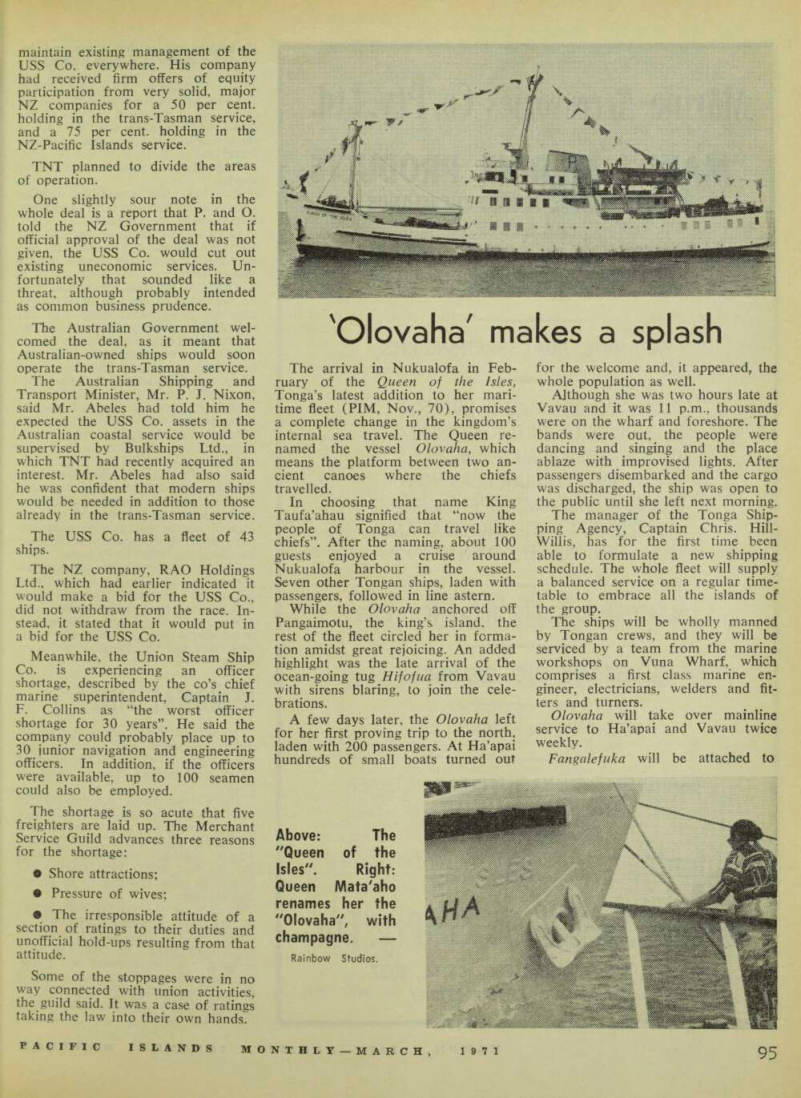
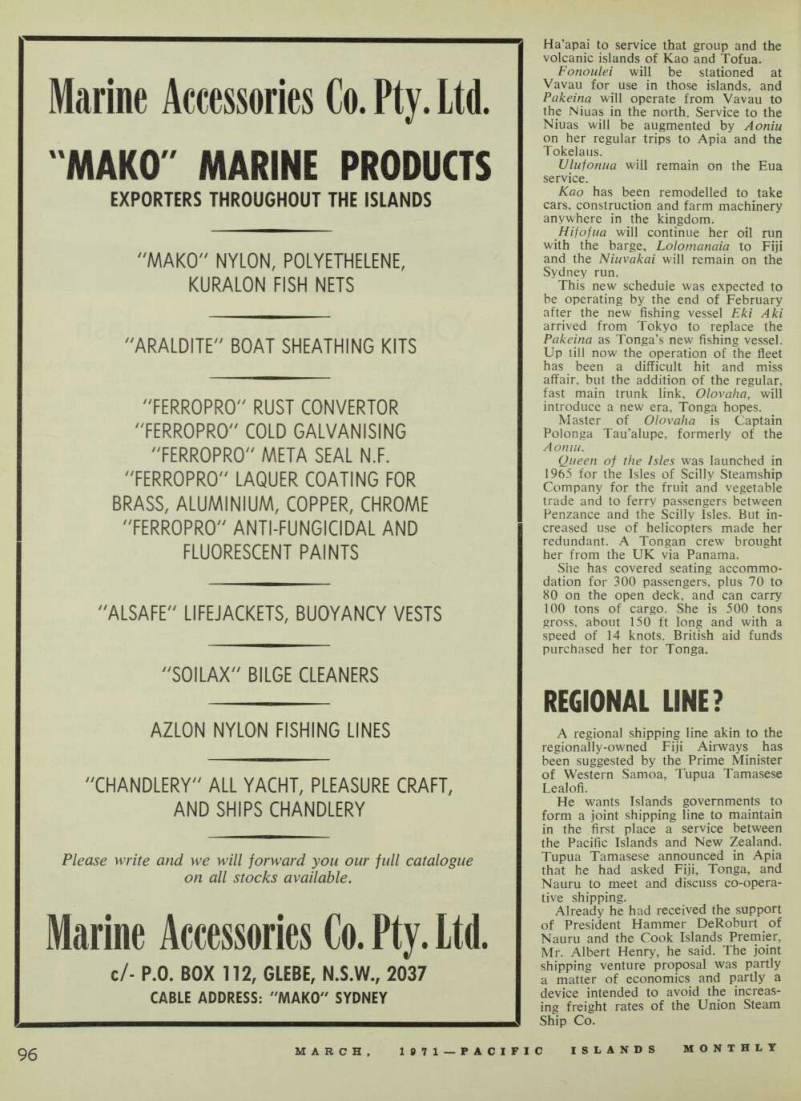
The arrival in Nukualofa in Feb ruary of the Queen of the Isles, Tonga’s latest addition to her mari time fleet (PIM, Nov., 70), promises a complete change in the kingdom’s internal sea travel. The Queen re named the vessel Olovaha, which means the platform between two an cient canoes where the chiefs travelled.
In choosing that name King Taufa’ahau signified that “now the people of Tonga can travel like chiefs”. After the naming, about 100 guests enjoyed a cruise around Nukualofa harbour in the vessel.
Seven other Tongan ships, laden with passengers, followed in line astern.
While the Olovaha anchored off Pangaimotu, the king’s island, the rest of the fleet circled her in forma tion amidst great rejoicing. An added highlight was the late arrival of the ocean-going tug Hifofua from Vavau with sirens blaring, to join the cele brations.
A few days later, the Olovaha left for her first proving trip to the north, laden with 200 passengers. At Ha’apai hundreds of small boats turned out
for the welcome and, it appeared, the whole population as well.
Although she was two hours late at Vavau and it was 11 p.m., thousands were on the wharf and foreshore. The bands were out, the people were dancing and singing and the place ablaze with improvised lights. After passengers disembarked and the cargo was discharged, the ship was open to the public until she left next morning.
The manager of the Tonga Ship ping Agency, Captain Chris. Hill- Willis, has for the first time been able to formulate a new shipping schedule. The whole fleet will supply a balanced service on a regular time table to embrace all the islands of the group.
The ships will be wholly manned by Tongan crews, and they will be serviced by a team from the marine workshops on Vuna Wharf, which comprises a first class marine en gineer, electricians, welders and fit ters and turners.
Olovaha will take over mainline service to Ha’apai and Vavau twice weekly.
Fangalefuka will be attached to
Above: The "Queen of the Isles". Right: Queen Mata'aho renames her the "Olovaha", with champagne.
Rainbow Studios,
Ha’apai to service that group and the volcanic islands of Kao and Tofua.
Fonoulei will be stationed at Vavau for use in those islands, and Pakeina will operate from Vavau to the Niuas in the north. Service to the Niuas will be augmented by Aoniu on her regular trips to Apia and the Tokelaus.
Ulufonua will remain on the Eua service.
Kao has been remodelled to take cars, construction and farm machinery anywhere in the kingdom.
Hifofua will continue her oil run with the barge, Lolomanaia to Fiji and the Niuvakai will remain on the Sydney run.
This new schedule was expected to be operating by the end of February after the new fishing vessel Eki Aki arrived from Tokyo to replace the Pakeina as Tonga’s new fishing vessel.
Up till now the operation of the fleet has been a difficult hit and miss affair, but the addition of the regular, fast main trunk link, Olovaha, will introduce a new era, Tonga hopes.
Master of Olovaha is Captain Polonga Tau’alupe, formerly of the Aomu.
Queen of the Isles was launched in 1965 for the Isles of Scilly Steamship Company for the fruit and vegetable trade and to ferry passengers between Penzance and the Scilly Isles. But in creased use of helicopters made her redundant. A Tongan crew brought her from the UK via Panama.
She has covered seating accommo dation for 300 passengers, plus 70 to 80 on the open deck, and can carry 100 tons of cargo. She is 500 tons gross, about 150 ft long and with a speed of 14 knots. British aid funds purchased her tor Tonga.
Regional Line?
A regional shipping line akin to the regionally-owned Fiji Airways has been suggested by the Prime Minister of Western Samoa, Tupua Tamasese Lealofi.
He wants Islands governments to form a joint shipping line to maintain in the first place a service between the Pacific Islands and New Zealand.
Tupua Tamasese announced in Apia that he had asked Fiji, Tonga, and Nauru to meet and discuss co-opera tive shipping.
Already he had received the support of President Hammer Deßoburt of Nauru and the Cook Islands Premier, Mr. Albert Henry, he said. The joint shipping venture proposal was partly a matter of economics and partly a device intended to avoid the increas ing freight rates of the Union Steam Ship Co.