Norfolk Wants
pp. 99-106 · Read in the full issue

Its Own Line
A group of Norfolk Island resi dents is trying to establish a ship ping service to trade from the island to Japan, Australia and New Zea land.
Mr. Jim Paton, one of the pro moters told a meeting of 24 inter ested residents that the object would be to form a company known as Norfolk Island Shipholders Co. Ltd., which would buy a suitable ship.
That company, in turn, would char ter the ship to Norfolk Island Ship ping Co. Ltd.
The service would mainly be needed to bring supplies into the island, but one of the problems in operating the service would appear to be securing outgoing cargo from Norfolk Island.
Much will depend, of course, on the ultimate service, whether it is flexible or fixed. Lord Howe would like to be included. Provided the ship had refrigerated space it could fill a gap which occurs in services to Lord Howe (PIM, Jan., p. 86).
Again there would probably be little difficulty in securing sufficient cargo on any leg of the service Aus tralia-Japan (or vice versa), Aus tralia-New Zealand (with some Jap anese cargo) or to Norfolk Island from either Australia or New Zea land.
The initial plans were built round being able to buy a ship the size of Maunganui, of 1,100 tons, which was suitable for palletisation of cargo and consequent quick loading and unloading. But this NZ ship was not available.
The promoters hope to avoid in dustrial trouble which often plagues the waterfronts of Australia and New Zealand, by negotiating con tracts with Sydney and Auckland watersiders to allow the watersiders to undertake all stevedoring.
Similarly, by manning the ship with Norfolk Islanders, it is hoped to avoid disputes with seamen’s unions in the two countries.
The memorandum of association for the proposal emphasises security recommendations about the condi tion of the ship, before completion of purchase, and for the profitability of its operation under “bare boat charter”.
The charter provides for a mini mum annual dividend of 10 per cent, for Norfolk Island investors.
There is provision for reserves against depreciation and contingen cies so that, if the venture should not continue beyond the original charter period of five years, the
shareholders would be assured of the return of their subscribed capital, in addition to dividends.
A number of influential business men with interests in or company registrations in Norfolk Island are likely to support the venture.
Uk Trade To Fiji
'Holds Up Well'
London-based ship broker, Bethell Gwyn and Co., which has been trad ing to Fiji for 89 years, is confident the recent 12i per cent, increase on UK-Fiji ship freights will not harm UK and European exports to Fiji.
Bethell, a wholly-owned subsidiary of P & O, annually sends 36,000 to 40,000 tons of manufactured products and foods to Fiji, on various ships.
In January, Bethell’s managing direc tor, Mr. D. L. Herman, visited Fiji for a week, meeting new Cabinet Ministers, including Mr. Charles Stin son.
He told PIM in London that a minor proportion of Bethell’s busi ness went to Apia, Western Samoa.
In recent years, traditional Euro pean cargoes, such as cement, fer tilisers and some steel products had been produced locally in Fiji or imported from closer countries, such as Australia, New Zealand and Japan. However, tonnages had “held up remarkably well,” he said.
The "Bear" Replaces
The Matson "M"
The huge “M” which has adorned the funnels of the Mari posa and Monterey for many years has disappeared. It has been re placed with a Californian bear.
The change comes with the new ownership of the liners, which are now under the control of the Pacific Far East Line. PFEL, with the ac quisition of Matson thus moves to the South Pacific. Now it covers the whole of the Pacific basin for it has been operating in the north Pacific to the Orient for about 25 years, and in the central Pacific to Guam for a number of years.
PFEL will probably make a num ber of changes, but at this stage it has said it will maintain the exist ing published passenger sailing schedules “into January. 1972”. It is also retaining all former Matson staff in Australia.
Mr. Sam N. Mercer, vice president, passenger division, PFEL, said at a news conference aboard the Mariposa in Sydney on February 11, it might be wondered why PFEL took such a bold step and invested considerable funds in face of diffi culties which faced the US merchant marine.
“I can tell you, first of all, that we have taken this step with great
confidence —a confidence soundly based on our many studies of all the issues involved,” he said. “We be lieve that the expanding economies of both our countries gives ample substance to these studies and heralds a bright future for a healthy exchange ot passengers and commo dities between the United Stales and Australia.
“Let me also make this clear— there is a continuing growth of American tourist interest in Austra lia and in the attractive ports of call through the South Pacific which we offer aboard these ships.”
Mr. Mercer said PFEL also felt that the northbound voyage through the Islands and the many fascina tions of the American continent still were a great lure for Australian passengers.
Referring briefly to cargo services, Mr. Mercer said two large container ships would be added to existing services.
PFEL has started an advertising campaign in Pacific newspapers to assure potential passengers that although “the bear has replaced the M” on Mariposa and Monterey funnels, the Grand Manner of Mat son cuisine and service has not been changed.
New Ships For
The Bank Line
The Bank Line is confident it will transport much of the palm oil exports out of New Britain, New Guinea, when shipments start late this year, according to the company’s London director, Mr. I. S. McEwen.
He told PIM in January that small exports were expected this year, but it was not until the end of 1972 that major shipments would begin to Europe and other destinations.
Bank Line also hoped to carry in creasing exports of tea, coffee and cocoa from New Guinea, overseas.
Cargoes on the company’s outward Europe runs were steady with exports from Britain, but industrial and vehicle products from France to Noumea were increasing.
With exclusive produce carrying contracts from the copra boards of New Guinea, the Solomons, the GEIC and Western Samoa, Bank also transports virtually all of Tonga’s copra.
The company has placed orders worth £Stg.33 million in British ship yards (Swan Hunter-William Dox ford) for 10 new ships for its 52-ship world fleet.
The new ships will be delivered from late 1972 and then will gradu ally replace four 16-year-old 5,690tonners familiar to the Islands—
Foyle bank, Laganbank, Cedar bank and Nessbank. Two other Islands copra shippers, the Beaverbank and the Fleetbank, were sold last year.
A privately-owned Glasgow-regis tered, but London-based company, Bank Line is controlled by Inverforth family interests.
Andrew Weir (later Lord Inver forth, who died in 1955, aged 90) began the company in Glasgow, Scotland, in 1885 with the purchase of the Willowbank, an 800-ton sail ing vessel.
Services through the Islands began in the early 1900 s and Bank is best known as the shipper of copra or coconut oil from large and small (Washington and Fanning Islands twice a year) Islands ports.
Writ Served Against
"Betty Lou" Owners
A writ for $W525,000 damages was filed in February against the owners of the Betty Lou, which sank in March last year while making a crossing between Salelologa and Muli fanua, Western Samoa. The Public Trustee, Mr. Se Apa, is acting on behalf of the widow and four chil dren of Mr. Keli Maualaivao, who drowned along with another in the sinking.
Mr. Se Apa said, however, no action would be taken against owners, O. F. Nelson and Co. Ltd, on behalf of one-year-old Melefaauuga Taaga, the other fatality, as she left no de pendents.
After months of investigation last year into the sinking, a commission of inquiry placed blame for the sink ing of the Betty Lou on the owners, Captain Asotau, and the Western Samoan Government (PIM, Nov., p. 89). The report found, among other faults, that the vessel sailed with al most twice the number of permitted passengers, and was not equipped with essential equipment.
Fast Gunboat Guards
Micronesian Fishing Grounds
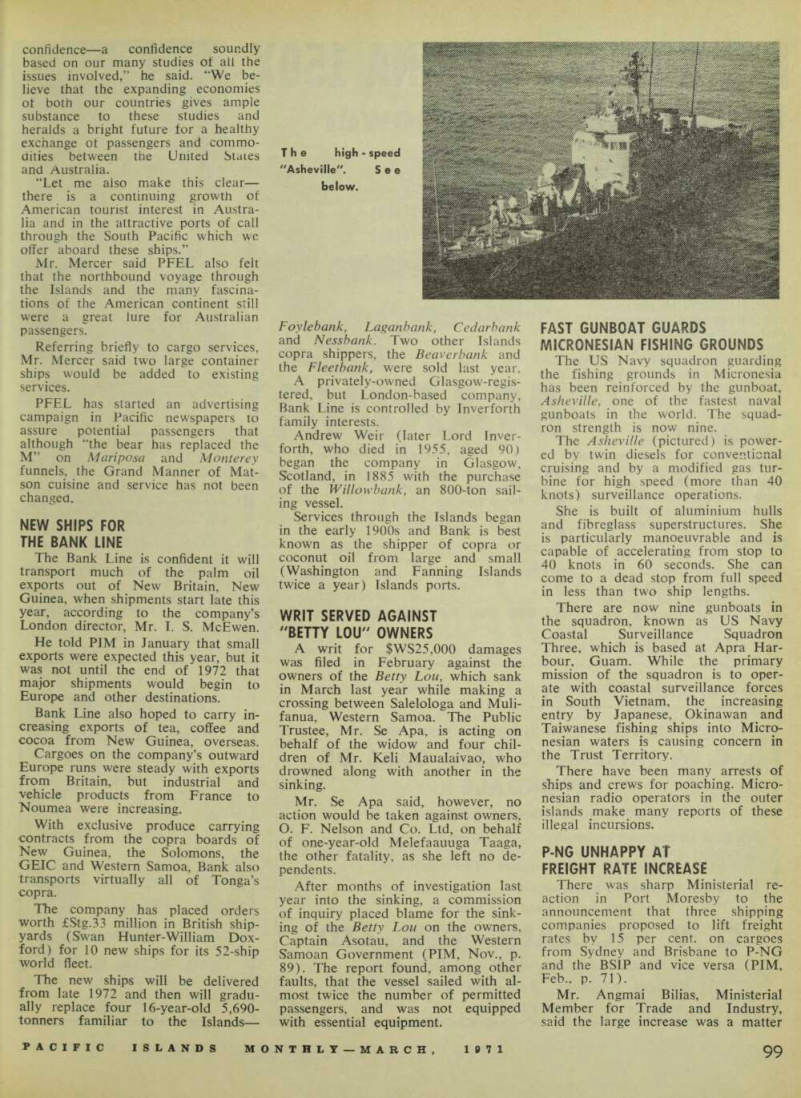
The US Navy squadron guarding the fishing grounds in Micronesia has been reinforced by the gunboat, Asheville, one of the fastest naval gunboats in the world. The squad ron strength is now nine.
The Asheville (pictured) is power ed by twin diesels for conventional cruising and by a modified gas tur bine for high speed (more than 40 knots) surveillance operations.
She is built of aluminium hulls and fibreglass superstructures. She is particularly manoeuvrable and is capable of accelerating from stop to 40 knots in 60 seconds. She can come to a dead stop from full speed in less than two ship lengths.
There are now nine gunboats in the squadron, known as US Navy Coastal Surveillance Squadron Three, which is based at Apra Har bour, Guam. While the primary mission of the squadron is to oper ate with coastal surveillance forces in South Vietnam, the increasing entry by Japanese, Okinawan and Taiwanese fishing ships into Micro nesian waters is causing concern in the Trust Territory.
There have been many arrests of ships and crews for poaching. Micro nesian radio operators in the outer islands make many reports of these illegal incursions.
P-Ng Unhappy At
Freight Rate Increase
There was sharp Ministerial re action in Port Moresby to the announcement that three shipping companies proposed to lift freight rates by 15 per cent, on cargoes from Sydney and Brisbane to P-NG and the BSIP and vice versa (PIM, Feb., p. 71).
Mr. Angmai Bilias, Ministerial Member for Trade and Industry, said the large increase was a matter
The high - speed "Asheville" See below.
for ‘great concern’. There had been no consultation with the Administration beforehand, although at least one of the companies had given an assur ance that there would be prior con sultation.
While agreeing that some of the costs of shipping companies were rising, the increases were ‘disap pointing’ because shipping companies had the benefit of technological changes and improvements.
Mr. Bilias said the higher rates would have repercussions through out P-NG as prices rose. The higher rates would also make it more dif ficult for P-NG primary producers to sell their products in competition with other countries.
He suggested that now might be the time for interested parties such as producers, exporters and import ers to negotiate with shipping com panies about freight rates, routes, frequencies of services, etc.
Still Cook Islands
Shipping Troubles
Auckland watersiders on Febru ary 8 began unloading the trouble bound Thallo, idle in port for some three weeks while the NZ Seamen’s Union pressed owners, South Pacific Transport Co. Ltd., to replace the Cook Islands crew with New Zea landers.
But in mid-February it was still not known whether the dispute had been fully settled. It appeared then to hinge on whether or not the Raro tongans should join the NZ union and thereby become acceptable as ship’s crew. The Cook Islands is in the process of forming its own sea men’s union and there is some ques tion of the two being affiliated.
Before the “compromise” there was also NZ union criticism of the state of the Thallo . Secretary of the Auckland branch, Mr. L. R. Ander son, said the ship was poorly fitted out with no decent amenities and not even washing facilities. In answer, Mr. Athol Rusden, managing direc tor of SPT, said in each cabin there was a fan and hot and cold water.
The ship had run between Ireland and Holland for four years before his company bought it and during that time there had been no com plaints of the conditions.
The compromise may well have been speeded up by publicity in the NZ Press that the Cook Islands were getting “desperately short of food”.
The Cooks’ Advocate-General, Mr.
E. J. V. Dyson, said on February 5 that the Thallo would sail anyway if the dispute was not soon resolved.
Thallo would pick the food up in Fiji if necessary, he said.
The Jean Philippe left Whangarei,
NZ, for Rarotonga on February 3 five weeks after her arrival. The ship had been held up by strike, by the collapse of a derrick (PIM, Jan., p. 88) and finally by a flood in the engine room. She was carrying 1,000 tons of cement and 100 tons of gen eral cargo for the Rarotonga airport project.
At the end of February, water siders at Auckland went on strike for a pay increase of 41 cents an hour on their present pay of 11.19 an hour.
The strike threatened to delay the departure of the cargo ship Taveuni from Auckland for Pacific ports by a week, and threatened the depar ture of the Tofua and Waimate.
Shipping briefs
• Karlander New Guinea Line has chartered the Golden Swan, about 4,500 tons, from Hong Kong, to cater for increasing cargo on the run from Australia to Honiara, Kieta and Rabaul. The first voyage out of Syd ney is scheduled for April 22. A Karlander spokesman said the increase in cargo was developing from the Bougainville copper project. Golden Swan was formerly the Enaren and operated from Sweden on the trans- Atlantic run. • The 9,336 ton Nauruan vessel
Enna G developed engine trouble while en route from Australia to Nauru in February, and returned to Rabaul, where she spent several days. • Tagua, the 158 ton Cook Islands ship stranded since December on Mangaia Reef, may not be salvaged.
After an examination of the Tagua by a Lloyds surveyor, the London Salvage Association apparently has decided to abandon her. If the Tagua, owned by the Rarotonga company, Boyd and Silk, looks likely to be driven into Mangaia harbour, how ever, she might be moved.
The Cooks internal shipping ser vice is thus one ship short, with the Akatere and the Bodmer in service.
No doubt some people are sorry that the Cook Islands Government at the end of last year didn’t go ahead with a shipping licence which earlier it had promised to Captain Hugh Williams.
Captain Williams had offered to put into service a 500 ton ship doing 101 knots, giving a 25 per cent, cut on deck passenger rates and a 10 per cent, cut on freight for five years.
After being told he could have the licence Captain Williams was negotiating to buy a ship, when ob jections were lodged to the granting of the licence, and the offer was withdrawn.
Captain Williams left the Cooks for Australia in October, breathing fire against “the monopoly” in a paid advertisement in English and in Maori in the Cook Islands News. • The Oriental Queen, the tour vessel owned by Toyo Yusen Com pany of Tokyo, and which runs a tour operation into Micronesia and Guam, ran aground in Saipan, in the Marianas, in January. She was grounded on a reef on the north side of the channel and all 103 pas sengers were shuttled ashore. She was pulled off later with the help of the US coast guard cutter Bass wook. A buoy mooring chain was found to have become wrapped around the ship’s port shaft.
About the same time a Liberian cargo vessel, the Oceania, en route from Noumea to Japan, hit an atoll reef at Ngatik. about 80 miles SW of Ponape, and sank. The 31 crew men, all Greeks, were rescued by Trust Territory supply ship, Kase lehlia and taken to Ponape.
O A sit-down strike on Suva wharf of 200 noisy seamen, delaved the departure of the liner Southern Cross by 90 minutes on February 15. The seamen were complaining at a decision to cut their overtime because the liner had not got a capacity load of passengers. The situation became even noisier when
as the Royal Fiji Military Forces Band played “Isa Lei” to the motion less ship, the crew sat on the wharf singing, “We Shall Overcome”. The strikers went back on board when, apparently, the captain agreed to their demands. • Cook Islander friends of pas sengers on board the luxury liner Bergensfjord have heard that the vessel hit an “unidentified object” recently near Peru. It turned out later that there had been an earth quake under the ship. Passengers had gone to bed when there was a terrific shaking of the ship. They were called to life-jackets and boat
stations and the captain said the ship was being examined for leaks after she had “struck something under the surface of the sea”. Fin ally the ship was declared safe and everyone had free drinks in the ball room. A radio check with America the next day indicated that the ship had passed over the epicentre of the quake. 9 Endeavour 11, Canadian 2,000 ton sailing barque, left Brisbane re cently for UK via Fiji, after being held up by a legal action. A judge ordered her release after her owners came to a settlement about writs alleging debts totalling $44,000 on
the ship. But on February 23 she was abandoned in Parengarenga Har bour, NZ, in heavy seas. She was aground inside the harbour bar and in danger of breaking up. The crew of 14 and a woman were safe, although the captain broke an arm and the woman suffered shock. • What had been the only workers’ union in the Cook Islands for many years, the Cook Islands In dustrial Union of Workers, was deregistered on January 15 by the Registrar of Unions in the Cook Islands. This was because the union had failed to deliver a statement of accounts to him for 1967 to 1970, inclusive.
On December 15 last year a new union was formed for waterside workers, the Cook Islands Industrial Union of Waterside Workers. Cook Islands seamen are not eligible to join this union, and this appears to be one of the reasons why the New Zea land Seamen’s Union have refused to work the island freighter MV Thallo.
The NZ Seamen’s Union wants the Thallo’s Cook Islands crew replaced by New Zealand seamen, and the NZ watersiders went on strike in sym pathy. • American Samoa registered im pressive increases in shipping during the first half of the fiscal year, ac cording to Port Director, Fred Uhrle.
Not counting fishing vessels, 434 ships visited Pago between July 1 and December 31, 1970—a 19.88 per cent, increase over the 362 ships visiting during the same period in 1969. • The E and A ships, Cathay and Chitral began a regular monthly ser vice between Australia and the Far East, taking in Port Moresby and Rabaul, in February. Both are com parative newcomers to the trade; Cathay completed her inaugural voy age on the route in November, 1969, and Chit ral began only last Novem ber. Both are air-conditioned and carry a total of 274 adults and 16 children. • Two American warships, the guided missile destroyers USS Golds borough and USS Lynde McCormick, were due in Suva on February 15.
The destroyers are 3,540-ton ships of the Charles F. Adams class and each carries a crew of about 350. • The first steel boat to be com pletely built in Western Samoa was launched in early January. Ordered by the American Samoan Govern ment, it is 32 ft long and has a 10 ft beam. Chief builder, Mr. R. F. Thom son of Gilberd 1.E.P., hopes the boat, admired by many, is the first of many such vessels to be built in Western Samoa.