Pacific Shipping
pp. 95-97 · Read in the full issue
GEIC sailors take to the seas of the world
From a Tarawa correspondent Fifteen German merchant ships this year will change from German to Gilbert and Ellice Islands crews. At the end of 1970, the South Pacific Marine Service, which represents eight German ship ping companies, employed 244 Gilbertese seamen in 17 ships.
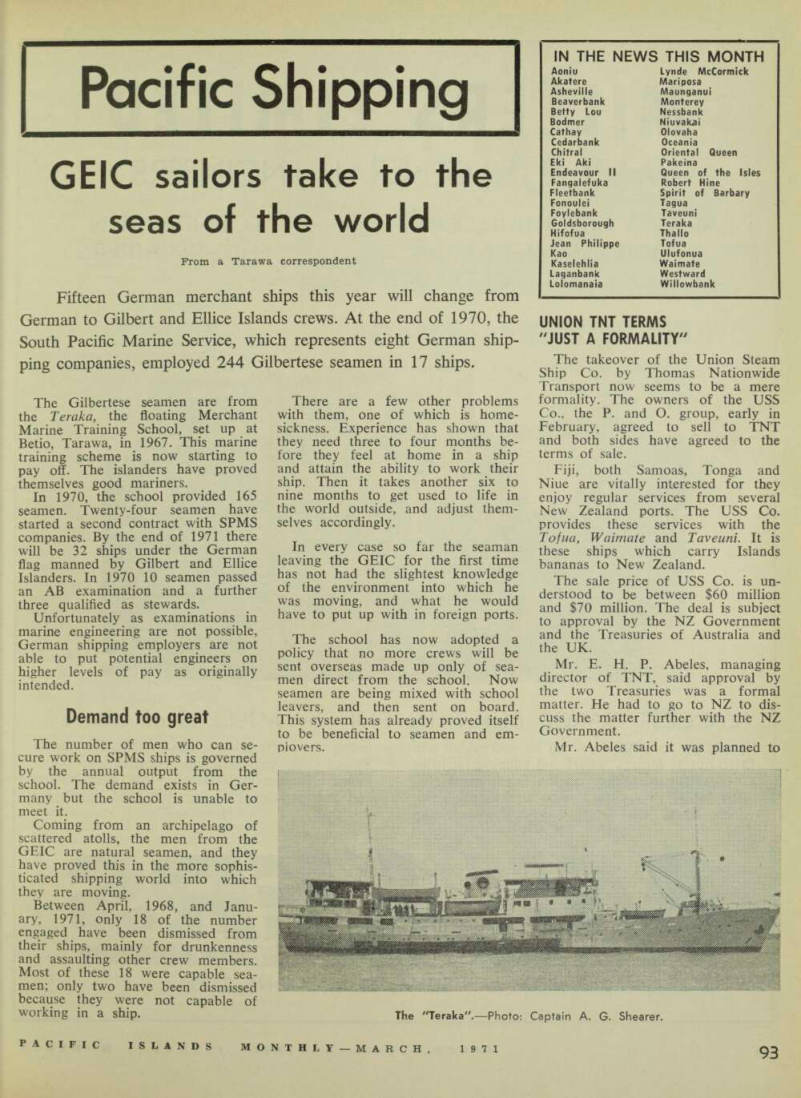
The Gilbertese seamen are from the Teraka, the floating Merchant Marine Training School, set up at Betio, Tarawa, in 1967. This marine training scheme is now starting to pay off. The islanders have proved themselves good mariners.
In 1970, the school provided 165 seamen. Twenty-four seamen have started a second contract with SPMS companies. By the end of 1971 there will be 32 ships under the German flag manned by Gilbert and Ellice Islanders. In 1970 10 seamen passed an AB examination and a further three qualified as stewards.
Unfortunately as examinations in marine engineering are not possible, German shipping employers are not able to put potential engineers on higher levels of pay as originally intended.
Demand too great
The number of men who can se cure work on SPMS ships is governed by the annual output from the school. The demand exists in Ger many but the school is unable to meet it.
Coming from an archipelago of scattered atolls, the men from the GEIC are natural seamen, and they have proved this in the more sophis ticated shipping world into which they are moving.
Between April, 1968, and Janu ary, 1971, only 18 of the number engaged have been dismissed from their ships, mainly for drunkenness and assaulting other crew members.
Most of these 18 were capable sea men; only two have been dismissed because they were not capable of working in a ship.
There are a few other problems with them, one of which is home sickness. Experience has shown that they need three to four months be fore they feel at home in a ship and attain the ability to work their ship. Then it takes another six to nine months to get used to life in the world outside, and adjust them selves accordingly.
In every case so far the seaman leaving the GEIC for the first time has not had the slightest knowledge of the environment into which he was moving, and what he would have to put up with in foreign ports.
The school has now adopted a policy that no more crews will be sent overseas made up only of sea men direct from the school. Now seamen are being mixed with school leavers, and then sent on board.
This system has already proved itself to be beneficial to seamen and em piovers.
Union Tnt Terms
"Just A Formality"
The takeover of the Union Steam Ship Co. by Thomas Nationwide Transport now seems to be a mere formality. The owners of the USS Co., the P. and O. group, early in February, agreed to sell to TNT and both sides have agreed to the terms of sale.
Fiji, both Samoas, Tonga and Niue are vitally interested for they enjoy regular services from several New Zealand ports. The USS Co. provides these services with the Tofua, Waimate and Taveuni. It is these ships which carry Islands bananas to New Zealand.
The sale price of USS Co. is un derstood to be between $6O million and $7O million. The deal is subject to approval by the NZ Government and the Treasuries of Australia and the UK.
Mr. E. H. P, Abeles, managing director of TNT, said approval by the two Treasuries was a formal matter. He had to go to NZ to dis cuss the matter further with the NZ Government. xMr. Abeles said it was planned to
The "Teraka".-Photo: Captain A. G. Shearer.
maintain existing management of the USS Co. everywhere. His company had received firm offers of equity participation from very solid, major NZ companies for a 50 per cent, holding in the trans-Tasman service, and a 75 per cent, holding in the NZ-Pacific Islands service.
TNT planned to divide the areas of operation.
One slightly sour note in the whole deal is a report that P. and O. told the NZ Government that if official approval of the deal was not given, the USS Co. would cut out existing uneconomic services. Un fortunately that sounded like a threat, although probably intended as common business prudence.
The Australian Government wel comed the deal, as it meant that Australian-owned ships would soon operate the trans-Tasman service.
The Australian Shipping and Transport Minister, Mr. P. J. Nixon, said Mr. Abeles had told him he expected the USS Co, assets in the Australian coastal service would be supervised by Bulkships Ltd,, in which TNT had recently acquired an interest. Mr. Abeles had also said he was confident that modern ships would be needed in addition to those already in the trans-Tasman service.
The USS Co. has a fleet of 43 ships.
The NZ company, RAO Holdings Ltd., which had earlier indicated it would make a bid for the USS Co., did not withdraw from the race. In stead, it stated that it would put in a bid for the USS Co.
Meanwhile, the Union Steam Ship Co. is experiencing an officer shortage, described by the co’s chief marine superintendent, Captain J.
F. Collins as “the worst officer shortage for 30 years”. He said the company could probably place up to 30 junior navigation and engineering officers. In addition, if the officers were available, up to 100 seamen could also be employed.
The shortage is so acute that five freighters are laid up. The Merchant Service Guild advances three reasons for the shortage: • Shore attractions; • Pressure of wives; • The irresponsible attitude of a section of ratings to their duties and unofficial hold-ups resulting from that attitude.
Some of the stoppages were in no way connected with union activities, the guild said. It was a case of ratings taking the law into their own hands.