Book Reviews
pp. 85-86 · Read in the full issue
A First Papuan Novel
That Comes Off
The first novel to be published from a Papuan writer is naturally going to attract more than its fair share of attention whether or not it deserves it, so it’s cheering to be able to say that Vincent Eri’s The Crocodile is a first novel worth reading.
Already I want to know if he has anything more to say, and if so, when will we have the chance to see whether one swallow makes a summer.
Vincent Eri, born in 1936 in the Papuan Gulf country, is a mission educated former school teacher who these days is a public servant with the P-NG Education Department, where recently he has been acting superintendent of primary education.
Last year he was among the first batch of graduates from the Uni versity of Papua and New Guinea.
The Crocodile is volume one of a new Pacific Writers Series by Bris bane’s Jacaranda Press, the general editor of the series being that man of wide interests in the Arts, Ulli Beier, of Port Moresby.
Disillusioned with the white man
The Crocodile is the story of a Gulf District villager, Hoiri Sevese, of his days with the mission school just before the Pacific War, of his marriage, his experiences as a carrier for an Administration patrol and with the wartime Australian Army, and of his eventual disillusionment with life in a country controlled by white men.
One assumes there are a lot of Vincent Eri’s own experiences in this novel, although he would have been too young for the war. It is a novel nreoccupied with white men, and :heir effect on the village people.
Whether missionary, patrol officer, Migau officer, housewife or shop keeper, they’re an unlovely lot—
inconsiderate, even callous, greedy, always ready to exploit their superiority, and with as much con tempt for the Papuan as the Papuan has for them.
But the white man wins every
time and Hoiri Sevese finally realises dimly that there is nothing he can do about it, that his son may better himself if he can buy a white man’s education.
Yet this is not a bitter novel. The unfriendly white men and women are not paraded for the sake of impact; each is a recognisable char acter in a familiar situation. As for instance, Mrs. Jones, of Port Moresby, who is showering when she asks young Hoiri to get her towel from the bedroom.
“Hoiri felt excited and uneasy. It was a while before he found the right towel. ‘Here is your towel, Sinabada’, Hoiri called out.
“ ‘Open the door and bring it to me,’ she ordered.
“Lots of things began to go round in Hoiri’s mind all at once. He could not afford to disobey her when she was kind enough to permit him and his father to stay in the boy house with Aravape. What if her husband came to the house un expectedly and found him with his
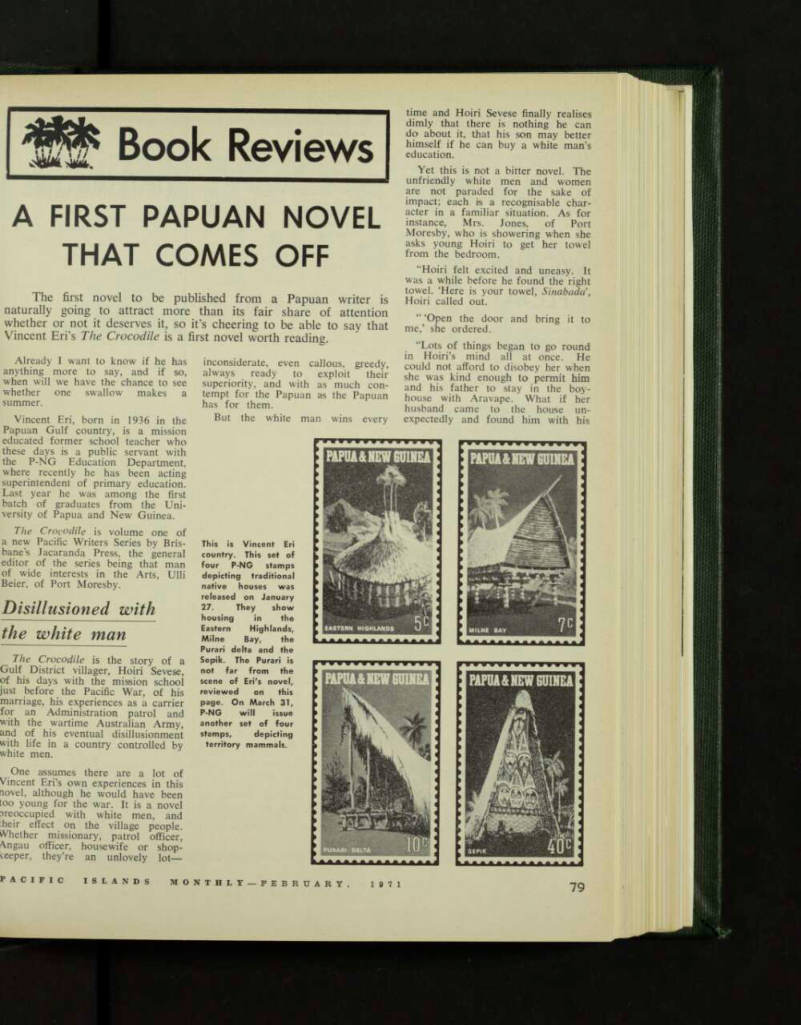
This is Vincent Eri country. This set of four P-NG stamps depicting traditional native houses was released on January 27. They show housing in the Eastern Highlands, Milne Bay, the Purari delta and the Sepik. The Purari is not far from the scene of Eri's novel, reviewed on this page. On March 31, P-NG will issue another set of four stamps, depicting territory mammals.
wife in the bathroom? How would he be able to explain this situation and how could his explanation be convincing? He could not imagine a whole lifetime behind the prison walls. Inch by inch Hoiri opened the door and stood inside. He could see her pale white feet below the curtain; soapy water was still run ning down the shins. Excitement
rose within him. With his face hidden behind the curtain Hoiri held out the towel.
“All of a sudden the curtain was drawn back and there stood before him the wet, dripping, banana-white figure of the woman who wanted the towel. Hoiri did not know whether to shut his eyes or open them wide.
In that brief moment his vision was attracted to the circle of wet black hair below the abdomen. It was with a sigh of relief that Hoiri returned to his uncle who was enjoying his betel nuts.
“ ‘lt’s a very difficult situation to be in,’ said his uncle. ‘Other cooks have had similar experiences. You see, she doesn’t really expect you to look at her.’
“ ‘But that’s inhuman. Anyone would!’
“ ‘Nevertheless, if she provokes you you must never respond. Cooks who think like you end up cooking for other prisoners in Bomana prison.
When you are in Moresby, it is wiser to act less manly. Whatever happens, the magistrate will never believe your story.’ ”
But this novel is of special interest for its scenes of village life, not town life. The account of one of the pre-war great lakatoi trading voyages from the Gulf to Port Moresby is fascinating stuff. The author is happier with description than with dialogue, some of which is inclined to be stilted.
And I would have liked to have got to know Hoiri’s wife better before she was taken by the crocodile of the title. Some more family scenes, some more character build ing, could have been given us with out interfering with the flow of the story.
But these are minor criticisms, and on the strength of this novel I would think that Vincent Eri is capable of getting control of his characters. I read The Crocodile through at a sitting, and it kept my unflagging interest.
It will now be interesting to see whether he will produce a novel as readable as this one without necessarily relying on racial con frontation for its appeal. Is he capable of pointing up the problems between black man and black man, because if he can he will be a novelist to be taken seriously, not simply the capable writer that he is. —SI. (THE CROCODILE. The Jacaranda Press. $3.50).