Yesterday
p. 81 · Read in the full issue
Twenty years ago this month, the Pacific seemed finally to be throwing off the affects of World War II. The news reports in PIM were beginning to be forward-looking, as administrators, planters and businessmen tackled new problems instead of complaining about what-might-have-been. Some of the problems are still with us.
For instance, in the issue of PIM for February, 1951, the magazine discussed what it described as the “worsening relations” between the people of New Caledonia and French Oceania with the Paris government.
Paris continued to offend her Pacific colonies by sending administrators “noted for incompetence and political bias”, and PIM predicted that the French colonies would weaken their ties with France and seek closer rela tions with Australia and the United States.
In Papeete in January the Assembly had refused to confirm the govern ment’s plans to introduce new taxa tion to provide for a deficit of 19 million francs. One of the main reasons for the deficit was the need to pay government officials higher salaries, plus back pay to those who had lost their jobs in 1940 as a result of the war. There was “disgust” because numbers of these officials had supported Vichy France. The rebellion was led by the Mayor of Papeete and Assembly vice-president, Mr. Alfred Poroi.
But the most tragic news of the month was the eruption on January 21 of Papua’s Mount Lamington, resulting in the death of 4,000 natives and 35 Euro peans. New Guinea people were calling for a public inquiry as to why there had not been sufficient warning given by the Adminis tration, as there had been signs of activity in the mountain. The Minister for Territories, Mr.
Percy Spender, said there was no need for an inquiry. Among those dead was the well-loved Director of Native Labour, Mr.
W. R. Humphries.
Trans Oceanic Airways, of Sydney, :ouldn’t inaugurate its flying-boat service between Australia and Port Moresby in February, as it had planned, because its new Solent crashed off Malta while en route to Australia. The aircraft was piloted W Caot"in Brian Monkton. The crew escaped, but one of the passengers jro'vneH The 17,940-ton “Aorangi”, the last Jassenger ship on the Sydney-North America run, was laid up in Sydney \^nn l nL a buyeK She had lost about .600,000 for her owners since she yegan the service in 1948.
To overcome an acute housing hortage in Noumea, a semi-official milding society had been authorised
by the Governor-General, with the backing of the colonial administra tion, the municipality, the Caisse Centrale of Overseas France, and leading banking, industrial and com mercial houses of New Caledonia.
The Noumea population had grown in five years from 15,000 to 18,000 while fewer than 150 new dwellings had been built. Today Noumea has a population of near 50,000 and the housing shortage is still critical.
The “coconut telegraph”' said that plans to bring Indonesian labour into the New Hebrides had been dropped.
Instead it was planned to import some 500 Italians to ease the labour situation.
Tonga celebrated the 50th anniver sary of the signing of the Treaty of Friendship between the kingdom and Great Britain on February 15. Queen Salote left Auckland, where she had been spending the summer, to be present at the ceremonies, which in cluded feasts, a procession, a regatta and dances.
Two youths in Papeete were sen tenced to death by guillotine for the murder of Mr. Arthur Brander in July, 1950. Mr. Brander, nephew of the last King of Tahiti, Pomare V, had been stabbed to death at his home. The youths were to appeal.
Plans to brew beer in Port Moresby were close to fruition.
New Guinea, with a European population of 10,000 (New Guineans weren’t permitted to drink) was consuming 350,000 gallons of beer a year, all im ported and sold at 4s. a bottle.
Mr. Joe Bourke of Wau, a pro moter of the scheme, announced a licence had been granted for the new South Pacific Brewery in Moresby. A brewer had been
engaged in Germany and would supervise construction of the plant. SP beer is still busy quenching thirsts in the territory in 1971.
Fifty young Micronesians arrived in Fiji to enter the Central Medical School. The arrival of the new stu dents created accommodation prob lems, but, PIM reported, there were no complaints. It was felt that the compliment paid the Suva School by the Americans in deciding that Suva should train their native medical per sonnel, far outweighed any temporary inconveniences.
There was strong discontent among planters in British terri tories of the South Pacific about the £5O sterling per ton f.o.b. being paid for copra by the British Ministry of Food. The free market price at European ports was more than double this.
PIM felt the nine year contract, which British planters had accep ted in 1948, was in need of review because of the devalua tion of sterling and the rise in costs of copra production in the South Pacific.
A strike by Tahiti seamen for more pay collapsed when the Governor announced he would put Marines to work as seamen in their place if they did not get back to work. The men had been on strike since December 15, asking for 5,000 francs (about SA3S) a month, instead of the 3,000 francs they were getting.
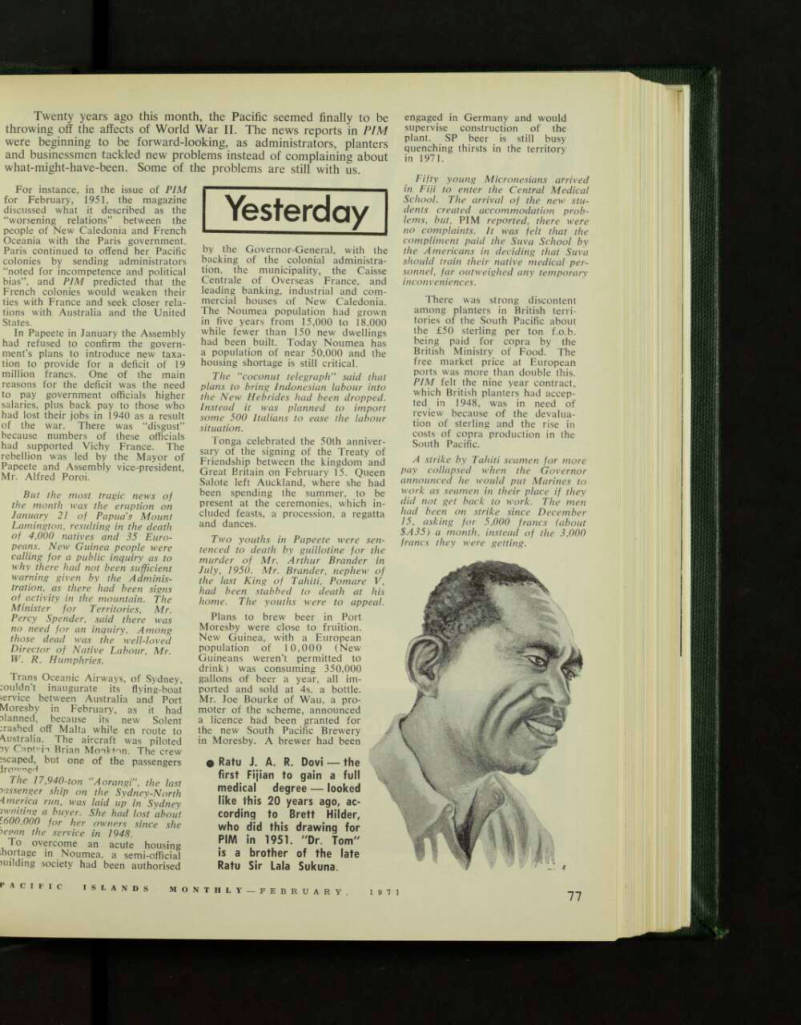
Ratu J. A. R. Dovi - the first Fijian to gain a full
medical degree - looked
like this 20 years ago, ac cording to Brett Hilder, who did this drawing for PIM in 1951. "Dr. Tom" is a brother of the late Ratu Sir Lala Sukuna.