Magazine Section
pp. 75-77 · Read in the full issue
The Strange Story Of The Man
Wells Fargo Couldn't Get
• Did Charles Wells Banks rob the American firm of Wells Fargo of more than $20,000 and clear off to the Cooks to escape retribution?
Or was Banks the "fall guy" for others who stole the money? The real story of Charles Wells Banks may never be known, but the facts that are known add to the colourful history of the Cook Islands.
From W. H. Percival, in Rarotonga
When Charles Wells Banks came to the Cook Islands in 1888, nobody there suspected that he had been accused of robbing Wells, Fargo and Company, the famous American fast mail service and bankers, of more than SUS2O,OOO and that a reward of $l,OOO had been placed upon his well thatched head.
No Cook Islanders then knew that a relentless man hunt for him was being carried out.
Mr. “J. Scard”, alias Charles Wells Banks, lived for a time on Atiu Island, one of the southern Cook Group, and there he married a local lass named Tuatika.
It’s unlikely that she knew that her handsome “husband” already had a wife in America whom he hadn't bothered to divorce.
The couple went to live in Rarotonga where “Scard” became Government Auditor and Registrar of Deeds and also accountant for the New Zealand firm of Donald and Edenborough. He fitted well into the Rarotongan society of his day, trusted and well liked, as he had been in San Francisco’s society before he and more than $20,000 of Wells Fargo money disappeared simultaneously.
Charles Wells Banks was born on June 3, 1839, tiear Birmingham, England. He went to sea as a cabin aoy at 14, jumped ship in New York and worked in m iron foundry. Later he became a clerk.
When the American Civil War broke out, Charles ‘ought for the Union with the 206th New York Volunteers. He was given a medical discharge after eceiving a bullet in the left leg during the battle at Peasant Hill, then he moved on to New Orleans where le became a quartermaster’s clerk.
After the war, Charles worked in Washington as ‘hief clerk in the Freedmans’ Bureau, an organisation hat dealt with the problems of settling Negro ex-slaves nto the community. Then he returned to New York vhere he became a customs house inspector.
Still restless, he returned to New Orleans, a gay ity be had come to love, and developed a taste for ;ood living. A good looking man, with a full black •card, thick wavy hair and intelligent grey eyes, he Iways dressed neatly and was fond of the company •f g° od looking women. (Turn to the next page).
He became a naturalised American citizen in New Orleans on May 14, 1867. Four years later he went to San Francisco with the probable intention of settling there.
Early in 1871 Charles Banks, still limping from his war wound, was given a junior position in the accounts department of Wells, Fargo and Co.; but before long his ability at book keeping was recognised and he was promoted to cashier of the Express Department.
The pony express, which Wells Fargo started in 1860, had made the firm famous for its fast mail service.
Starting from St. Joseph, Missouri, relays of horses and riders covered the 2,000 miles of wild frontier to San Francisco in 10 days.
Charles Banks became a member of the exclusive Union and Bohemian clubs of San Francisco; he always bought good quality clothes, and was a kindly, if somewhat vain, man. He was well informed on current topics and enjoyed discussion with the sharpest'brains in San Francisco.
Feeling settled at last, he got mar ried, and dabbled in the stock market with moderate success. He became owner of a gravel mine and a vine yard, and established his wife in a beautiful home in Oakland.
By his own efforts and abilities Charles Wells Banks had transformed himself from a poor immigrant boy into a highly respected member of San Francisco’s upper middle classes.
But even that was not enough to quench his ambition.
During the late summer of 1886 he sent his wife off to New York for a long holiday, and rented a room in a part of San Francisco where he was unknown, using the alias, “J. Scard”.
Under the same name he booked a passage to Australia on the Star of Papeete and then put the final part of his plan into operation.
On November 1, 1886, he didn’t appear at his office. When the safe was opened later that morning it: was found that over $20,000 hadl disappeared.
Enquiries revealed that Banks hadl also vanished from the San Franciscoi scene. Wells Fargo called in Chief] of Detectives Jim Hume and toldi him to find Banks and the missings $20,000 —and fast. Hume was in structed to keep the affair secret fori as long as possible, otherwise the; firm’s reputation for dependability might be seriously damaged.
Ace detective Hume had the reputation of a sheriff-detective whc always got his man and he had: no intention of letting Charles Banks ruin his image.
Within a few days Hume shooW the executives of Wells Fargo rigidl
He reported that Charles Banks, that dignified, erudite and scientifically minded gentleman, had led a double life. For intellectual exercise he had exchanged views with the best brains in the city, and for exercise of another sort he had frequented the lowest brothels of the waterfront.
It was quite fashionable for “respectable” men to use brothels what rocked Wells Fargo was Banks’ choice of brothels. Hume also repor ted that Banks had supported as many as three mistresses at a time, and reluctantly admitted that Banks was no longer in San Francisco.
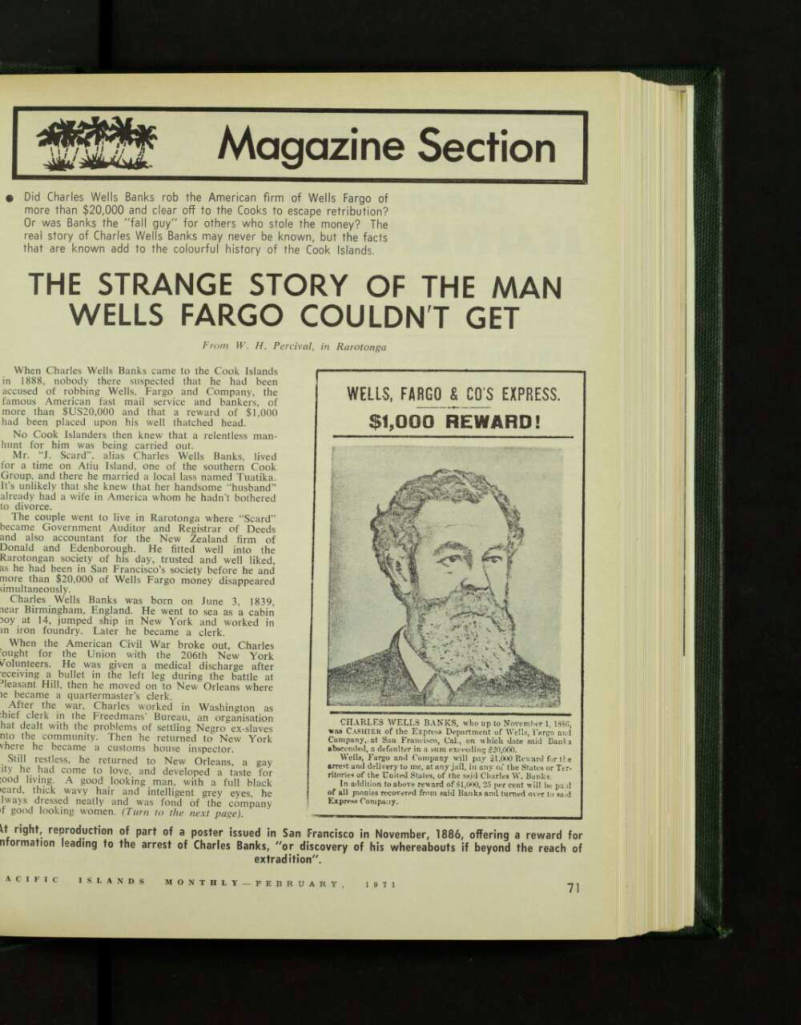
Then the news was broken to the public. Jim Hume issued a reward poster announcing that “Wells, Fargo and Company’s Express” was offering a $l,OOO reward for “Charles Wells Banks, who up to November 1, 1886, was cashier of the Express Depart ment of Wells, Fargo and Company, at San Francisco, California, on which date said Banks absconded, a defaulter in a sum exceeding $20,000.” In addition Wells Fargo offered as re ward, 25 per cent of the total money recovered from Banks.
Hume’s poster gave a very detailed description of Banks, even to the shape of his nose, his false teeth, and varicose veins, which he endeavoured to cure by the use of elastic bandages.
“Disposition, quick and nervous, smokes tobacco, but does not chew it,” noted Chief Detective Hume.
“Age 47, height about sft 8 in. or 9 m.— weight about 1451 b.”
Wells Fargo never revealed the exact amount of money that dis appeared with Charles Banks. They iust said it was a sum exceeding $20,000 a fortune in those days.
Jim Hume felt that Banks was no longer in America and his hunch was verified when the Star of Papeete berthed again in San Francisco. One of his men showed the master the “wanted” poster, and the captain at once recognised Charles Banks as “Scard”, although Banks had shaved off his beard and moustache.
Hume sent detectives to Sydney and Auckland to track Banks down.
In Auckland, the detectives talked with schooner captains whose vessels did regular runs from there to the Cook Islands—and they learned quite a lot about Charles Banks. They took passage on the next ship for Rarotonga, confident that they would soon be splitting the reward money among themselves.
When they landed in Rarotonga and tried to arrest him, Charles Banks aappily informed them that the Cook Islands had no extradition treaty with he , US which was the main reason ae had chosen to settle in the Cook slands.
He also let them know that he
was a friend of Queen Makea, the chieftainess recognised by the British Government, and who ruled the Cook Islands with a very firm hand. He told them that the Cook Islands were under British protection and that the Cook Islands kingdom was autonomous. The detectives returned home, Hume was not yet beaten. He reasoned that with his tastes and background, Banks would not be able to endure life in Rarotonga for the rest of his days; that he would have to break out of his South Pacific prison to the bright lights of Auckland or Sydney. He made certain that the moment Banks set foot in either country he would be immediately arrested.
But Charles must have known that his record and description were well known throughout the Pacific, and that once he boarded an Aucklandbound schooner the skipper would put him in irons for the reward money. He never left the Cook Islands.
In 1897, when Charles had been living in the Cooks for nine years, investigation into the Cook Islands Administration revealed something of his background. The following year he relinquished his government appointment.
Still trusted and well liked, he continued to be Donald and Edenborough s accountant, and its successor, A. B. Donald (C. 1.) Ltd., until he became blind.
His life became dull, composed
mainly of work and highlighted by the arrivals of inter-island trading schooners and steamships from the US and NZ.
His salary as accountant, and some times acting manager, would have been only a fraction of what he had earned in America. He lived frugally and worked hard, a man married to his job.
Until blindness he read Kipling and played billiards occasionally with his European friends. He became a regular churchgoer and in later years became worried about his spiritual welfare. He drank gin and brandy in very moderate quantities. On formal occasions he was smartly turned out i n white duck, blancoed boots and sun helmet, He died in Rarotonga on March 21, 1915, aged 75, and was buried in the graveyard of the London Missionary Society’s church in Avarua. His wife had died earlier, An obituary written by Torea Katoriki j n April, 1915, said this about Charles Banks: “During his long and painful blind ness, borne with great patience and resignation, he was very well attended by his friends, especially by the Shearman family. The funeral, which took place on Monday, March 22, was very largely attended by a large number of mourners testifying to the esteem and respect in which he was held.”
And Jim Hume never did get his man.