There's progress
pp. 66-137 · Read in the full issue
in West Irian, he says
From JOHN RYAN, in Port Moresby American, Thomas F. Power Jr., has developed a special knack in working with the Indonesians in West Irian.
He’s just finished four years as executive secretary of The Fund Of The United Nations For The Development Of West Irian (FUNDWI), which has been using $A30 million left by the Dutch when Sukarno, Ellsworth Bunker and the United States forced them to quit in 1962.
The Dutch $A30 million was “on ice” until the end of 1966, when Indonesia, yanked out of the United Nations by Sukarno, was taken back in by President Suharto. A team of international UN consultants examined West Irian in 1967, were appalled by the economic damage caused by the Indonesians since their takeover on May 1, 1963, and re commended an economic campaign of rejuvenation to cost an officially estimated S60 million.
But the world wasn’t interested in West Irian or its estimated 800,000 villagers, and Tom Power and his
(Continued on p. 127)
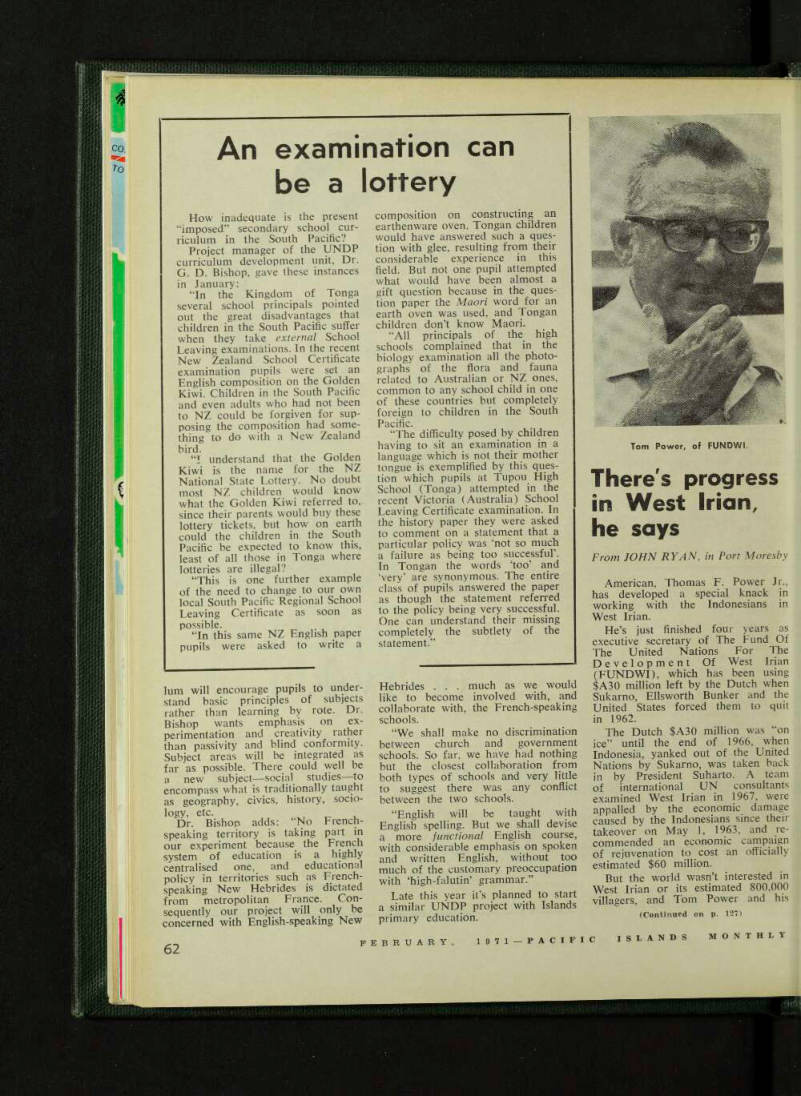
Tom Power, of FUNDWI.
UN superiors had to make do with the Dutch SA3O million. For Power, who got into post-war planning with the US State Department in 1941, West Irian’s heart-breaking attempts to get back onto its puny economic feet, has been his largest single responsibility.
Power makes no claims about the overall success of the UN plan of rehabilitation for West Irian, but un mistakable touches of pride do come through.
And so do touches of the dedicated ‘steel” in his manner . . . and this is what made his association with ;he Indonesians so successful. Power s a no-nonsense Boston American -vho made it clear way back in 1967 hat no matter how the Indonesians ; elt about the vanquished Dutch, the Dutch SA3O million was going to be xsed for development—not for quiet mndouts to Djakarta and Djajapura West Irian) government agencies or :ivil servants.
This established, Power and his taff got on with the job.
It was a tough one. Between May, 963. and July, 1967, when the UN onsultants arrived, much of the )utch equipment in West Irian had >een allowed to run down, or had ieen shipped out to nearby Indo icsian provinces.
The entire framework of West dan’s administration, transport, com aunications, cash-cropping, and law nd order was on the edge of col apse.
Worst was the marine fleet. Of the 6 ships working when the Dutch ulled out, only 40 were still in the fater. Because the ships were not working, the crops weren’t getting ut and food and other essential sup lies weren’t getting in. Because the lips were not carrying maintenance quipment and fuel to the major utlying towns and airstrips, the viation industry was also nearly at standstill.
Diesel power stations, water sup lies, timber, mills, fishing, fleets,
>wn bus services—anything requir
ig regular greasing and oil, was i a very sorry state. FUNDWI also ad to try, within the limits of iplomacy and being a “guest” in test Irian, to build up an infra ructure of transport and industry lat would continue despite lack of tention from the sometimes care ss Indonesian civil service. Or more irticularly, from West Irian village iople who often had neither the
aining nor the incentive to maintain lem.
Now, four years later, Tom Power nd FUNDWI have earmarked all of le original Dutch $3O million for svelopment programmes to 1972.
Only one other nation—Canada ith $A 176,000 —has agreed to con ibute towards West Irian’s rehabili ition. Canada gave its money for /iation spares, and for aviation Ilowships to help teach Indo jsians how to maintain Twin Otter rcraft made in Canada, and flying )w in West Irian.
Recently, Holland and Australia sgan negotiating to try to channel ore money to West Irian through e new Asian Development Bank, here may be (according to Power) chnical problems with the bank, it Holland has pledged $5 million r West Irian, and Australia has edged $2 million from a $lO mii >n contribution to the bank.
Australia has an obvious diplo atic interest in the economic well ing of West Irian: the Indonesian ovince shares an unmarked 455ile mountain and swamp border th Australian-administered Papua- Guinea, and since 1963, more an 3,000 refugees (political and onomic) from the West Irian lages have sneaked across the rder to Australian territory.
About 400 have been granted per issive residence (political asylum) t Australia wants to help reduce ; flow across the border, so that ationships between Canberra and akarta will not suffer. An economic y affluent West Irian is one way keeping the West Irianese at me.
In the interests of international rmony on the New Guinea Island 63,000 square miles, estimated al population 3 million) the Aus lians want to try, within reason, avoid a severe economic imbalance tween the Indonesian and Aus lian halves. It’s a superhuman ), because the total budget for ; 2,200,000 village people in Aus
tralian territory this year (fiscal 1970/71) is a record $241 million, while in West Irian it’s considerably less for an estimated 800,000 vil lagers.
Here’s what FUNDWI, with some help from Djakarta, has achieved so far:— • Marine fleet: 38 ships working now, but FUNDWI spare parts have just arrived for more than 30 others, and Indonesia has signed a contract with Dutchman, J. van den Bos at Sorong shipyard, for the rehabilita tion of many ships there. Eight small coastal ships also built in New Zea land for West Irian. • Aviation: Nine Indonesian planes now flying, and ground-to-aii civil aviation radio network being improved. Three major new airstrips being built at Wamena and Waghete (Highlands) and at Nabire on the Tjenderawasih coast, capable oj taking Indonesian Air Force Hercules transport planes to supply feeder services to many of the 27 smaller main airstrips. • Power stations: Nearly a dozer diesel power stations being rehabili tated, including the big generator ai Djajapura; water supplies in severa towns also being upgraded, and on( new supply being installed. • Public transport: New Daf buse: (from Holland) have just arrived a' Djajapura to replace many origina buses broken down or “cannibalised’ since 1963. New maintenance work shops equipped near Djajapura. • Health: Equipment and training for local and Indonesian staff. One of the early priorities—spraying anc prophylactics against malaria—due to begin in 1971. Large quantities o; malarial-suppressive tablets were shipped into West Irian during 197( but could not be distributed to vil lagers because of the long am severe breakdown in shipping and ai: transport. • Education: Fellowships foi higher training, including the sendini
f selected village teachers to lacquarie University, New South teles. • Fishing: A Japanese skipjack una) fleet now working strongly i north-western (Sorong) waters, id making good hauls with prices Japan nearly twice as high as ex acted. West Irian villagers also fing trained at sea. Inland fisheries e also expanding rapidly, with ousands of small fish-ponds being tablished throughout the Highlands, pecially among the estimated 60,000 dani tribespeople of the Baliem alley. • Timber: New Zealand (Wel igton) company J. C. Groome Ltd. id FUNDWI now well advanced ith the $750,000 sawm i 11 in g id export-log project between jajapura and the border with Aus ilian New Guinea. The first big ipments are now on the way to pan, and prospects are good. • Small industry: A small loans ency is being established with JNDWI and Indonesian money, look for native business prospects help recreate West Irian’s in istructure of small businesses erything from barber shops to soft ink factories.
At the bottom end of the ladder, JNDWI is also trying to achieve mething positive for the primitives: estimated 30,000 Asmat swamp /ellers of the Casuarina (south ern) coast of West Irian. The ;mats, world-famous wood-carvers, ; former cannibals and headhunters ing extraordinarily difficult lives the area in which Michael Rocke ler was lost in November, 1961.
Dutchman J. C. Hoogebrugge and JNDWI are encouraging the mats to resume carving, and more m 1,800 pieces have been shipped Rotterdam for world sale. Power /s the money will go back to the mats in two ways—first, as pay mt for work; secondly, for the ilding of medical aid clinics and • drugs in the highly malarial, ingrove Asmat country.
Is Indonesia serious about trying develop West Irian?
Power: “Yes. I think they are illy trying. They have lots of )blems in other parts of Indonesia, t in West Irian they now mean siness.” • Dillingham Corporation Ltd. has m awarded a contract valued at Dut $l3 million for road projects the South Wahgi and Southern ghlands highways in Papua-New linea. The sections—from Kundi a to Minj, Kudjip to Mt. Hagen, . Hagen to Togoba and Kaupena Asaisa.