Footnotes
pp. 46-47 · Read in the full issue
one has asked me for a New Year message.
This, of course, is not surprising; I can’t think of any good reason why anyone should.
However, I propose, belatedly and unasked, to offer one. It is this: Beware of slogans.
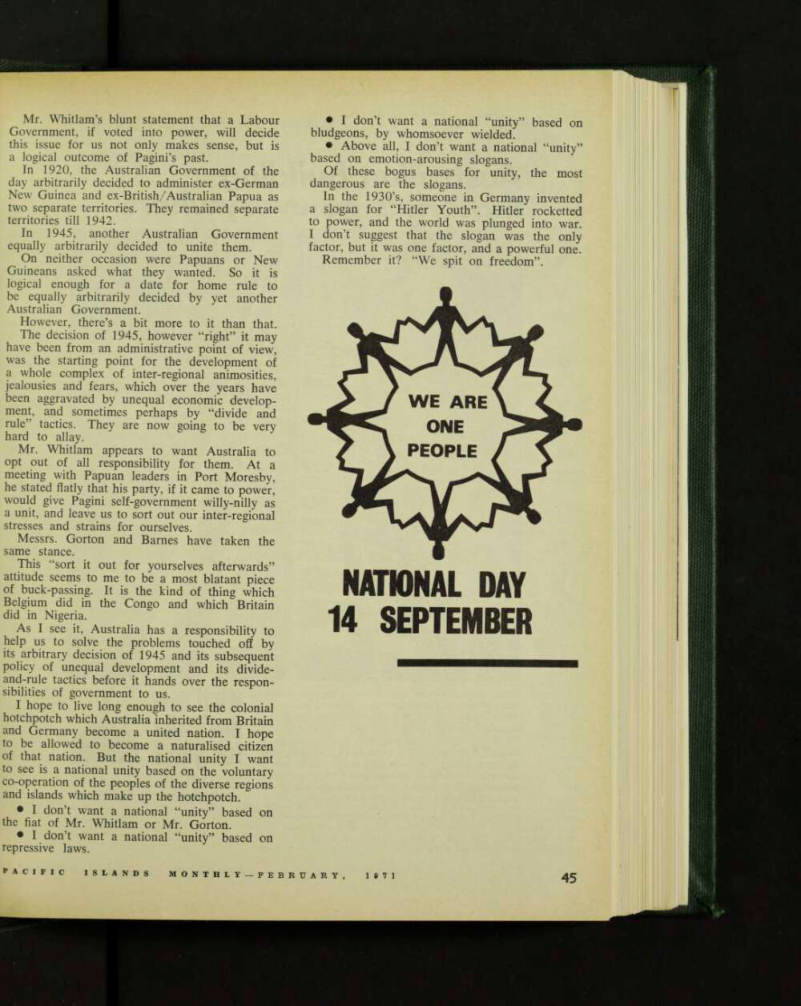
Last year, when our September public holiday was transmuted from “Commemoration Day” into “National Day”, we were presented with a slogan to go with it “We Are One People”.
This noble sentiment was exhibited on posters, in English, Motu and Pidgin, within a circle of figures holding hands.
It seems to have met with general approval, though one observant high school lassie noticed that all the figures were male, and proceeded to ink in skirts on alternate hand-holders. And our local cartoonist, J. K. McCarthy, took a swipe at it by reminding us of its resemblance to the “Ein Volk” of Adolf Hitler’s time.
“We Are One People”. An
obvious untruth. We are an
agglomeration of tribes brought
arbitrarily together under a single administration by a colonial power, which is currently exhorting us to become one nation.
“We Are One Nation” would have been a not unreasonable slogan, if we must have a slogan, because although not true at the moment indeed, inter-regional, inter-tribal and even intra-tribal
bickering seems to have reached an all-time high—it could, given lashings of faith, hope and charity, become true in the foreseeable future.
“We Are One People” could not. It could only be made to become true by mounting a massive campaign to encourage inter-tribal marital unions, and it would take about a thousand years to achieve. There are, of course, ways in which this period could be shortened.
For instance, bonuses could be offered for babies born from inter-tribal unions.
But this would probably upset the proponents of family planning, so it might be necessary to approach the problem from the opposite direction and institute fines for parents producing mono
tribal offspring.
More drastically still, mono-tribal unions could
They Cant
Impose Unity On
New Guinea
be prohibited by law; this would at least be in line with the current trend towards repressive legislation. But even with such extreme measures as this, progress would be very slow.
On January 6, the day on which the Christian Church recalls the visit of the wise men to Bethlehem, the wise men of the Australian Labour Party visited Mount Hagen, birthplace of the “go-slow” Compass Party, and Mr. Whitlam was told in no uncertain terms that the people of the Western Highlands don’t
want to be rushed into home rule.
The same news bulletin which reported this confrontation also reported that on Manus Island our Select Committee on Con stitutional Development had been told equally forthrightly that on that island they wanted home rule next year. The men of Manus rubbed the message in by accusing European members of the House of Assembly of advocating a “go-slow” policy for their own advantage.
These irreconcilable contradictions have met both Mr. Whitlam’s Labour Party delegation and Mr. Paulus Arek’s select committee wherever they have gone.
In the face of a situation like this, Messrs.
Gorton and Barnes’ dictum that the people of Pagini can have self-government when the majority of them want it evades the issue.
Mr. Barnes still appears to take it for granted that a territory-wide referendum would produce a majority vote against early home rule. A year ago I would have agreed with him; now I wouldn’t like to bet on it. But, whichever way it went, a referendum would only point up and accentuate the deep cleavages between region and region, and even within regions, on this issue.
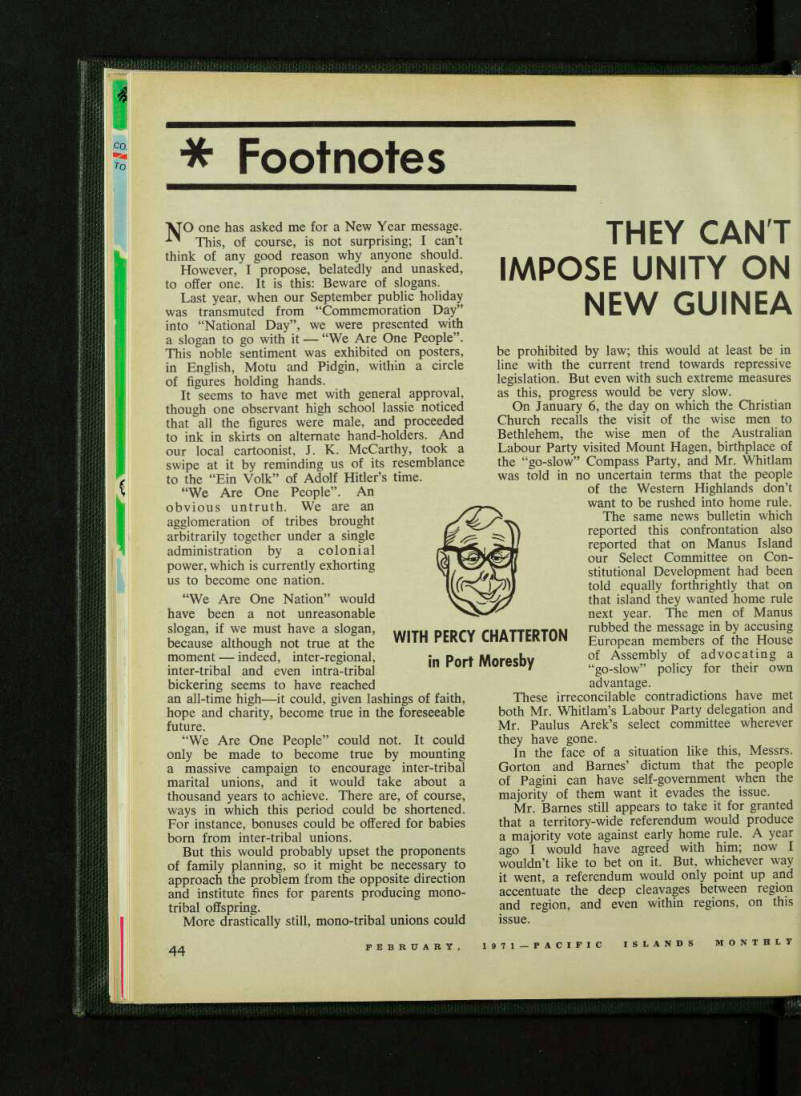
With Percy Chatterton
in Port Moresby
Mr. Whitlam’s blunt statement that a Labour Government, if voted into power, will decide this issue for us not only makes sense, but is a logical outcome of Pagini’s past.
In 1920, the Australian Government of the day arbitrarily decided to administer ex-German New Guinea and ex-British/Australian Papua as two separate territories. They remained separate territories till 1942.
In 1945, another Australian Government equally arbitrarily decided to unite them.
On neither occasion were Papuans or New Guineans asked what they wanted. So it is logical enough for a date for home rule to be equally arbitrarily decided by yet another Australian Government.
However, there’s a bit more to it than that.
The decision of 1945, however “right” it may have been from an administrative point of view, was the starting point for the development of a whole complex of inter-regional animosities, jealousies and fears, which over the years have been aggravated by unequal economic develop ment, and sometimes perhaps by “divide and rule” tactics. They are now going to be very hard to allay.
Mr. Whitlam appears to want Australia to opt out of all responsibility for them. At a meeting with Papuan leaders in Port Moresby, he stated flatly that his party, if it came to power, would give Pagini self-government willy-nilly as a unit, and leave us to sort out our inter-regional stresses and strains for ourselves.
Messrs. Gorton and Barnes have taken the same stance.
This “sort it out for yourselves afterwards” attitude seems to me to be a most blatant piece of buck-passing. It is the kind of thing which Belgium did in the Congo and which Britain did in Nigeria.
As I see it, Australia has a responsibility to help us to solve the problems touched off by its arbitrary decision of 1945 and its subsequent policy of unequal development and its divide and-rule tactics before it hands over the respon sibilities of government to us.
I hope to live long enough to see the colonial hotchpotch which Australia inherited from Britain and Germany become a united nation. I hope to be allowed to become a naturalised citizen of that nation. But the national unity I want to see is a national unity based on the voluntary co-operation of the peoples of the diverse regions and islands which make up the hotchpotch. • I don’t want a national “unity” based on the fiat of Mr. Whitlam or Mr. Gorton. • I don’t want a national “unity” based on repressive laws.
• I don’t want a national “unity” based on bludgeons, by whomsoever wielded. • Above all, I don’t want a national “unity” based on emotion-arousing slogans.
Of these bogus bases for unity, the most dangerous are the slogans.
In the 1930’5, someone in Germany invented a slogan for “Hitler Youth”. Hitler rocketted to power, and the world was plunged into war.
I don’t suggest that the slogan was the only factor, but it was one factor, and a powerful one.
Remember it? “We spit on freedom”.