Tropicalities
pp. 42-45 · Read in the full issue
Britain’s top BBC Current Affairs reporter Kenneth Allsop and his film team now touring the Pacific, have been refused entry to Nauru. Allsop told our man in Port Moresby, John Ryan, he was astounded.
Bbc Not
Welcome
In Nauru
“We’d heard rumours before reaching Papua-New Guinea that the Australians might be a bit nervous about a news-in-depth BBC team filming and recording P-NG people, and we thought that if we were to have trouble with anybody, it would be the Australians,” he said.
“But in P-NG we’ve had the very best of co-operation—and now the Nauruans, with probably a great deal less to be nervous about, are carry ing on like they’ve got a State Secret.”
BBC team leader Anthony Sum mers said Nauru’s offices in London and Australia had given every assistance in the early arrangements for the Nauru visit in January. “But then we got an urgent cable from President Hammer Deßoburt that it would be ‘inconvenient and embar rassing’ for us to visit him . . . there was some mention of no accommoda tion. but it all sounds ridiculous.”
Allsop and Summers cabled furthei entreaties to President Deßoburt from P-NG, and Vice-Chancellor of the P-NG University Dr. John Gunther (an old friend of President Hammer Deßoburt) telephoned Nauru to try to help the BBC team.
Dr. Gunther: “Hammer and his Chief Secretary —an Englishman kept on telling me on the telephone that it would not be convenient for a BBC visit. I don’t know what’s going on. I don’t think even the Queen of England will get the BBC into Nauru!”
As a last resort, Summers fired off to Nauru on January 13 a SA3O cable explaining carefully to the President, that the BBC was interest ed in the celebrations marking the third anniversary of Nauru’s indepen dence, and was interested in the im minent general election —but was also interested in the ordinary life of the 6,000 people on Nauru and the unique island itself. Hoping for an answer, the BBC team then flew on to Honiara, Santo, Vila, on the way to a film interview with King Taufa’ahau of Tonga.
The Allsop-Summers team is spend ding thousands of pounds sterling on the Pacific tour for film for
Britain’s top-ranking nightly half hour show called “24 Hours”.
There is in fact no hotel accom modation on Nauru, and visitors must stay privately. But it is most un likely that lack of accommodation is the reason for the refusal to allow the team entry, because the Nauruans are extremely hospitable people and accommodation would be found if the government was anxious to have the BBC team come.
President Deßoburt and his Ministers are sensitive to outside criticism of Nauru. They were very critical of an article on Nauru pub lished last year by the Reader’s Digest, written by a freelance. Free lance journalists will find it difficult, probably impossible, to get an entry permit for Nauru these days.
The attitude to the BBC team is probably also due simply to official apprehension that Nauru may be dealt with unkindly by the media, and since Nauru is not at present in the market for tourists, the government probably considers it has nothing to lose by keeping up the barriers.
Honour when
it's (over) due
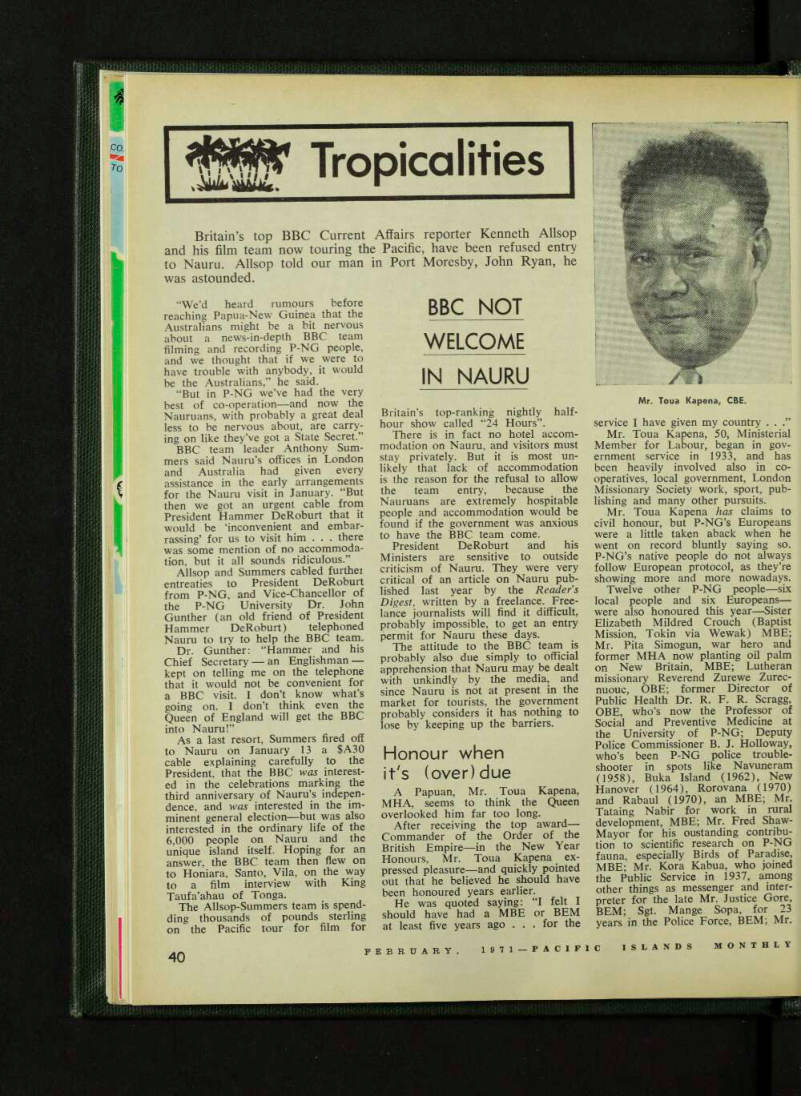
A Papuan, Mr. Toua Kapena, MHA, seems to think the Queen overlooked him far too long.
After receiving the top award— Commander of the Order of the British Empire—in the New Year Honours, Mr. Toua Kapena ex pressed pleasure—and quickly pointed out that he believed he should have been honoured years earlier.
He was quoted saying: “I felt I should have had a MBE or BEM at least five years ago . . . for the
service I have given my country . . .”
Mr. Toua Kapena, 50, Ministerial Member for Labour, began in gov ernment service in 1933, and has been heavily involved also in co operatives, local government, London Missionary Society work, sport, pub lishing and many other pursuits.
Mr. Toua Kapena has claims to civil honour, but P-NG’s Europeans were a little taken aback when he went on record bluntly saying so.
P-NG’s native people do not always follow European protocol, as they’re showing more and more nowadays.
Twelve other P-NG people—six local people and six Europeans— were also honoured this year—Sister Elizabeth Mildred Crouch (Baptist Mission, Tokin via Wewak) MBE; Mr. Pita Simogun, war hero and former MHA now planting oil palm on New Britain, MBE; Lutheran missionary Reverend Zurewe Zurec nuouc, OBE; former Director of Public Health Dr. R. F. R. Scragg, OBE, who’s now the Professor of Social and Preventive Medicine at the University of P-NG; Deputy Police Commissioner B. J. Holloway, who’s been P-NG police trouble shooter in spots like Navuneram (1958), Buka Island (1962), New Hanover (1964), Rorovana (1970) and Rabaul (1970), an MBE; Mr.
Tataing Nabir for work in rural development, MBE; Mr. Fred Shaw- Mayor for his outstanding contribu tion to scientific research on P-NG fauna, especially Birds of Paradise, MBE; Mr. Kora Kabua, who joined the Public Service in 1937, among other things as messenger and inter preter for the late Mr. Justice Gore, BEM; Sgt. Mange Sopa, for 23 years in the Police Force, BEM; Mr.
Mr. Toua Kapena, CBE.
Pukari Lokoko, for services to health, BEM; Archdeacon By am William Roberts for outstanding services to education, OBE; Mr. Frederick Townsend of the Department of Civil Aviation, Queen’s Fire Service Medal.
Once again, the notable absentee was Speaker of Parliament Mr. John Guise, MHA, who let it be known a couple of years ago that he was not much interested in the London awards. On record, Mr. Guise has outstanding claims to a civil award, although in 1970 he was given an honorary doctorate by the University of Papua and New Guinea. Some newspapers give him the “Dr.” prefix, others don’t. The Speaker himself is not fussy one way or another.
Vila's urban blight
Urban blight in Vila, capital of the New Hebrides? A call is going out to oppose the setting up of more ugly hoardings on bush roads around the town.
Writes Tessa Fowler: “Vila is a much more enjoyable town in which to live because visitors are interesting for residents who are tired of the same old faces. Yet tourism is start ing to spoil the country.
“Surely there should be legislation against hoardings, before the roads around Vila are made impossibly ugly?”
More on making
your own money
F/M’s long report about how the Solomon Islanders make their own money (Nov., p. 61) has prompted old Solomon’s hand R. A. Lever, of Surrey, England, to give us some additional information about the making of hard cash in the Islands.
P/M’s article by R. W. Taylor talked about white shell money produced by the people of Langa Langa Lagoon, Malaita, from a species of cockle. Mr. Lever adds some facts about the better known and more valuable red money, worth about four times that of the baser white variety.
It’s prepared from a kind of oyster.
Mr. Lever continues: One reason for its greater value is that the thorny oyster lives in fairly deep water attached to stones, thus requiring expenditure of some diving effort to collect and bring it to the surface. This particular mollusc, known to the natives as romo, is called Spondylus varius by scientists and has a wide distribution in Mela nesia.
A specimen length of shell money lying before me as I write has 16 discs to the linear inch, and what an
incredible amount of work must have been expended to cut, polish, pierce, smooth the rims and thread them on fibre cords! The material used for the tip of the drill is chert.
Besides the red and white shells there is a third species, a greyish mussel; the discs from this, called marawai, usually being used at the end of the fathom lengths, 10 of which are frequently fastened together.
It used to be the custom for older strings to be sent back to the “mint” where they were made so as to be refurbished. This comprised cleaning, repolishing and restringing for which labour two old strings* handed in meant one reconditioned string coming back.
Although most accounts of shell money in the Solomon Islands deal with Malaita, this industry used also to be carried out from Ysabel in the centre of the group, to Gaudalcanal, Nggela, Ulawa and San Cristobal in the east. No records from the western islands have been seen but the money was bartered as far afield as Bougainville and, I believe into New Guinea, though this has now ceased. It is certainly most interesting that, within the limits of the protectorate, currencies of shell money, porpoise teeth and, in Santa Cruz, feather money were all prepared.
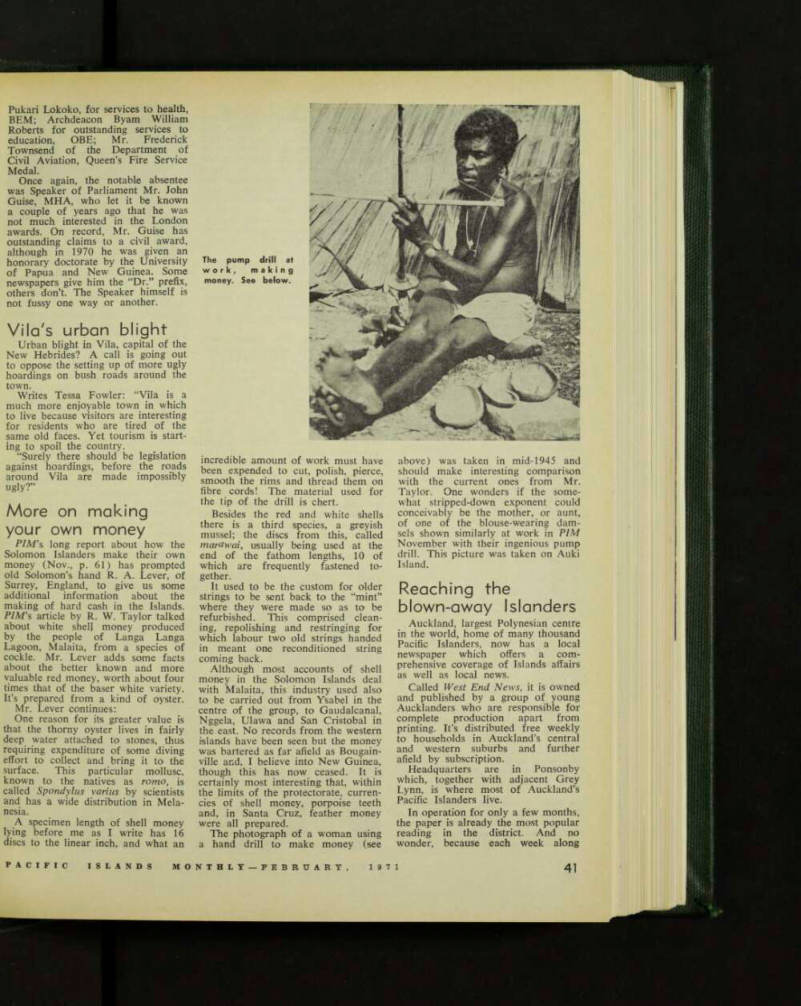
The photograph of a woman using a hand drill to make money (see
above) was taken in mid-1945 and should make interesting comparison with the current ones from Mr.
Taylor. One wonders if the some what stripped-down exponent could conceivably be the mother, or aunt, of one of the blouse-wearing dam sels shown similarly at work in PIM November with their ingenious pump drill. This picture was taken on Auki Island,
Rpnrhinn thp
, 11 , , ,
DlOWn-aWaV Islanders
. , , ,„ i . l ucklan , d ; largest Polynesian centre “*• T now h“ s ato Pacitlc Islanders now has a local newspaper which offers a com- Prehens.ve coverage of Islands affairs as weM as local news - . .
Called West End News, it is owned and published by a group of young Aucklanders who are responsible for complete production apart from printing. It’s distributed free weekly to households in Auckland s central ar, d western suburbs and further afield by subscription, Headquarters are in Ponsonby which, together with adjacent Grey Lynn, is where most of Auckland s Pacific Islanders live, In operation for only a few months, the paper is already the most popular reading in the district. And no wonder, because each week along
The pump drill at work, making money. See below.
with articles of local and national interest in English it publishes half of a page in Maori, Rarotongan and Samoan, summarising Auckland and Island news. Translation is done by Polynesians living in Auckland. Many of them contribute stories of their own.
West End News has vociferously supported the new Ponsonby Com munity Centre with its Citizens’
Advisory Bureau whose main role is to help new New Zealanders, especially from the Pacific Islands, to adjust to their new homeland.
Mr. Michael Hart, president of the Community Association, founded the paper.
It has also supported the local Boystown Police and Citizens’ Club’s efforts to encourage more Pacific Islands youngsters to use its recreational and civic training facilities.
Another organisation well covered by the News is the Samoan Progres sive Movement whose president, Manitete Fonoti, is a regular visitor to the paper’s office. It has given much editorial space to the move ment’s appeal for $500,000 to build a multi-storey Samoa House in the central city, including an article in Samoan written by vice-president, Charlie Tuai.
Says editor John Harris: “What we are trying to do is both help Pacific Islanders settle into Auckland life by telling them about the place in their own languages, and also to let them know what is going on back home. And of course there’s plenty for non-Pacific Islanders too. We have found that most Aucklanders are interested in the Islands to some extent.”
Mr. Harris hopes to travel around the Islands soon to familiarise him self with present conditions.
Another interesting aspect of West End News is the advertisements in the Islands languages. Arranged by advertising manager Mel Schwass, they have reportedly had a great impact on Island readers.
He's a Papuan chief
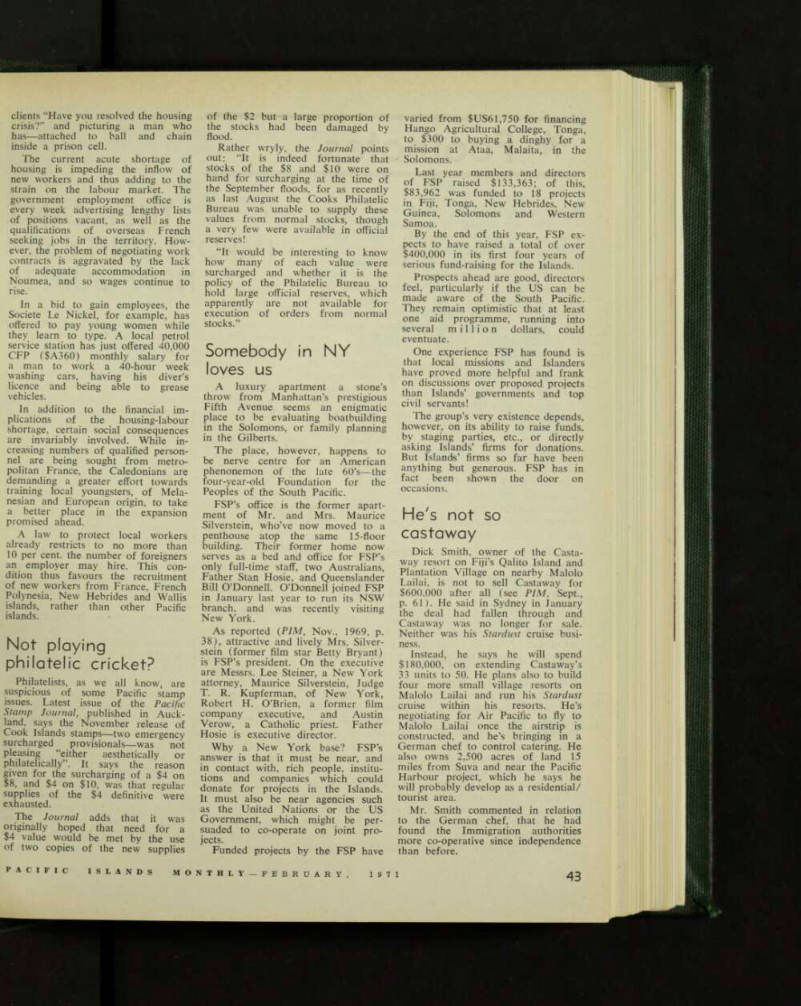
An Australian priest has been awarded a rare honour by the Orokaiva people of Agenehambo in Papua’s Northern District. Arch deacon Martin Chittleborough of the Anglican Mission at Agenehambo, has been given an otohu, symbol of a chief. He is thought to be only the third white man to be honoured in
this way, the others being Anglican Bishop of Papua-New Guinea, Bishop David Hand, and Prince Charles, who received his otohu when he visited the area in 1966. An otohu is made from boars’ tusks and dogs’ teeth and is worn round the neck. The people also gave him a set of church vest ments made out of tapa cloth.
Archdeacon Chittleborough. who comes from Adelaide, has lived at Agenehambo for five years. He was appointed Archdeacon of the North ern District early in 1970.
He's back to work
at sixty-nine
A priest who first set foot in Papua- New Guinea 42 years ago, has re turned to stay—after an absence of 21 years.
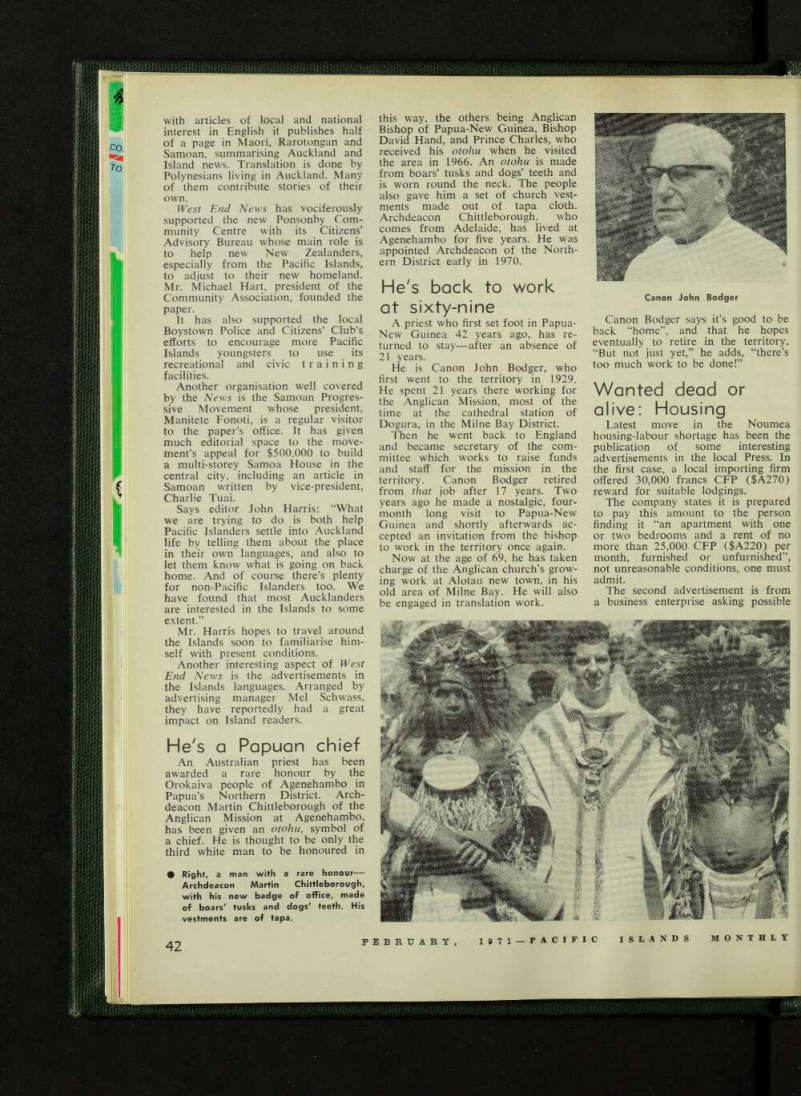
He is Canon John Bodger, who first went to the territory in 1929.
He spent 21 years there working for the Anglican Mission, most of the time at the cathedral station of Dogura, in the Milne Bay District.
Then he went back to England and became secretary of the com mittee which works to raise funds and staff for the mission in the territory. Canon Bodger retired from that job after 17 years. Two years ago he made a nostalgic, four month long visit to Papua-New Guinea and shortly afterwards ac cepted an invitation from the bishop to work in the territory once again.
Now at the age of 69, he has taken charge of the Anglican church’s grow ing work at Alotau new town, in his old area of Milne Bay. He will also be engaged in translation work.
Canon Bodger says it’s good to be back “home”, and that he hopes eventually to retire in the territory.
“But not just yet,” he adds, “there’s too much work to be done!”
Wanted dead or
alive: Housing
Latest move in the Noumea housing-labour shortage has been the publication of some interesting advertisements in the local Press. In the first case, a local importing firm offered 30,000 francs CFP (SA27O) reward for suitable lodgings.
The company states it is prepared to pay this amount to the person finding it “an apartment with one or two bedrooms and a rent of no more than 25,000 CFP (SA22O) per month, furnished or unfurnished”, not unreasonable conditions, one must admit.
The second advertisement is from a business enterprise asking possible
Right, a man with a rare honour— Archdeacon Martin Chittleborough, with his new badge of office, made of boars' tusks and dogs' teeth. His vestments are of tapa.
Canon John Bodger
clients “Have you resolved the housing crisis?” and picturing a man who has—attached to ball and chain inside a prison cell.
The current acute shortage of housing is impeding the inflow of new workers and thus adding to the strain on the labour market. The government employment office is every week advertising lengthy lists of positions vacant, as well as the qualifications of overseas French seeking jobs in the territory. How ever, the problem of negotiating work contracts is aggravated by the lack of adequate accommodation in Noumea, and so wages continue to rise.
In a bid to gain employees, the Societe Le Nickel, for example, has offered to pay young women while they learn to type. A local petrol service station has just offered 40,000 CFP (SA36O) monthly salary for a man to work a 40-hour week washing cars, having his diver’s licence and being able to grease vehicles.
In addition to the financial im plications of the housing-labour shortage, certain social consequences are invariably involved. While in creasing numbers of qualified person nel are being sought from metro politan France, the Caledonians are demanding a greater effort towards training local youngsters, of Mela nesian and European origin, to take a better place in the expansion promised ahead.
A law to protect local workers already restricts to no more than 10 per cent, the number of foreigners an employer may hire. This con dition thus favours the recruitment of new workers from France, French Polynesia, New Hebrides and Wallis islands, rather than other Pacific islands.
Not playing
philatelic cricket?
Philatelists, as we all know, are suspicious of some Pacific stamp issues. Latest issue of the Pacific Stamp Journal, published in Auck land, says the November release of Cook Islands stamps—two emergency surcharged provisionals—was not pleasing “either aesthetically or philatelically”. It says the reason given for the surcharging of a $4 on $B, and $4 on $lO, was that regular supplies of the $4 definitive were exhausted.
The Journal adds that it was originally hoped that need for a $4 value would be met by the use of two copies of the new supplies
of the $2 but a large proportion of the stocks had been damaged by flood.
Rather wryly, the Journal points out: “It is indeed fortunate that stocks of the $8 and $lO were on hand for surcharging at the time of the September floods, for as recently as last August the Cooks Philatelic Bureau was unable to supply these values from normal stocks, though a very few were available in official reserves!
“It would be interesting to know how many of each value were surcharged and whether it is the policy of the Philatelic Bureau to hold large official reserves, which apparently are not available for execution of orders from normal stocks,”
Somebody in NY
loves us
A luxury apartment a stone’s throw from Manhattan’s prestigious Fifth Avenue seems an enigmatic place to be evaluating boatbuilding in the Solomons, or family planning in the Gilberts.
The place, however, happens to be nerve centre for an American phenonemon of the late 60’s—the four-year-old Foundation for the Peoples of the South Pacific.
FSP’s office is the former apart ment of Mr. and Mrs. Maurice Silverstein, who’ve now moved to a penthouse atop the same 15-floor building. Their former home now serves as a bed and office for FSP’s only full-time staff, two Australians, Father Stan Hosie, and Queenslander Bill O’Donnell. O’Donnell joined FSP in January last year to run its NSW branch, and was recently visiting New York.
As reported {PIM, Nov., 1969, p. 38), attractive and lively Mrs. Silver stein (former film star Betty Bryant) is FSP’s president. On the executive are Messrs. Lee Steiner, a New York attorney, Maurice Silverstein, Judge T. R. Kupferman, of New York, Robert H. O’Brien, a former film company executive, and Austin Verow, a Catholic priest. Father Hosie is executive director.
Why a New York base? FSP’s answer is that it must be near, and in contact with, rich people, institu tions and companies which could donate for projects in the Islands.
It must also be near agencies such as the United Nations or the US Government, which might be per suaded to co-operate on joint pro jects.
Funded projects by the FSP have
varied from $U561,750 for financing Hango Agricultural College, Tonga, to $3OO to buying a dinghy for a mission at Ataa, Malaita, in the Solomons.
Last year members and directors of FSP raised $133,363; of this, $83,962 was funded to 18 projects in Fiji, Tonga, New Hebrides, New Guinea, Solomons and Western Samoa.
By the end of this year, FSP ex pects to have raised a total of over $400,000 in its first four years of serious fund-raising for the Islands.
Prospects ahead are good, directors feel, particularly if the US can be made aware of the South Pacific.
They remain optimistic that at least one aid programme, running into several million dollars, could eventuate.
One experience FSP has found is that local missions and Islanders have proved more helpful and frank on discussions over proposed projects than Islands’ governments and top civil servants!
The group’s very existence depends, however, on its ability to raise funds, by staging parties, etc., or directly asking Islands’ firms for donations.
But Islands’ firms so far have been anything but generous. FSP has in fact been shown the door on occasions.
He's not so
castaway
Dick Smith, owner of the Casta way resort on Fiji’s Qalito Island and Plantation Village on nearby Malolo Lailai, is not to sell Castaway for $600,000 after all (see PIM, Sept., p. 61). He said in Sydney in January the deal had fallen through and Castaway was no longer for sale.
Neither was his Stardust cruise busi ness.
Instead, he says he will spend $lBO,OOO, on extending Castaway’s 33 units to 50. He plans also to build four more small village resorts on Malolo Lailai and run his Stardust cruise within his resorts. He’s negotiating for Air Pacific to fly to Malolo Lailai once the airstrip is constructed, and he’s bringing in a German chef to control catering. He also owns 2,500 acres of land 15 miles from Suva and near the Pacific Harbour project, which he says he will probably develop as a residential/ tourist area.
Mr, Smith commented in relation to the German chef, that he had found the Immigration authorities more co-operative since independence than before.