Tropicalities
pp. 32-33 · Read in the full issue
South Seas
History By
The Mile
An old friend of PIM, Dr. John Cumpston, returned to his home in Canberra in late December after spending six months in the United States literally producing South Seas history by the mile.
John is a one-time Australian consul in New Caledonia, and, more recently, historian in Australia's Department of External Affairs (now Foreign Affairs).
His latest job has been to seek out and microfilm documents relating to Australia, New Zealand and the Pacific Islands in the libraries and museums of such famous old New England seaports as Salem, Nantucket and New Bedford. In particular, he has been looking for the logbooks and other papers of American whalers, sealers, sandalwooders and traders who were in Australian, New Zea land and Pacific waters in the first three-quarters of last century.
John’s project was organised by the Pacific Manuscripts Bureau at the Australian National University and was supported financially by 10 libraries in Australia, one in New Zealand and one in Hawaii.
Copies of every microfilm that he produced will be deposited in each of the sponsoring libraries.
The way John tells it, there ought to be enough material to keep an army of scholars busy for the next couple of decades —“about a third of a million logbook pages, plus some other material.”
“Some of the material,” he says, “will not be relevant, but there is some very interesting stuff amongs, it.”
Among the choicest of the early items is the journal of the Britannia, kept by Robert Murray, which con tains many interesting notes, remarks and sketches on a voyage from Eng land to New South Wales, New Zealand and India in 1792-96, during which the Loyalty Islands of New Caledonia were discovered. However, the journal does not solve one of the minor mysteries of Pacific history: why the Loyalty Islands were so named.
Another interesting old journal is that of the ship Herald which visited Tanna, New Hebrides, on a voyage from Rotterdam to China and return 1804-5. As far as is known, this was the first visit to Tanna by a European ship after Captain Cook was there in HMS Resolution in 1774.
In the journal of the Indus for 1815-17, kept by one Charles Forbes, there are some interesting details about the long-forgotten sandalwood trade in the Marquesas Islands, which no one has ever written up.
And so on.
All of this New England material is being indexed in detail by the Pacific Manuscripts Bureau so that people wishing to use the microfilms will not have to wade through about five miles of the stuff, which is what “about a third of a million logbook pages, plus some other material” re presents.
H.E.M. knocks off
to carry bricks
And while we’re on the subject of Pacific history, we record the retire ment from the Australian National University of one of the most enthusiastic devotees of that subject, Mr. H. E. (Harry) Maude.
Mr. Maude, who is 64, has been trapped up” in the Pacific for the past 40 years. He became a member of the ANU’s Department of Pacific History in 1957 after 28 years as a Pacific administrator.
His Pacific career began as a cadet administrative officer in the Gilbert and Ellice Islands in 1929.
In the following year he nearly became one of the first correspondents for PIM, then a newly-established journal. However, being a public servant, he had to submit his news items for vetting to the Resident Commissioner, Mr. Arthur Grimble, and Grimble was such a tough censor that, by the time he had finished with them, there was nothing left but some remarks about the weather.
Thus foiled as a journalist, Mr.
Maude went on to become the GEIC’s Native Lands Commissioner and
officer in charge of the Phoenix Islands Settlement Scheme (which„ soon got renamed as a “Plan” aft| its abbreviation began showing in correspondence).
Later, he did a spell at Pitcairn Island reorganising the constitution and setting up the post office. Then he became British Consul and Agent in Tonga, First Assistant Secretary of the Western Pacific High Commission, and finally Resident Commissioner in the GEIC.
His next post was with the South Pacific Commission, where he served for nine years as Deputy Secretary- General and Executive Officer for Social Development.
On joining the ANU, Mr. Maude began producing what turned out to be a long stream of papers on a wide variety of Pacific history topics. Some of these were collected in a book, Of Islands and Men, published in 1968.
In addition, Mr. Maude worked hard for the establishment of the Journal of Pacific History (now five years old), the Pacific Manuscripts Bureau (nearly three years old) and the Pacific History Series published by the ANU Press. He also en couraged others to produce biblio graphies on the Pacific Islands, he wrote introductions for other people’s Pacific history books, supervised the work of quite a number of Ph.D students in Pacific history, and willingly sat on any committee that had anything to do with the same subject.
In this spare time, he diligently scoured second-hand booksellers' catalogues for Pacific books to add to his library, which must undoubt edly be the finest private library of its kind.
After all this, we need scarcely say that H.E.M. intends to devote his retirement to his favourite subject: Pacific history.
Noumea echoes
fire tragedy
The horrifying dance hall fire near Grenoble in France, resulting in 145 young people being burnt to death recently, has provoked a close look at public halls in Noumea.
Following inspections by the Administration in November, three night clubs were temporarily closed for renovation. One old cinema was also closed and several establish ments allowed a fixed period to rec tify security installations.
The closing of the three night clubs provoked prompt reactions from two proprietors, who did not
hesitate to pronounce their grievances the local Press. fcThe proprietor of the night club •TLa Grange” protested against a newspaper account of her establish ment which, she claimed, seemed to suggest that “dancers and drinkers are accommodated right in the kitchen . . . thus running the risk of sitting on a bottle of explosive Portagas and being roasted”.
The manager of another establish ment protested against the sudden closing of his cabaret when, he declared, “in the six years that I have been working at the Tahiti Cabaret the Administration has never shown any concern over the risk of a fire. Moreover, many employees and persons in charge of the same Administration have not hesitated to joyfully risk suffocation in my night club”.
The nightclub closings did bring some peaceful nights to Noumea beachside residents. For the tourists, however, it was unhappily quiet, and some locals, in view of the lack of facilities, were obliged to sail out into the harbour to entertain visiting seamen aboard their own ships.
Nauru-Australia
Association?
Mr. John Pilbeam, new Govern ment Representative in Australia and New Zealand for the Republic of Nauru, is giving priority to the formation of an Australia-Nauru As sociation.
Hopefully, a meeting will be held on January 31 (the third anniversary of Nauru’s independence), at which a steering committee will launch the association. A general meeting will be held sometime later.
The idea is President Hammer Deßoburt’s, who feels that com munion between Australia and Nauru will be improved by such an associa tion where people can meet on a social and cultural level.
Mr. Pilbeam (see background, p. 82) said in Melbourne in December that quite a number of Nauruans were living in Australia, including young Nauruans at schools, cadetships and training courses.
And many Australians, directly or indirectly, are associated with Nauru.
Mr. Pilbeam, a pleasant personality, who is making his first visit to Nauru in January, said that although Nauru was one of the smallest independent countries in the world, it was able to take the initiative to provide transportation services of great value to other South Pacific territories Jacking Nauru’s resources.
He made it a
job to be proud of
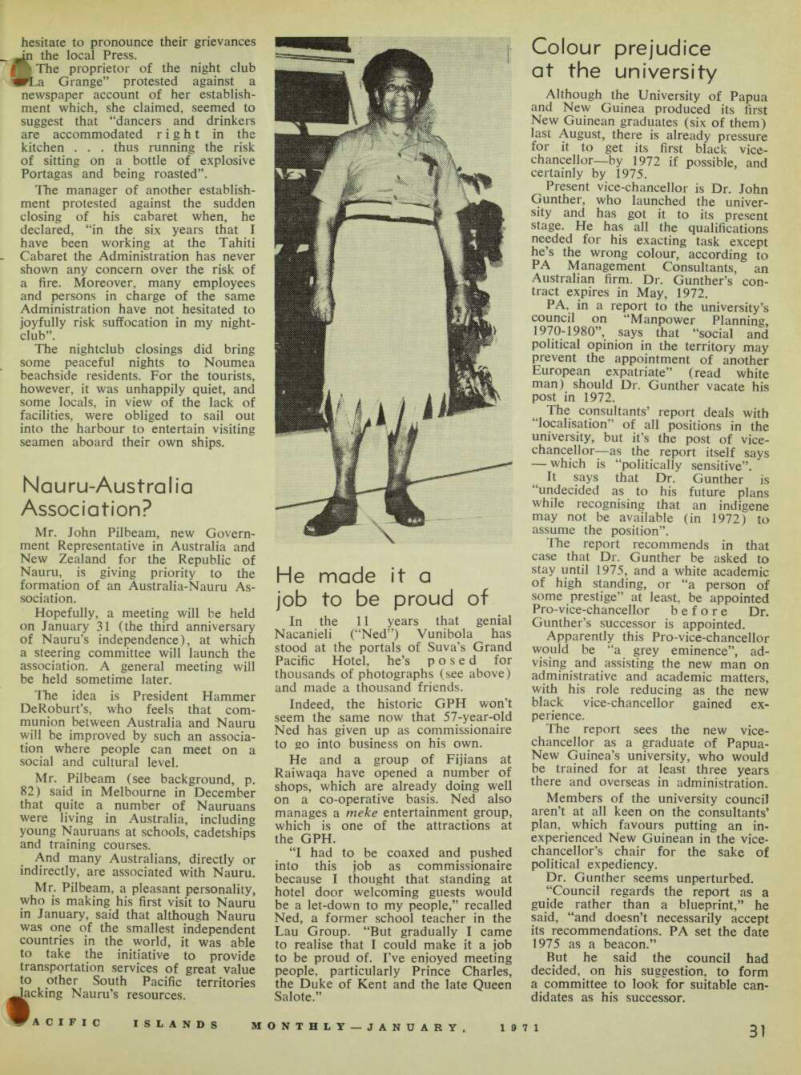
In the 11 years that genial Nacanieli (“Ned”) Vunibola has stood at the portals of Suva’s Grand Pacific Hotel, he’s posed for thousands of photographs (see above) and made a thousand friends.
Indeed, the historic GPH won’t seem the same now that 57-year-old Ned has given up as commissionaire to go into business on his own.
He and a group of Fijians at Raiwaqa have opened a number of shops, which are already doing well on a co-operative basis. Ned also manages a meke entertainment group, which is one of the attractions at the GPH.
“I had to be coaxed and pushed into this job as commissionaire because I thought that standing at hotel door welcoming guests would be a let-down to my people,” recalled Ned, a former school teacher in the Lau Group. “But gradually I came to realise that I could make it a job to be proud of. I’ve enjoyed meeting people, particularly Prince Charles, the Duke of Kent and the late Queen Salote.”
Colour prejudice
at the university
Although the University of Papua and New Guinea produced its first New Guinean graduates (six of them) last August, there is already pressure for it to get its first black vice chancellor—by 1972 if possible, and certainly by 1975.
Present vice-chancellor is Dr. John Gunther, who launched the univer sity and has got it to its present stage. He has all the qualifications needed for his exacting task except he’s the wrong colour, according to PA Management Consultants, an Australian firm. Dr. Gunther’s con tract expires in May, 1972.
PA, in a report to the university’s council on “Manpower Planning, 1970-1980”, says that “social and political opinion in the territory may prevent the appointment of another European expatriate” (read white man) should Dr. Gunther vacate his post in 1972.
The consultants’ report deals with “localisation” of all positions in the university, but it’s the post of vice chancellor—as the report itself says which is “politically sensitive”.
It says that Dr. Gunther is “undecided as to his future plans while recognising that an indigene may not be available (in 1972) to assume the position”.
The report recommends in that case that Dr. Gunther be asked to stay until 1975, and a white academic of high standing, or “a person of some prestige” at least, be appointed Pro-vice-chancellor before Dr.
Gunther’s successor is appointed.
Apparently this Pro-vice-chancellor would be “a grey eminence”, ad vising and assisting the new man on administrative and academic matters, with his role reducing as the new black vice-chancellor gained ex perience.
The report sees the new vice chancellor as a graduate of Papua- New Guinea’s university, who would be trained for at least three years there and overseas in administration.
Members of the university council aren’t at all keen on the consultants’ plan, which favours putting an in experienced New Guinean in the vice chancellor’s chair for the sake of political expediency.
Dr. Gunther seems unperturbed.
“Council regards the report as a guide rather than a blueprint,” he said, “and doesn’t necessarily accept its recommendations. PA set the date 1975 as a beacon.”
But he said the council had decided, on his suggestion, to form a committee to look for suitable can didates as his successor.