The High Cost Of
pp. 29-110 · Read in the full issue
Parliament faces up to . . .
Fiji Independence
From a Suva correspondent Politics—and the cost of politics—were the vital news in the Dominion of Fiji in December —little more than two months after the independence celebrations.
Enormous interest surrounded the three-way fight for the Rewa-Suva Fijian seat in the House of Repre sentatives.
It was won by the Alliance Party’s candidate Mr. Uraia Koroi, 54, who resigned from his job as Fijian pro gramme organiser of Radio Fiji to contest the election. He polled 2,197 votes —against the 1,637 pulled in by National Federation Party candidate, Ratu Mosese Varesekete Tuisawau.
The third contender, Dockworker and Seamen’s Union leader Mr.
Taniela Veitata, was standing under the National Liberal Party banner.
He polled 229 votes, losing his $lOO deposit because he got less than 10 per cent, of the total votes cast.
Interest in the results derived from the fact that Ratu Mosese, editor of the NFP newspaper Pacific Review, was the first Fijian to represent the party in such an election. Had he won, it would have been a major triumph for the opposition party. As it was, he was not disgraced.
Ratu Mosese is the older brother of the Prime Minister’s wife, Adi Lady Lala Mara, who is paramount chief of the Rewans.
His chiefly status gives him great pull in the Rewa Province, and it’s believed that most of the Rewa people were for him. His supporters included an important chief of the province, Ratu Tone Mataitini, who is now a member of the Senate, nominated by the Great Council of Chiefs.
Votes for Ratu Mosese seem to have been for the man, not the party, while it is felt that Mr. Koroi’s win stems largely from the loyalty most Fijians have for the Fijian Association and the Alliance.
The Senate
The committee appointed to decide the salaries of Fiji’s 22 senators tabled its report in December —and tax payers found that the “watchdog”
Upper House will cost them $53,000 in 1971 in pay and allowances.
The senators, who look like meeting in the mornings only during parlia
mentary sessions (the Lower House will meet in the afternoons and even ings) recommended for themselves a taxable salary of $l,OOO a year.
In addition, they recommended a non-taxable allowance of $12.50 for each day they sit in the Senate. The House of Representatives later ap proved all the recommendations.
The President, Suva solicitor Sena tor R. L. Munro, will receive $1,500 a year, plus the daily sitting allowance and a $5OO-a-year entertainment allowance.
Senators will have free telephones and a 50 per cent, refund on all private telephone calls. Telegrams sent on Senate business will be free.
Other concessions include an $ll --day accommodation allowance for senators who live more than 20 miles by road from Suva, or outside Viti Levu.
The committee suggested a super annuation scheme for senators, gen eral accident insurance cover for them and insurance cover for senators travelling by air on official business.
The report said there could be no parallel between the conditions of senators and members of the House of Representatives, since senators would retain their other jobs.
Salaries received by members of the House of Representatives are meant to encourage them to be full time politicians, it said.
The committee consisted of Senator Munro, as chairman, and Senators Volavola, Ganilau, Inia, Nasilivata and Sarvan Singh.
The Foreign Service
Fiji’s foreign service will cost about $F409,000 this year.
According to the 1971 estimates tabled in the House of Represen tatives, in December, $lOO,OOO has already been spent on setting up the service and opening diplomatic missions in London, Canberra and New York since independence (only in October).
Pay for the staff of the Department
(Continued on p. 29)
(Continued from p. 27) «f Foreign Affairs in Suva will total £9,897.
Fiji’s two high commissioners and its United Nations ambassador will get about $6,000 each in salaries.
Other costs of the missions will total $247,600.
These include $147,000 for office and house rents, $35,000 for the pay of locally-hired staff, $30,000 for communications.
Now a Defence Ministry
Does Fiji really need a Defence Minister? Speculation about the high cost of the newly-created position fol lowed the announcement in December of Ratu Penaia Ganilau’s appointment to the job.
It will command a salary of $F7,000 a year and the Secretary for Defence will receive $6,189.
The Prime Minister’s announce ment received the support of the Leader of the Opposition but Dr.
W. L. Vender, Liberal member, de clared that as Fiji was undefendable, the money should be spent elsewhere —on housing, for instance.
A Minister for Housing should be appointed to provide low-cost accom modation. Housing was a crucial national question, daily growing worse, he said.
Dr, Verrier’s proposal seems un likely to provoke any immediate reaction. (See panel opposite for an other reaction.) In the meantime Ratu Penaia, as one of Fiji’s most distinguished sol diers, seems well equipped for the role of Defence Minister.
During World War II he was a commissioned officer in the Fiji Military Forces. He was on active service for nearly three years in Malaya.
He was ultimately promoted to the rank of lieutenant-colonel, becoming commanding officer of the Ist Bat talion, Fiji Infantry Regiment, and later receiving the Distinguished Service Order.
Cold facts on economics
To coincide with the vice-regal opening of the dominion’s “new era” parliament on November 27, details of the sixth development plan were announced. Implementation of all the projects planned during the next five years will cost the govern ment and private investors a whop ping SF34 million (see p. 97).
The same day, Minister of Finance, Mr. W. M. Barrett, presented his 1971 budget speech, forecasting higher prices for certain luxury items, and warning against “rapacious entre preneurs” in the field of foreign in vestment. revealed that government ex
pected a Si million deficit during 1971, but said this was “in no way due to any extravagance on the part of government,” but had a lot to do with independence, including the “cost of overseas representation and contributions to international agencies, increased expenditure on scholar ships, an increase in the size of the defence force, increased emoluments of members of parliament.”
“It will not be necessary to incur the same order of increases in the following years as these new items will tend to level off,” he declared. (Unimpressed, The Fiji Times commented that the items listed by the Minister would grow in cost in succeeding years. It might have behoved the Finance Minister, said the editorial, to declare intention of seeking “actively for methods of reducing expenditure and of stimu lating a zeal for efficiency and economy among politicians and civil servants. . . ,”) Mr. Barrett said that tax increases on items like liquor, cigarettes, petrol and cars would yield $600,000 in extra revenue. But he warned that if shopkeepers used the increases as an excuse to increase their profit margins, legislation protecting the consumer might be necessary.
The tax increases will put local beer up by 2c a bottle, spirits up by 20 cents a bottle, petrol up by a cent a gallon and private cars up by 5 per cent. Cigarettes will increase by perhaps a cent a packet.
Mr. Barrett saw no reason why the higher price of petrol and private cars should lead to higher bus fares, road transport costs and freight rates, as most public service vehicles operated on diesel fuel.
Cuts on duty on spare parts made earlier in the year had to be offset against the duty increases on petrol and cars.
Although government is budgeting for a $ 1 million deficit, revenue raising measures for 1971 do not include increases in personal and company tax. But these categories could be hit during the next budget. (Continued on p. 108)
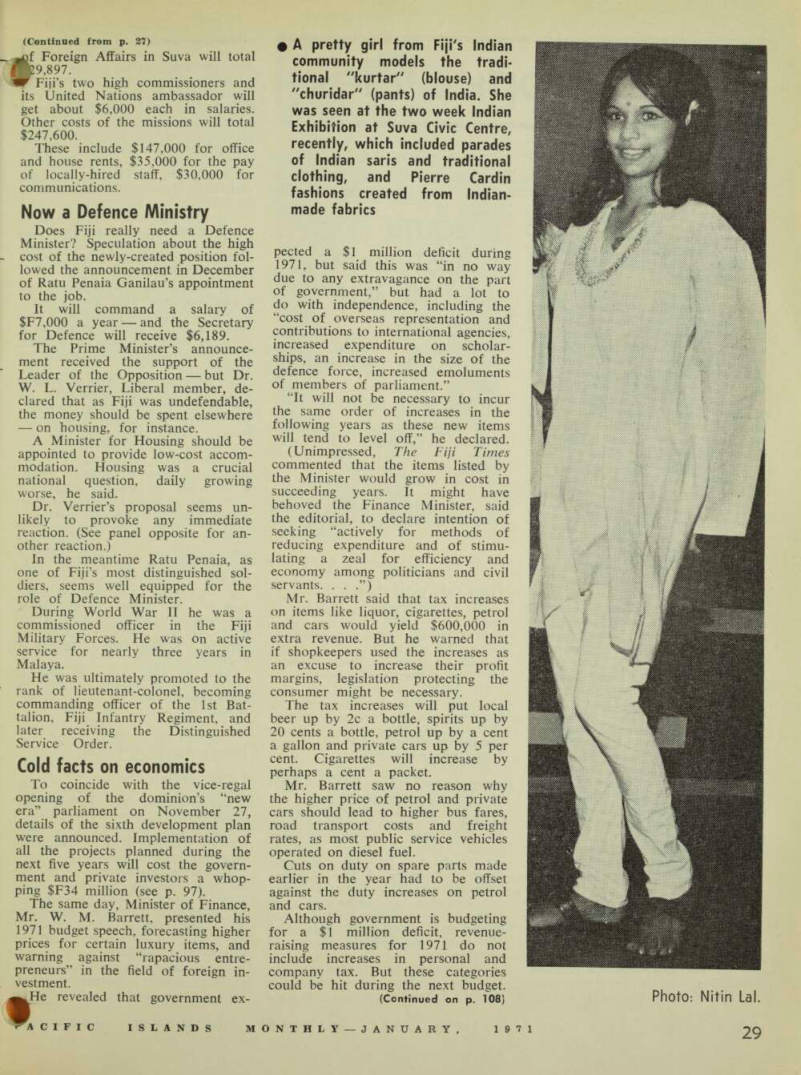
• A pretty girl from Fiji's Indian community models the tradi tional "kurtar" (blouse) and "churidar" (pants) of India. She was seen at the two week Indian Exhibition at Suva Civic Centre, recently, which included parades of Indian saris and traditional clothing, and Pierre Cardin fashions created from Indian made fabrics
Photo: Nitin Lal.
Mr. Barrett revealed they would be the subject of special studies during the next year.
The $59 £ million budget for 1971 provides for a recorded recurrent expenditure of just over $45 mil lion. The capital budget will be $14,400,000, a 26 per cent, increase on this year’s expected figure.
Government anticipates raising just over $44 million in recurrent revenue —an increase of $4.5 million over the revised assessment for the present year.
Mr. Barrett said that at present the major part of revenue was in directly derived from Customs duties and other taxes and charges levied on imported goods. Hopefully, import duties would become less important as Fiji’s own industries developed.
On the question of incentives, Mr.
Barrett said the government re cognised that tax incentives were important to new and expanding industries, and these were available.
But they should not be given without close study of their effect on the Fiji economy.
Mr. Barrett reiterated past gov ernment statements about encouraging foreign investment but warned against the dangers of domination.
Fiji had to be careful that in wel coming foreign investment, it didn’t allow it to reach the proportions where the foreign investor ended by dictating terms.
“To permit lenders to dictate to government would be merely ex changing one foreign power in con trol of our destiny for a number ol rapacious entrepreneurs whose eventual benevolence could inevitably be far less than that shown to us by Her Majesty’s Government in the UK, over the past 96 years,” said Mr.
Barrett.
“Although aid givers are very generous at times, inevitably the day of reckoning must come. Every investor in Fiji, be he an inter national lending agency or a private investor, will require his price at some stage in our development. It is up to your government, and the Minister of Finance in particular, to balance the good of the country against the price which we must be called upon to pay in the future.”
He pointed out it was difficult to exercise control over private foreign investment, because it was govern ment’s policy to impose as little restraint as possible on the develop ment of Fiji’s natural resources and industry.
Mr. Barrett said the trade deficit
for 1970 was expected to be almost $4O million, but this would be more> than offset by tourist receipts I estimated at $26 million and capital inflow of about $l6 million.
The government’s debt situation was relatively healthy, he said. The public debt at the end of 1970 was exjected to be about $4O million, about 25 per cent, of this held ex ternally.
A “relatively low” 8 per cent, of the total revenue would be required to service the public debt during the current year. However, the proportion of external to total public debt would probably rise in coming years—and the servicing of the external debt would absorb an increasing pro portion of Fiji’s foreign exchange receipts.
This development would have to be watched very closely to ensure that Fiji didn’t get into the difficulty experienced by many less developed countries—straining its resources to meet overseas debt commitments.
The growth in government ex penditure was a major factor in the economic upturn from 1967, the minister added. In 1966, the govern ment spent $25.2 million on its re current services and $7.7 million on capital development. In the 1970 budget, a final recurrent expenditure is likely to reach $39.4 million (as against an approved estimate of $35.7 million) and final capital ex penditure of $lO million (as against an approved estimate of $11.4 mil lion).
Fiji Now Has More
Than 520,000 People
An error in migration statistics in 1969 led to an overestimation in Fiji population figures, according to new figures released.
It seems that Fiji has 13,048 fewer people than previously estimated. The population at the end of 1969 should have been officially counted at 513,717, instead off 526,765.
The revised total population estimates for the past four years are: 1966—478,355; 1967—490,716; 1968 502,035; 1969—513,717.
Racial composition at the end of 1969 was: 260,567 Indians; 219,784 Fijians; 9.346 part-Europeans; 6,798 Pacific Islanders; 6.313 Rotumans; 5,600 Eu r opeans; 4,947 Chinese and 362 others.
The 1970 mid-year estimate of population is 520,071.
The reduction in the population total means the birth rate is higher than previously believed. The 1969 rate of 28.97 per thousand of the population has been revised to 29.71 per thousand. m