*Footnotes
pp. 43-45 · Read in the full issue

ICAN hardly wait for it—the day of the great exodus.
There will be an air of expectant excitement at Port Moresby’s airport, where the big Hercules trans ports will be drawn up side by side on the tarmac, their ramps down and doorways wide open.
A convoy of three-ton trucks will appear first, and the impedimenta of bureaucracy—the desks, the cup boards, the filing cabinets, the typewriters, the duplicators, the photo-copiers, the water coolers and the fans, the water heaters and the king-size jars of instant coffee—will be unloaded and reverently carried up the ramps into the waiting planes.
Then will come the chartered buses with the junior staff. Awed by the solemnity of the occasion, they will make their way sedately across the tarmac and up the ramps, two by two, like the animals going into Noah’s Ark; first the cleaners and the teaboys, then the clerical assistants and the twittering typists, then the clerks, grade by grade, from clerks grade one, with ball points stuck in their hair, through to clerks grade eleven, their batteries of Parker 51’s gleaming from their shirt pockets like rows of medals.
Soon the big black limousines will begin to set down their loads—chiefs of division, assistant heads of
departments, deputy heads of depart ments, departmental heads. Small deads and big heads, carrying bulging brief-cases and precautionary woollen pull-overs (it’s chilly up there), they will move up the ramps and disappear into the dark interiors of the Hercules.
A pregnant pause. Then, pennant fluttering bravely in the breeze, limousine numbered A.l will slide smoothly on to the tarmac and come to a purring halt. The Administrator and Mrs. Johnson will alight.
His Honour will be keeping a stiff upper lip appropriate to the occasion and to his position as our consul at sunset. But our First Lady will be
ooking (to borrow a phrase from the BBC commenta tors) absolutely radiant. And I don’t blame her— swopping that much-bepatched relic of 19th century British colonialism at Konedobu, heartache for a house proud hostess, for a brand-new Government House in he health-packed highlands, a house, moreover, prestigiously planned to be made over into Paradesia’s Presidential Palace.
The Administrator will inspect the police Guard of Honour; farewells will be said to local dignitaries; then our departing great will be piped aboard their aircraft by pipers from the PIR Band.
The ramps will be drawn up, doors will close, engines will burst into raucous life, and one by one the big planes will taxi out on to the runway and take off, swinging in a wide arc over the airport as they head for the new National Capital in the Arena Valley.
It sounds too good to be true. Perhaps it is too good
to be true. But if cops can be clairvoyant—and under our new Public Order Ordinance they are not merely allowed but actually required to be so—surely I may be allowed a quick look into the crystal ball.
Anyway, if it does come true, I’ll be out there at Jackson’s, leaning over the railings and waving like mad as the aerial armada heads northward. Then I’ll drive home to Scratchley Road, a strangely and blessedly quiet Scratchley Road, a Scratchley Road of which I think Her Majesty’s Special Commissioner, Sir Peter Scratchley, would have approved.
After that I think I’ll devote my leisure to promoting a new political movement. It will be called PUFF— Papuans United For Freedom. It probably won’t last long. The police will move in and, in pursuance of the powers conferred on them by the Public Order Ordinance 1970 and all other powers them enabling (which seem, by the way, to be pretty extensive), will break it up.
All these ribald reflections have been touched off by a report recently tabled by our Parliamentary Select Committee on a new and permanent House of Assembly building to take the place of the converted pre-war hospital in which parliament now meets.
This committee, having come to the conclusion that
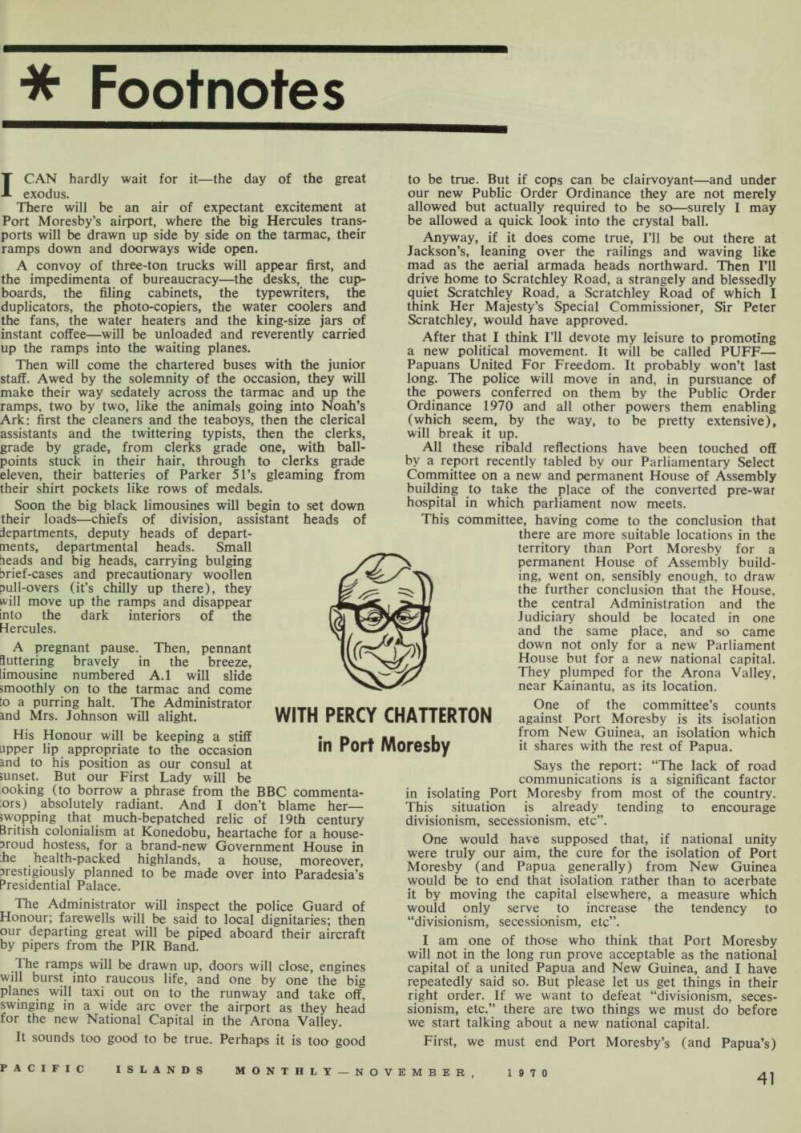
With Percy Chatterton
in Port Moresby
there are more suitable locations in the territory than Port Moresby for a permanent House of Assembly build ing, went on, sensibly enough, to draw the further conclusion that the House, the central Administration and the Judiciary should be located in one and the same place, and so came down not only for a new Parliament House but for a new national capital.
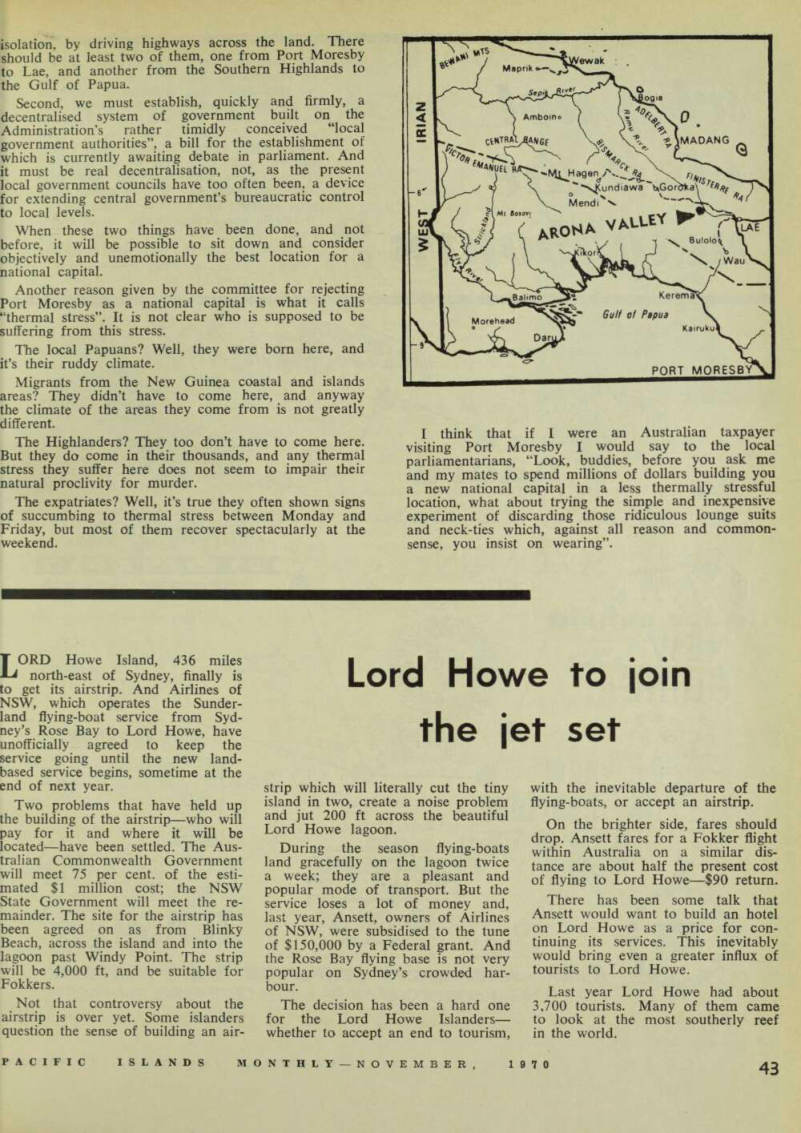
They plumped for the Arona Valley, near Kainantu, as its location.
One of the committee’s counts against Port Moresby is its isolation from New Guinea, an isolation which it shares with the rest of Papua.
Says the report: “The lack of road communications is a significant factor
in isolating Port Moresby from most of the country.
This situation is already tending to encourage divisionism, secessionism, etc”.
One would have supposed that, if national unity were truly our aim, the cure for the isolation of Port Moresby (and Papua generally) from New Guinea would be to end that isolation rather than to acerbate it by moving the capital elsewhere, a measure which would only serve to increase the tendency to “divisionism, secessionism, etc”.
I am one of those who think that Port Moresby will not in the long run prove acceptable as the national capital of a united Papua and New Guinea, and I have repeatedly said so. But please let us get things in their right order. If we want to defeat “divisionism, seces sionism, etc.” there are two things we must do before we start talking about a new national capital.
First, we must end Port Moresby’s (and Papua’s)
isolation, by driving highways across the land. There should be at least two of them, one from Port Moresby to Lae, and another from the Southern Highlands to the Gulf of Papua.
Second, we must establish, quickly and firmly, a decentralised system of government built on the Administration’s rather timidly conceived “local government authorities”, a bill for the establishment of which is currently awaiting debate in parliament. And it must be real decentralisation, not, as the present local government councils have too often been, a device for extending central government’s bureaucratic control to local levels.
When these two things have been done, and not before, it will be possible to sit down and consider objectively and unemotionally the best location for a national capital.
Another reason given by the committee for rejecting Port Moresby as a national capital is what it calls “thermal stress”. It is not clear who is supposed to be suffering from this stress.
The local Papuans? Well, they were born here, and it’s their ruddy climate.
Migrants from the New Guinea coastal and islands areas? They didn’t have to come here, and anyway the climate of the areas they come from is not greatly different.
The Highlanders? They too don’t have to come here.
But they do come in their thousands, and any thermal stress they suffer here does not seem to impair their natural proclivity for murder.
The expatriates? Well, it’s true they often shown signs of succumbing to thermal stress between Monday and Friday, but most of them recover spectacularly at the weekend.
I think that if I were an Australian taxpayer visiting Port Moresby I would say to the local parliamentarians, “Look, buddies, before you ask me and my mates to spend millions of dollars building you a new national capital in a less thermally stressful location, what about trying the simple and inexpensive experiment of discarding those ridiculous lounge suits and neck-ties which, against all reason and common sense, you insist on wearing”.