Tropicalities
pp. 36-38 · Read in the full issue
Nz Pregnancy
Tests-An Insult
To 'All Women'
Tropicalities
Western Samoa’s Prime Minister, Tupua Tamasese Lealofi, arrived back in Apia from a visit to New Zealand in October quite satisfied that there was no racial discrimination involved in a New Zealand immigration decision to submit Samoan single girls to pregnancy tests. That’s all right for him and politics. But. . .
The women of Western Samoa, at least, are angry at New Zealand’s decision that all unmarried Samoan girls wishing to emigrate to NZ should submit to the tests as some girls had been arriving in the country pregnant.
President of the National Council of Women, Masiofo Fetaui Mata’afa, (wife of former prime minister Mata’afa) said the new regulation was an insult not only to Samoan women but also to women every where.
Previously a girl would-be im migrant had only to state whether or not she was pregnant. But NZ im migration authorities discovered that often there were misrepresentations.
In justifying such tests, the NZ Minister of Immigration, Mr.
J. R. Marshall, said: “Considerable numbers of single Western Samoan women migrating to New Zealand have been pregnant and have given birth to children within six or seven months of their arrival in New Zealand.
“In each case the question as to pregnancy had been answered in the negative on the form. If pregnancy had been admitted, the woman would not have been accepted as an im migrant.
“We do not wish to encourage, as immigrants, girls who are unmarried and are about to become mothers. It is in their interests as much as ours that they should have their child at home where it may be cared for within the family.”
He added that the pregnancy tests were not an insult; there was no physical contact involved and the tests had been an immigration re quirement for some years but had not been enforced.
Meanwhile, NZ’s Maori Organisa tion on Human Rights has written to the National Council of Women ex pressing its sympathy with the council’s cause.
The Maori organisation agreed the pregnancy tests for Samoan women
were an “insulting discrimination”, and praised the Samoan council for its strong stand against “racial dis crimination”.
They're being
revived on Malaita
On a visit recently to Auki in the Solomons, we were chatting with one of the residents. In the course of conversation he said one of his sons had died a few years previously.
We expressed the usual condolences.
Then his eyes lit up and he went on to say that just two days before, three of his children had gone to heaven; but he said it with such an expression of joy and delight we didn’t know whether to express sorrow or join in his apparent re joicing.
We played safe and gave a serious nod of the head and waited for him to continue. He then told us that the children had returned the same day and had told him all about it and of their meeting with their brother. He related to us a graphic description of heaven, and the nice room that his dead son had there.
Finally he explained, to our relief, that his other three children had not themselves died but had merely gone up to heaven briefly during a revival meeting.
Revival meetings, as their partici pants call them, have been held re cently in several areas on Malaita following the visit of a Dutch Pente costal missionary, and they ap parently have had a considerable following among the adherents of the South Sea Evangelical Church.
The movement even has had some
effect in Honiara, where it followed a recent crusade in the SSE Church there. Boys left school to hold prayer meetings in the bush, and healing sessions were held. But though claims of healing and even of raising from the dead were made, no one actually knew of any par ticular instances. But the main effect has been on Malaita where children have in some cases been withdrawn from school to follow the new faith, and men have left their work.
At one time some thought that it would get a real hold on the people, but perhaps because the local leader is a former mental patient and some of his followers have ended up need ing treatment, most Malaita people treat it as the latest joke, especially after one adherent was stopped by the police from beating a woman to make her confess and thus relieve her of any devils that might have resided in her.
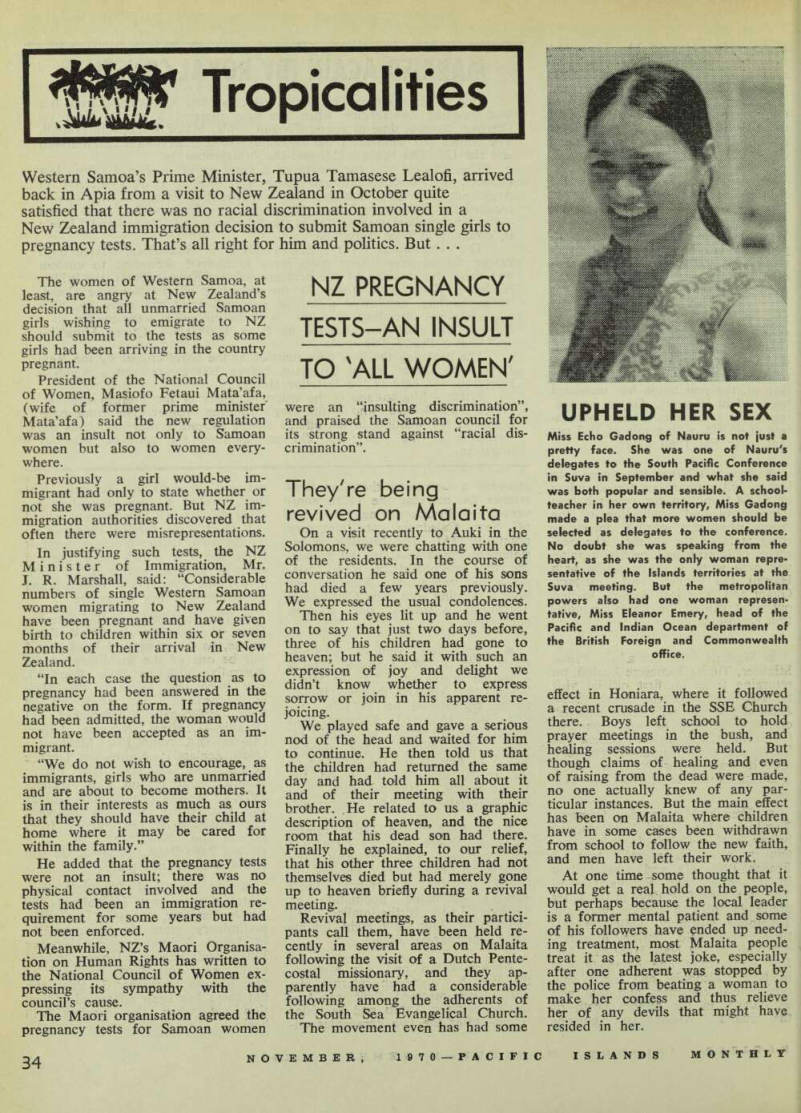
Upheld Her Sex
Miss Echo Gadong of Nauru is not just a pretty face. She was one of Nauru's delegates to the South Pacific Conference in Suva in September and what she said was both popular and sensible. A school teacher in her own territory. Miss Gadong made a plea that more women should be selected as delegates to the conference.
No doubt she was speaking from the heart, as she was the only woman repre sentative of the Islands territories at the Suva meeting. But the metropolitan powers also had one woman represen tative, Miss Eleanor Emery, head of the Pacific and Indian Ocean department of the British Foreign and Commonwealth office.
On the trail of
Tonga's mosquitoes
One of the most comprehensive studies ever undertaken in the South Pacific of the disfiguring condition of filariasis is now in its third year on Tonga’s northern island of Niuatoputapu. The man responsible is Dr. James Hitchcock Jr., of the tropical diseases division of the University of California, Los Angeles.
When Tonga’s genial giant King Taufa’ahau, 378 lb and 6 ft 2 in., landed on the island in late August to inspect the annual harvest, the barefoot, bearded filariologist handed him up his greeting card in the form of a typed progress report on his research.
He told the king he could dissect a single mosquito into a hundred parts and that out of 1,000 mosquitoes he had examined for filarial larvae, 51 were positive carriers of the disease, 20 would spread heart worms in dogs and five were infected with nematodes, the forerunner of parasites on certain creatures.
He said that in four months on the island, he had completed blood films on the entire population of 1,500. He also made a start on blood testing the dog population. He had bred a colony of mosquitoes captured from an uphill situation, away from human habitation. Aleady he had despatched hundreds of eggs of the three main varieties in the area to UCLA for future cross breeding experiments.
In addition to the common variety Aedes polynesiansis found in a large part of the South Pacific, and the two species peculiar to Tonga, Aedes tabu (found on Tongatapu) and Aedes tongae (found on the islands of Ha’apai and Vavau), the dedicated Dr, Hitchcock has come across a new strain of the black and white variety on the neighbouring, volcanic island of Tafahi. He has hesitated to give this a distinguishing name until his experiments are confirmed.
But he claims that, for the first time in Tonga, this new variety is also incriminated in transmitting the disease as a night biter. Hitherto, known carriers have operated only in daylight.
Another pecularity about this new type of black and white or tiger mosquito, believed to be a first any where, is its autogenous ability to develop eggs without first taking a blood meal.
This news was almost too much for the king, who was ready for the sumptuous feast of roast pork and yams laid on by his subjects, but obviously an exciting discovery for
the man with an itch, Dr. Hitchcock.
As they walked toward the festive board, arranged under an arbour of green fronds and red hibiscus, he told the king he hoped to complete his studies next year and use the information as the basis for a national campaign to fight off filariasis.
In October, when Dr. Hitchcock, his wife Elenore and their two children, came by the capital on their way to California, King Taufa’ahau showed his appreciation of the valuable contribution they are making to the health of his people by calling them up to the palace for a final chat and farewell.
A wedding of
two cultures
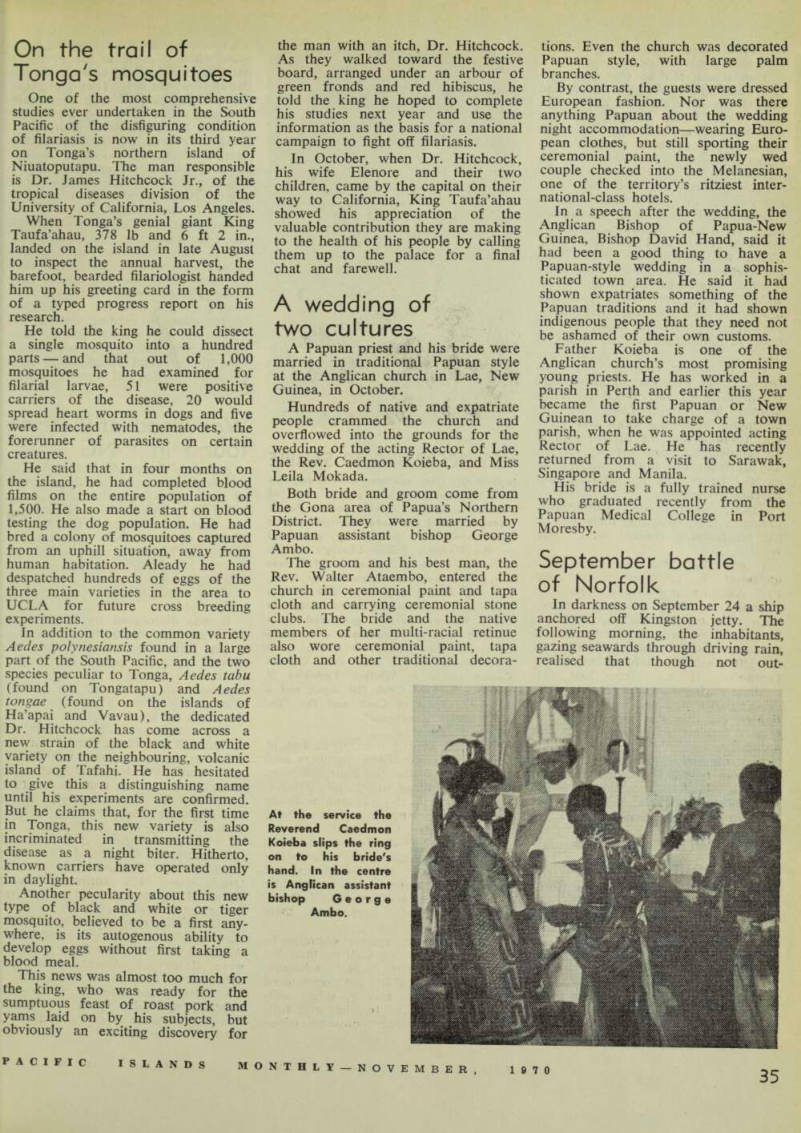
A Papuan priest and his bride were married in traditional Papuan style at the Anglican church in Lae, New Guinea, in October.
Hundreds of native and expatriate people crammed the church and overflowed into the grounds for the wedding of the acting Rector of Lae, the Rev. Caedmon Koieba, and Miss Leila Mokada.
Both bride and groom come from the Gona area of Papua’s Northern District. They were married by Papuan assistant bishop George Ambo.
The groom and his best man, the Rev. Walter Ataembo, entered the church in ceremonial paint and tapa cloth and carrying ceremonial stone clubs. The bride and the native members of her multi-racial retinue also wore ceremonial paint, tapa cloth and other traditional decora
tions. Even the church was decorated Papuan style, with large palm branches.
By contrast, the guests were dressed European fashion. Nor was there anything Papuan about the wedding night accommodation—wearing Euro pean clothes, but still sporting their ceremonial paint, the newly wed couple checked into the Melanesian, one of the territory’s ritziest inter national-class hotels.
In a speech after the wedding, the Anglican Bishop of Papua-New Guinea, Bishop David Hand, said it had been a good thing to have a Papuan-style wedding in a sophis ticated town area. He said it had shown expatriates something of the Papuan traditions and it had shown indigenous people that they need not be ashamed of their own customs.
Father Koieba is one of the Anglican church’s most promising young priests. He has worked in a parish in Perth and earlier this year became the first Papuan or New Guinean to take charge of a town parish, when he was appointed acting Rector of Lae. He has recently returned from a visit to Sarawak, Singapore and Manila.
His bride is a fully trained nurse who graduated recently from the Papuan Medical College in Port Moresby.
September battle
of Norfolk
In darkness on September 24 a ship anchored off Kingston jetty. The following morning, the inhabitants, gazing seawards through driving rain, realised that though not out-
At the service the Reverend Caedmon Koieba slips the ring on to his bride's hand. In the centre is Anglican assistant bishop George Ambo.
numbered, they were about to yield to a strong naval force.
The frigate, HMAS Queenborough with Commander Weil on board, had battled her way through heavy seas from Lord Howe Island, and was late for her appointment; but soon her company of naval trainees com menced landing, and began their in vasion.
Blue uniforms and sailor-caps were everywhere on “the golden mile”.
Large parcels containing transistors, tape recorders, perfume, jewellery and souvenirs of all kinds, were being hauled to the Kingston jetty. Find ing themselves unpopular when they resisted, shopkeepers allowed the in vaders to take over. Some made free drinks part of the surrender terms.
Inhabitants provided transport for those in difficulties on “the Kingston trail”.
Heavy buying continued. It was feared at one time that supplies might be insufficient, but delighted faces proved this rumour false. By late afternoon freshening winds and heavy seas foretold that the invaders might be compelled to beat a hasty retreat.
Signals from the ship at anchor in creased belief that the exercise was
nearing completion.
Traffic speeded up. Enthusiastic motor cyclists, balancing their loot on the handle-bars, coasted wildly sea wards.
It was then that the commander appeared. It had been thought that the Administrator was already a prisoner on board. He had certainly been seen on a launch at mid-day, travelling seawards, but now he and the commander appeared together on the jetty, bidding each other friendly farewells. It was true that im mediately afterwards the commander, clinging to a net, was lowered into a lighter, but this was accomplished in seemly fashion, with due respect for authority.
Any remaining invaders were then taken out to sea by willing and able Norfolk Islanders, accustomed to the local hazards of reefs and tides, until the quay was apparently cleared.
They want media
for The Message
The Christian Communities Com mission of Papua-New Guinea and the Solomon Islands has taken the churches in its area to task for failing to use communications properly.
The commission, which represents both Protestant and Roman Catholic churches, was formed recently to help the churches make the best of exist ing and potential communications facilities and to encourage the train ing of nationals in their use.
At their annual meeting in Lae in September commission members said they believed that the churches were “seriously failing to exploit, develop and support the communications media in the spreading of the gospel and in training Christians”.
“We believe,” they went on, “that unless the churches take immediate steps to make the fullest use of literacy, literature, radio and public relations, they will soon find them selves gravely handicapped in their work.
“We therefore urge the churches to put communications high on their list of priorities; to budget adequate funds for the use and development of communications; and to select suit able personnel for training and full time work in the communications media.”
CCC members were happier, how ever, when it came to the proposed national broadcasting commission for Papua-New Guinea. They welcomed the establishment of such a commis sion and called for a churches repre sentative to be appointed to it.
At their first meeting, earlier this year, CCC members decided to press the Australian Government for a broadcasting franchise which would allow religious radio stations to be set up in the territory.
But since then, opinion about this has been changing within the CCC and at their September meeting they decided to withold the application for the time being. They have changed their minds partly because they feel that facilities for religious programmes on existing stations are improving, and partly because they want the opportunity to see exactly what the national broadcasting com mission will do and how it will be constituted.
War dead still being
found in P-NG
An army bomb disposal officer in October was to assist in the recovery of the bodies of some US airmen killed in a World War II crash in the Schrader Range of the Madang district of Papua-New Guinea. The plane, a bomber, was thought to have crashed while returning from a bombing mission over Wewak to Nadzab, near Lae, in late 1943 or early 1944.
It was discovered on July 26 by an American Nazarene missionary, about four days’ walk from the Simbai patrol post in rugged mountain country. The missionary reported that he found the aircraft after being given a description of the crash by local people.
The missionary said the front of the aircraft was badly burned, but the paint on the rear section was still in good condition. He found what he thought to be the remains of four men—two in the top turret, one in the co-pilot’s seat, and one in the mid-section.
At the rear of the aircraft he found an unexploded bomb and 50 calibre machine gun ammunition was scat tered about. US authorities have identified the aircraft, and stated that it carried a crew of three.
Meanwhile, remains of 10 US air men recovered from the jungle near Angoram, in the East Sepik of NG, were flown to Australia in late September. They were found in a US four-engined bomber which was wrecked so badly when it crashed that its existence was not confirmed until early this year.
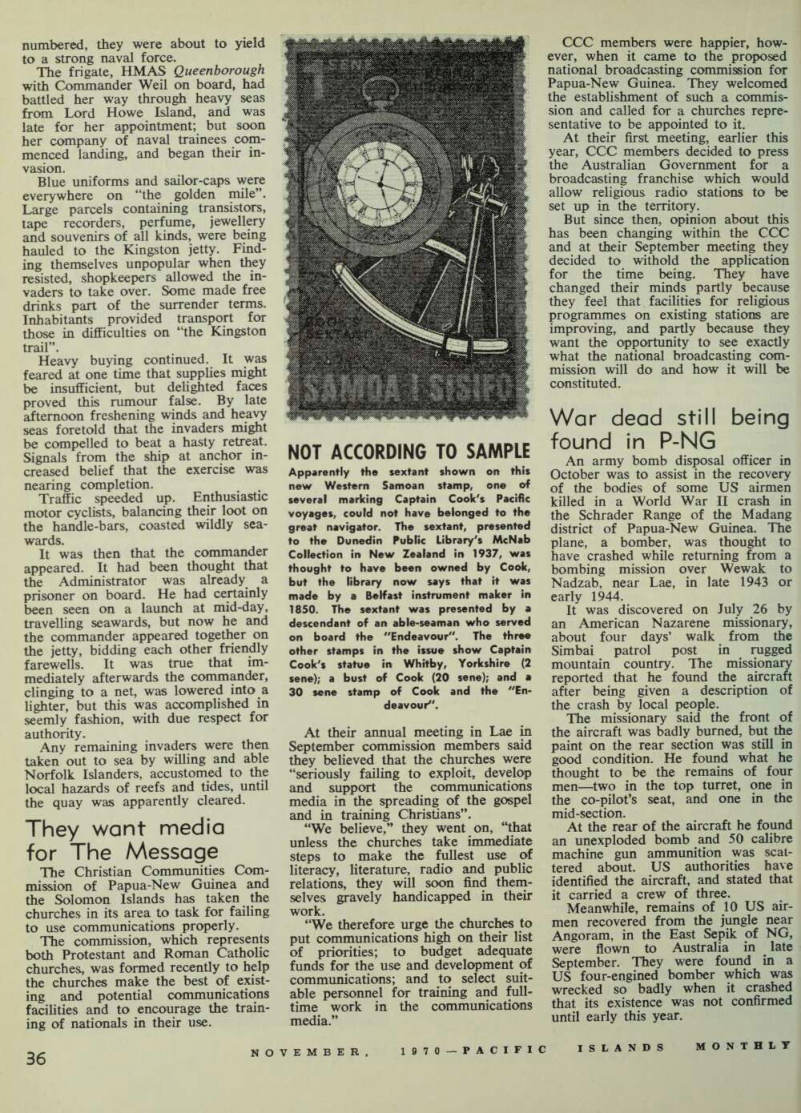
Not According To Sample
Apparently the sextant shown on this new Western Samoan stamp, one of several marking Captain Cook's Pacific voyages, could not have belonged to the great navigator. The sextant, presented to the Dunedin Public Library's McNab Collection in New Zealand in 1937, was thought to have been owned by Cook, but the library now says that it was made by a Belfast instrument maker in 1850. The sextant was presented by a descendant of an able-seaman who served on board the "Endeavour". The three other stamps in the issue show Captain Cook's statue in Whitby, Yorkshire (2 sene); a bust of Cook (20 sene); and a 30 sene stamp of Cook and the "En deavour".