The Wild New Hebrides
pp. 87-89 · Read in the full issue

Firearms And Firewater In
By Robert Langdon
“The highway of the sea offers facilities that Darkest Africa never can, and the South Sea Islands are still a happy hunting ground for the terrible white man with his firearms and firewater, wickedly tendered as ‘trade’ with the poor savage children. Slave raiding has been modified into so-called labour traffic. There is a need for vigilance. . .
So ran an editorial statement in the first issue, 77 years ago, of the first periodical entirely devoted to the New Hebrides.
One could have been excused for thinking that the aim of the journal was to draw attention to, and fight against, the wickedness of the seemingly numerous and unscrupulous white men in those then untamed islands. However, the title page makes it clear that the journal’s aim was to help raise funds “for the Evangelisation of the Remaining Cannibals on these Islands”.
Priced at one penny, and published at Woodford, Essex, in the UK. the journal first appeared in July. 1893, under the editorship of the Rev.
James Paton, BA, of Glasgow, a member of the prolific Paton family which dominated the Presbyterian mission in the New Hebrides for many years.
The journal was entitled The New Hebrides South Sea Islands
Quarterly Jottings of the John G.
Baton Mission Fund. 0 4 ..
Some three years ater its title was changed to Quarterly Jottings from ye j FS f to 5f a ’ t jL* vici ssitudes, Quarter y J ttmgs pr ed
?nSf’-fw
?qc? er , ul ter U the 260th number was puDiisnea.
Although it was frequently given to fulminating prose, particularly in its early years, Quarterly Jottings is a unique repository of information for anyone with an interest in the history of the New Hebrides. News items on happenings of every kind, biographies of missionaries and notable native converts, and articles on local myths, legends and customs were the regular fare of the journal. Here are a few
sample news items chosen completely at random: • A good friend of the New Hebrides e Missi on Mr. H. W.
Bamett> of 4 National Bank Build . in B s > Qu een Street, Glasgow, sent us a notice in May that he had just received this season . s supply of arrowroot eighteen casks, about 3 ’ 600 lbs-from Erromanga and £f ate B [ s Q f very fi ne quality, and put up * n cotton bags containing 5 l bs and 10 lbs each, will be sold at Is. 2id per lb, carriage paid, Thus arrowroot is given by the natives to help the Mission and pay for printing the Scriptures and other Religious books . . .” (No. 13, June, 1896). • Dr. Wm. Gunn of Aneityeum, one of the senior missionaries of the group, has, with much care and trouble, produced a correct map of the New Hebrides islands. The aid of captains of vessels sailing in the group has been availed of and the
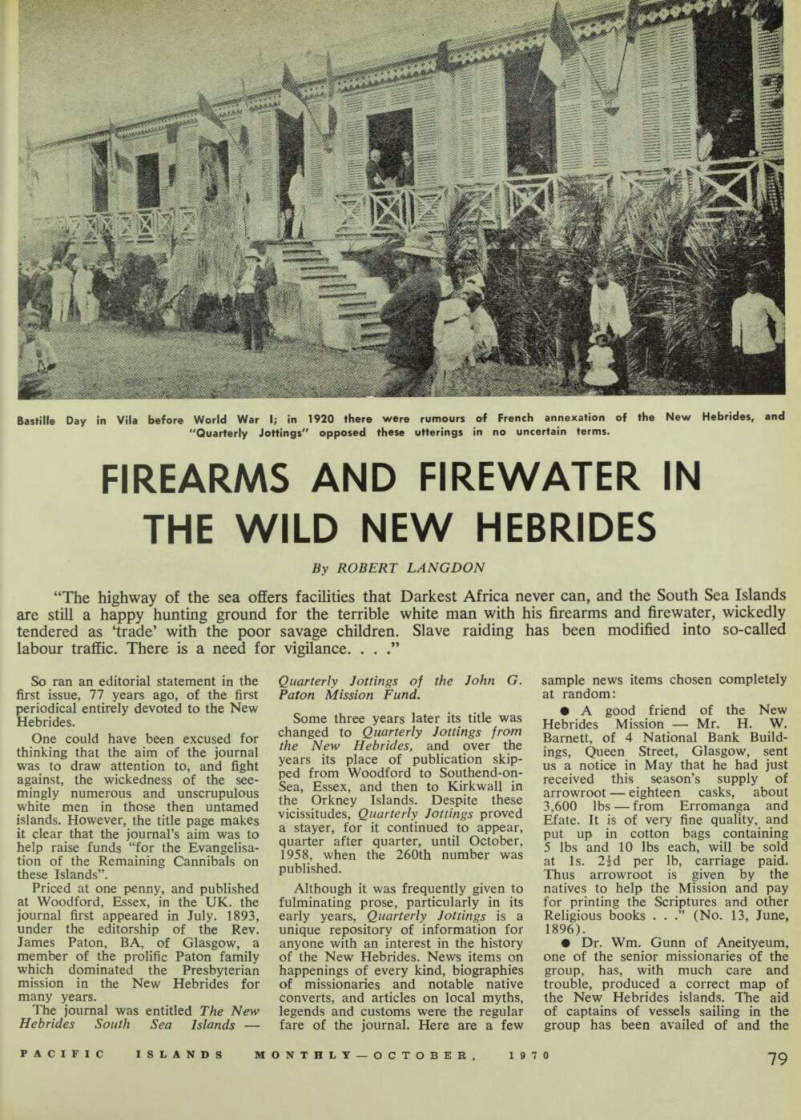
Bastille Day in Vila before World War I; in 1920 there were rumours of French annexation of the New Hebrides, and "Quarterly Jottings" opposed these utterings in no uncertain terms.
map is declared to be the best and most reliable yet produced. It was sent home in original and we have had the pleasure of getting it lithographed. We have a small quantity of the new maps left after sending a good supply to the islands and Australia, and shall be happy to forward a copy to any friends who may wish to possess a good map of the group. (No. 48, April 1905). [lncidentally, the map in question eventually became a feature of Quarterly Jottings, being published regularly either on the inside or outside of the back cover]. • The murder of our teachers and others [at Wala, Malekula] was an event that could not well escape action on the part of the authorities; and, accordingly, in the month of July last a punitive expedition, in which detachments from both British and French men-of-war took part, went to the village in the bush where the tragedy had taken place, in the hope of being able to bring some of the murderers to justice.
In this, however, they failed, and the result of the expedition, so far from being satisfactory, has, un fortunately, left the condition of matters worse than it was before.
The bushmen, secure among their hills, have never been in touch with such “authority” as is now known in the Islands, and are given over to lawlessness and scheming; and now more than ever, since they boast that they have beaten the white man and killed his agents. The life and property of white men and of all clothed (school) people are quite unsafe at present on the mainland of this most northerly part of Malekula. (No. 91, January, 1916). • It is galling to have to turn aside from congenial work to rebut false charges, but the effusions that appear in La Bulletin du Commerce published in Noumea, New Cale donia, and dated December 20, 1920, are too glaringly false to be per mitted to pass without comment.
There it is announced that the subject of the New Hebrides is con stantly under discussion between France and England; and a Senator who champions French Annexation regards the arguments in favour of French ownership as “irrefutable”— as to which a little pamphlet that is known to our readers supplies solid reasons to the contrary. (No. 114, October, 1921). • The heathen in Pentecost, — affirm that the Ambrim people are not giving the volcano [on that island] sufficient kaikai (food). So, to appease the hunger and wrath
of the devil within the volcano, a company of heathen attempted to climb the crater with loads of cocoanuts to throw in as a peace offering. But on reaching the ash plain they found that Mount Benbow had closed down, and a new vent formed about a mile further south.
Owing to the terrific pressure in the new vent great quantities of ashes were being expelled with thundering noise. The constant booming and the inky darkness made the natives afraid to approach, and thinking that another big outburst was im minent, they returned in a hurry to Ranon. In their picturesque style the natives declared that the devil of the volcano was slinging stones at them. (No. 103, January, 1919). • It is hardly possible to ex aggerate the devastation of the hurricane and accompanying cloud bursts which cost the lives of 125 New Hebrideans at Christmas. A recent eye-witness told me that the
uprooted trees which had been washed into the sea off Paama piled the beaches to a height of fifty feet.
People are resignedly digging below the feet of mud and spoil to find their lost clothing and other goods. (No. 234, April, 1952).
Although Quarterly Jottings is, in many ways, of unique historical value, no library in the world—as far as the Pacific Manuscripts Bureau, Canberra, can establish— has anything like a complete set of the journal. However, for well over a year the bureau has been trying to put together a complete file of the journal on microfilm, by arrang ing for copies to be photographed wherever they can be located.
To the end of June, the bureau had succeeded in tracking down all but three issues—l2B, 140 and 161—and it hopes that these, too, will even tually be brought to light so that an unbroken microfilm run from No. 1 to 260 may be lodged in each of the bureau’s member libraries.