Magazine Section
pp. 81-84 · Read in the full issue

South Pacific Craftsmen Still
Use Traditional Skills
Pacific Islanders, suddenly part of Western-style cash economies, are finding out that there is money to be made out of the traditional arts and crafts of their forefathers. Angus Mcßean describes the skills of the Pacific in this article, reproduced by courtesy of the South Pacific Commission, from Handicrafts of the South Seas*
Many interesting skills and techniques have been developed by Islanders of the Pacific. Of these, the weaving of vegetable fibres is one of the most widely spread, and examples of this art can be found in almost every district—from the river and swamp villages of the Sepik, or the mountain valleys of the New Guinea Highlands, to the tiny coral islets of the Tokelau or the Ellice groups.
Some of it, notably the fine mats of the Samoas, is of almost incredible delicacy and fineness; other examples, such as the string bags of New Guinea or the Solomons, are of extraordinary strength.
The fibres used are of equal diversity. Admittedly, the pandanus takes pride of place, but the coconut leaf, the coconut leaf-bud, the tendrils of vines, the fibres of the coconut husk and of the banana stem, the bark of trees and shrubs, the stems or the leaves of water-weeds, and the skin of the sago-palm leaf stem, are among the many other fibres used.
The art of tapa-making has never been known in some territories; in others where once it flourished, the skill has been almost lost; but in many territories it is still an integral part of the life of the people, and large quantities of tapa, some of superfine quality, are being produced, partly for sale to Europeans but largely for everyday use by the Islanders themselves.
An almost infinite variety of styles and skills is manifest in the domain of wood carving, especially in Melanesia, where some of the carvers are more than artisans—they are artists in their own right. This is notably the case in parts of the Solomon Islands and in the Sepik area of New Guinea.
Polynesia, too, has fine wood carving; that of the Marquesas is outstanding for the intricacy of its detail. Polynesian wood carving is characterised by elegance in its pro * Handicrafts of the South Seas can be obtained, priced $l, from the SPC Publica tions Bureau, 720 George Street, Sydney, or the SPC headquarters, Noumea. It is well illustrated.
portions. Different again is the carving of Micronesia, where delicacy and finish in execution are frequently combined with great humour and imagination.
Then there is pottery, confined to a relatively small number of districts and using extremely primitive and imperfect techniques, yet producing in some cases, such as in the Chambri Lakes area, articles of consummate skill and artistic sense.
These are the main forms of
handicrafts but, in addition, there is a wealth of further products illustrat ing patient skill, ingenuity, imagina tion, and sense of form and colour.
These include the huge array of articles in polished shell or tortoise shell, the inlays of shell in ebony, inlays of silver in tortoise-shell,
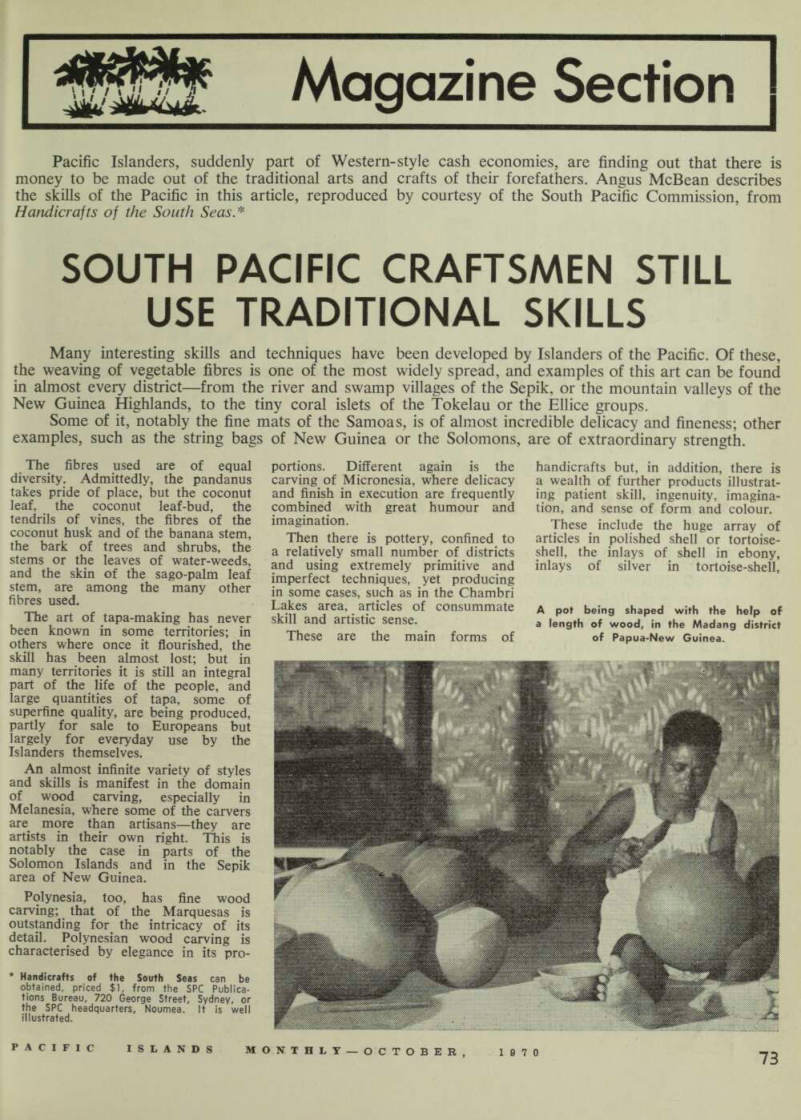
A pot being shaped with the help of a length of wood, in the Madang district of Papua-New Guinea.
intricately fashioned spears with barbs of splintered bone or of thorn spines, “bride money” of many types, shell necklaces, armlets, and infinitely more; and such modifications of European skills as the beadwork of Wallis and Futuna and other groups, the patchwork quilts (tifaifai) of Tahiti, the hand-painted and silkscreened dress fabrics of Western Samoa and Tahiti, and the engraved shell of artisans m Tahiti and Fiji.
WEAVING: In general, the most important fibre used in weaving in the Pacific is produced from the leaves of various forms of the pandanus or “screw pine”. This curious tree, standing on “stilt roots’; and capable nVmg i° n a , ost mor B amc soil, produces long leaves somewhat reminiscent of sisal hemp or phormmm flax, hut with sharply serrated edges and mid-ribs.
The preparation of the fibres is nearly as time-consuming as the actual weaving itself. There are many ways of preparing pandanus, depending on the variety, and also depending on the technique of a given island as well as on the purpose for which the material is to be used.
One method is to pass each leaf quickly through a fire, then to boil it briefly in fresh water, and with a sharp shell or perhaps a knife, cut off the serrated edges and the midrib. The strips of pandanus are then carefully bleached in the sun for a number of days and finally rolled
into long coils ready for use.
Before being plaited, they are passed at a sharp angle between the thumb and a blunt shell or the reverse edge of a knife, in order to make the fibres flexible, and are then slit to the requisite size—any thing from a 32nd of an inch to i in. in width.
On other islands, the passing of the leaves through ’the fire and the subsequent boiling are omitted; the preparation is basically a matter of very careful sun bleaching, the leaves being half-plaited in such a way that when unplaited for use they do not warp or twist.
Elsewhere, for very fine mats, the women use a special type of rather fleshy pandanus, from which the outer skin is stripped and this alone is used in order to produce a silky, very delicate mat.
The pre p arat ion of vegetable dyes is far more complex, and in many instances a secret process is involved; this is regarded as the property of a given island or village. The dyes so produced, however, are of lovely mellow tones and very fast. Un fortunately, there is a growing tendency to adopt the simpler tech
nique of using “store dyes”, which are less fast and also of a more gaudy colour. This is now being dis couraged. weaving of the South Pacific 2<j done by hand in the villages and in the spare time of the individual weaver. It is painstaking, intricate work and cannot always be done to a strict timetable because, apart from the women’s need to look after their families and also to work in the family food gardens, the fibres cannot be bleached if the weather is too wet. Also, the fibres cannot be woven if the weather is so dry as to make them brittle in 1116 weaving, TAPA MAKING: The making of tapa or native bark cloth is, in some respects, an even more intricate process. Once the chief form of cloth—at least for ceremonial occasions—over a large part of the South Pacific, notably in Polynesia (though not in all parts), tapa is now n 0 longer made in several terri stories where once it was a universal ar *.
In others, though, tapa of out standing quality in texture and design is still made, and by no means only f° r sa l e . purposes. In several island groups it is still the usual form of sheet or quilt, to be thrown over the body on a somewhat chilly night, anc * it is still used on such occasions as a wedding or at a ceremonial dance.
Although other trees and shrubs.
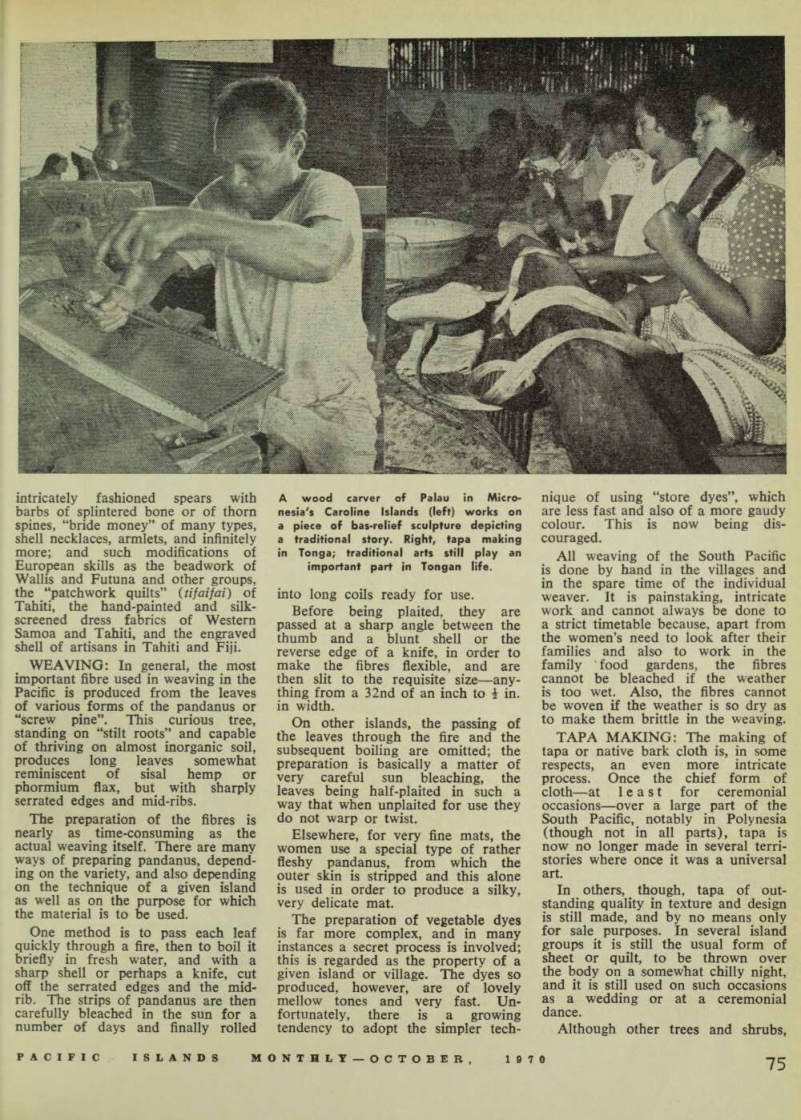
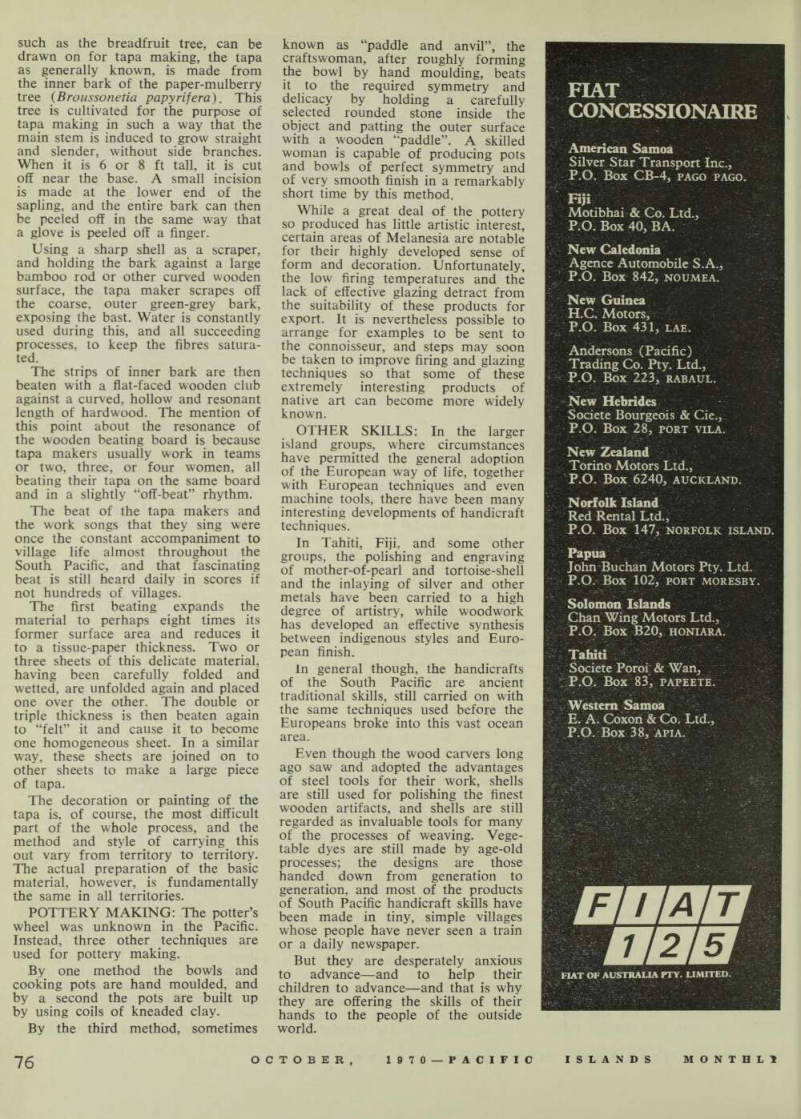
A wood carver of Palau in Micro nesia's Caroline Islands (left) works on a piece of bas-relief sculpture depicting a traditional story. Right, tapa making in Tonga; traditional arts still play an important part in Tongan life.
such as the breadfruit tree, can be drawn on for tapa making, the tapa as generally known, is made from the inner bark of the paper-mulberry tree (Broussonetia papyriferd). This tree is cultivated for the purpose of tapa making in such a way that the main stem is induced to grow straight and slender, without side branches.
When it is 6 or 8 ft tall, it is cut off near the base. A small incision is made at the lower end of the sapling, and the entire bark can then be peeled off in the same way that a glove is peeled off a finger.
Using a sharp shell as a scraper, and holding the bark against a large bamboo rod or other curved wooden surface, the tapa maker scrapes off the coarse, outer green-grey bark, exposing the bast. Water is constantly used during this, and all succeeding processes, to keep the fibres satura ted.
The strips of inner bark are then beaten with a flat-faced wooden club against a curved, hollow and resonant length of hardwood. The mention of this point about the resonance of the wooden beating board is because tapa makers usually work in teams or two, three, or four women, all beating their tapa on the same board and in a slightly “off-beat” rhythm.
The beat of the tapa makers and the work songs that they sing were once the constant accompaniment to village life almost throughout the South Pacific, and that fascinating beat is still heard daily in scores if not hundreds of villages.
The first beating expands the material to perhaps eight times its former surface area and reduces it to a tissue-paper thickness. Two or three sheets of this delicate material, having been carefully folded and wetted, are unfolded again and placed one over the other. The double or triple thickness is then beaten again to “felt” it and cause it to become one homogeneous sheet. In a similar way, these sheets are joined on to other sheets to make a large piece of tapa.
The decoration or painting of the tapa is, of course, the most difficult part of the whole process, and the method and style of carrying this out vary from territory to territory.
The actual preparation of the basic material, however, is fundamentally the same in all territories.
POTTERY MAKING: The potter’s wheel was unknown in the Pacific.
Instead, three other techniques are used for pottery making.
By one method the bowls and cooking pots are hand moulded, and by a second the pots are built up by using coils of kneaded clay.
By the third method, sometimes
known as “paddle and anvil”, the craftswoman, after roughly forming the bowl by hand moulding, beats it to the required symmetry and delicacy by holding a carefully selected rounded stone inside the object and patting the outer surface with a wooden “paddle”. A skilled woman is capable of producing pots and bowls of perfect symmetry and of very smooth finish in a remarkably short time by this method.
While a great deal of the pottery so produced has little artistic interest, certain areas of Melanesia are notable for their highly developed sense of form and decoration. Unfortunately, the low firing temperatures and the lack of effective glazing detract from the suitability of these products for export. It is nevertheless possible to arrange for examples to be sent to the connoisseur, and steps may soon be taken to improve firing and glazing techniques so that some of these extremely interesting products of native art can become more widely known.
OTHER SKILLS: In the larger island groups, where circumstances have permitted the general adoption of the European way of life, together with European techniques and even machine tools, there have been many interesting developments of handicraft techniques.
In Tahiti, Fiji, and some other groups, the polishing and engraving of mother-of-pearl and tortoise-shell and the inlaying of silver and other metals have been carried to a high degree of artistry, while woodwork has developed an effective synthesis between indigenous styles and Euro pean finish.
In general though, the handicrafts of the South Pacific are ancient traditional skills, still carried on with the same techniques used before the Europeans broke into this vast ocean area.
Even though the wood carvers long ago saw and adopted the advantages of steel tools for their work, shells are still used for polishing the finest wooden artifacts, and shells are still regarded as invaluable tools for many of the processes of weaving. Vege table dyes are still made by age-old processes; the designs are those handed down from generation to generation, and most of the products of South Pacific handicraft skills have been made in tiny, simple villages whose people have never seen a train or a daily newspaper.
But they are desperately anxious to advance—and to help then children to advance—and that is why they are offering the skills of their hands to the people of the outside world.