Procrastination Is Spoiling
pp. 59-63 · Read in the full issue

The Beauty Of Vila
From TESSA FOWLER, in Vila
Vila is a charming town of pink, baby blue and white buildings, nestling at the foot of jungle clad mountains overlooking a magnificent bay. These pastel buildings are where the non-natives live. Out of sight behind beautiful hedges of bougainvillea and hibiscus, away from the road, are the shanty towns and labour lines where the rest of the population live.
In these shanty towns a family of six may sleep in a house built from crates, no bigger than a privy; or in appalling heat without ventilation under roofs of secondhand corrugated iron.
The labour lines with rooms for rent at first seem to offer better ac commodation, but at $lO or $2O a month the price is at least a quarter of the average wage and, like the shanty towns, there are no amenities. One dripping tap serves a community of 20 families; there is no lavatory; rubbish is thrown among the mangroves on the shore outside everyone’s front door.
The administration did not admit to having noticed the slums until a census was carried out by sociolo gists of the Australian National University in 1965. John Leaney of the British Administration carried out another in 1966, which also included Santo (where housing is not so bad since most New Hebrideans live in large airy ex-US army Nissen huts). A committee was then formed
to discuss the problem of providing low cost housing.
In 1967 a large block of land was purchased. Plans for the layout of the houses were completed in 1969.
In 1970 the only obvious achieve ment is that the French and British were both represented at a recent South Pacific Commission conference on low cost housing in Honiara.
A decision either way would probably have avoided hardship for poorly housed New Hebrideans. If the government had built units, New Hebrideans would be well housed today. If the government had not decided to build units, New Hebrideans might be well housed today by private enterprise.
In 1965, land prices and construc tion costs were such that decent if not luxurious lodgings for New Hebrideans at $lO per-room-per month were a good investment.
When the government announced— so prematurely—its intention to put up cheap housing, no investor could go ahead. Land prices around Vila
have risen to the point where the investment is probably no longer at tractive.
Final plans for the housing estate have not yet been made, but some of the planners’ idea are known. acquiring family responsiniimes; or Slfes inThe v'iUa°ee haVe ' & * tamilies m tne village, The planners suggest a hostel for bachelors as a first priority. But why?
Firstly every man who comes to Vila has relations he can stay with, where he will be properly fed.
Secondly he can share a room with
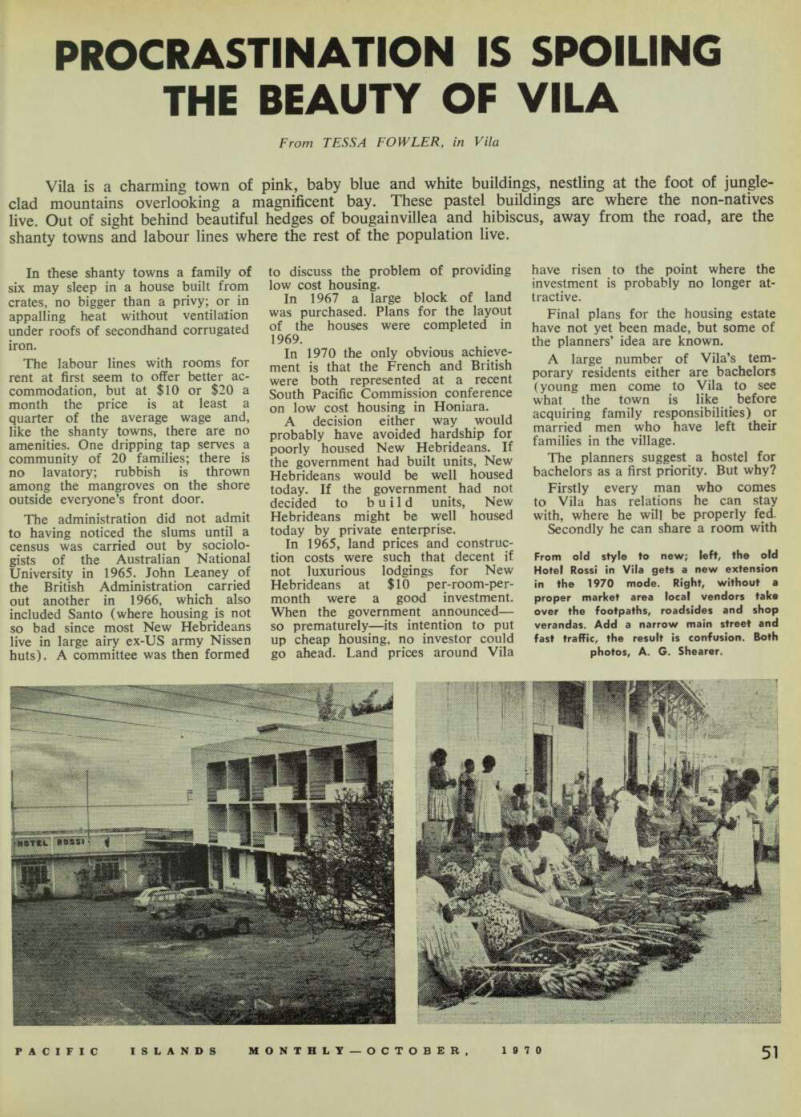
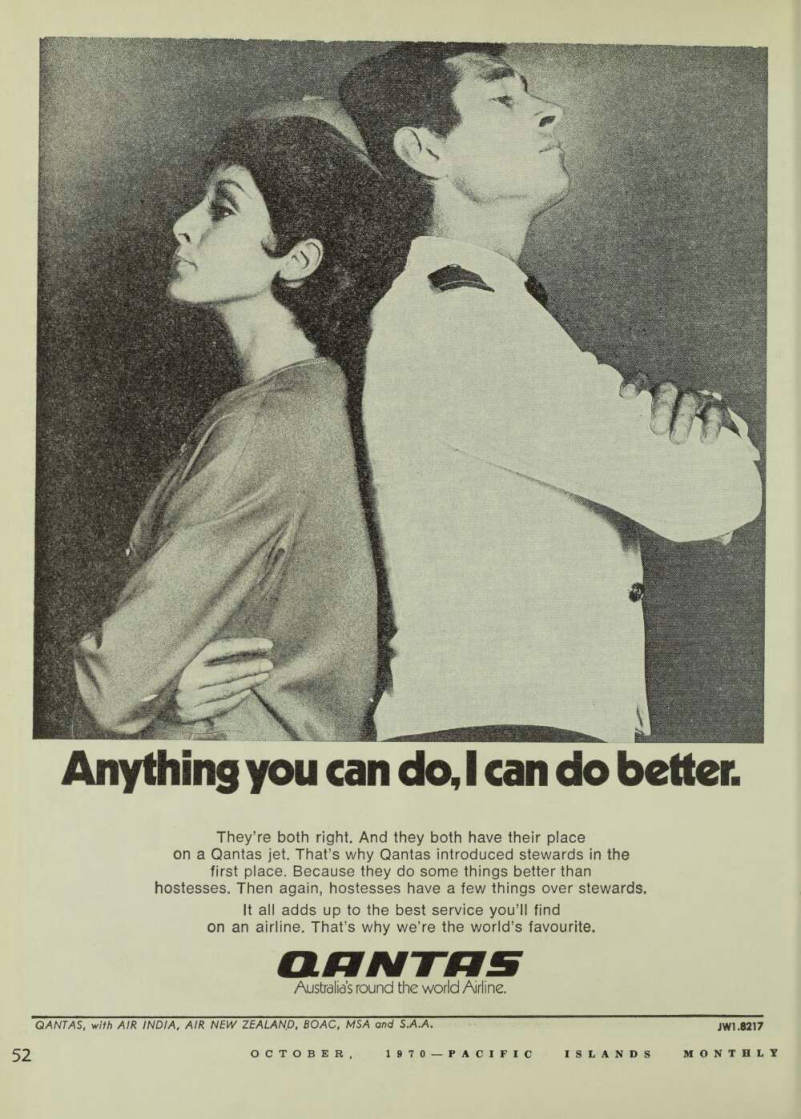
From old style to new; left, the old Hotel Rossi in Vila gets a new extension in the 1970 mode. Right, without a proper market area local vendors take over the footpaths, roadsides and shop verandas. Add a narrow main street and fast traffic, the result is confusion. Both photos, A. G. Shearer.
Bachelors in need
other men, or even take one alone.
And as he is not supporting a family, the rent cannot be much burden to his finances. Thirdly, to encourage men to come to Vila without their families may simply aggravate social problems.
Because people don’t take care of houses they don’t own, the low cost houses will probably not be available for rent, but will be available on hire purchase. Decent housing will then only be provided for those who have decided to remain in Vila per manently. It amounts to encourag ing people to remain in the towns.
In the village there are beautiful views, a sufficiency of leisure, clean liness, peace, healthy food and healthy work.
The slums of Vila and Santo will produce for the next generation a fair proportion of the unhealthy and delinquent.
It also appears that the housing estate is to be built in cement; such an expensive material means that the number of houses will probably be too few for the demand.
I believe the village environment should be copied. Plantations of wild cane, thatching palm and bamboo could be made near Vila, and sup plies of the most suitable building material for the economic and climatic conditions of the South Pacific, sold to New Hebrideans.
Failing that, a thorough study of new building materials should be made: prefabricated rooms of fibre glass is a possibility.
Slums are not the only problem to be tackled: Vila’s recent growth has been so rapid that this sleepy little tropical town is discovering traffic jams and parking problems.
The development of tourism requires that the beauty of the town be pre served; the first semi-industrial operations must not be allowed to interfere with their neighbours.
The solution to these problems, it was hoped, would be found in the overall “town plan” for building development over the next 20 years, drawn up recently by British expert, David Ball.
Unfortunately Mr. Ball for all his talents, was another expert who knew his field and did not know the New Hebrides; who supposed that en couraging Vila to follow the growth patterns of small towns in England was an admirable result.
The permanent European com munity in Vila live here because they like it better than England.
Immitation, therefore, is hardly an inspiring thought for them. The New Hebridean has no experience of town
life. But he could expect something better than an immitation of England town life.
One admirable idea of Mr. Ball’s is that certain areas are to be re served as parks and public beaches.
Unfortunately the recent boom in land prices, coupled with the fact that the plan is British and the owners of most of the land likely to become public parks are French, gives the plan a poor chance of realisa tion.
One of the unusual beauties of Vila until a few months ago was the main road set by white beaches.
Those white beaches are now dis appearing under tons of earth excavated from the new wharf so that soon Vila will be like every dreary little seaside town with a parking lot beside the sea.
It’s also suggested that areas should be zoned, the value of property pro tected by grouping houses according to value. But this would be suicidal in a multi-racial society.
Both town plan and the housing scheme are extremely conventional, a defect that seems almost inevitable in a country as small and as remote as the New Hebrides. Ideas travel slowly; those that reach the New Hebrides are tired and old so that it is our lot always to be starting on something just when it goes out of fashion. And because we are small we can only borrow experts for short periods; we have no home grown experts. Too many of the institutions and organisations of the New Hebrides are immitations.
It need not be so; because we are remote we are not bothered by world opinion; because we are small, experiments are possible. Perhaps the future democratic town govern ments of Vila and Santo might make more innovations, not immitations.
It’s too late for the public to preserve their white beaches. Let us hope that when the town plan is made public, people will give their views before it is implemented.