Nothing Idyllic About Fiji's
pp. 57-58 · Read in the full issue
Smog And Traffic Jams
From SUE WENDT, in Suva Sweetness and light might prevail on the political scene, but other developments in Fiji are a far cry from the idyllic South Seas.
Traffic jams and water pollution, for instance, and unimaginative highrise apartments. And a scattering of factory stacks, belching unsightly columns of smoke and soot. Even the reefs seem threatened by overexploitation and pollution.
All are examples of the urgent need for long-term planning in Fiji —now getting its independence. Can the planners of this new nation avoid the unfortunate aspects of progress?
Implementation of the new town planning scheme for Suva—it took three years to prepare—may prevent duplication of some of the existing eye-sores. Most buildings going up, or recently erected, in main centres are dull or ugly. Some are monstrosities.
Every day a cement factory near Suva’s otherwise beautiful Bay of Islands spews out a smoky banner; often, smog from ships’ funnels hangs over the dock area and Walu Bay.
Despite recent legislation and court fines, buses and lorries still emit poisonous exhaust clouds—still pollution in rivers and foreshores is causing increasing concern.
“Don’t gather shellfish from certain areas,” Fijians who’ve been doing it for centuries are now warned.
“because such food is polluted and harmful.”
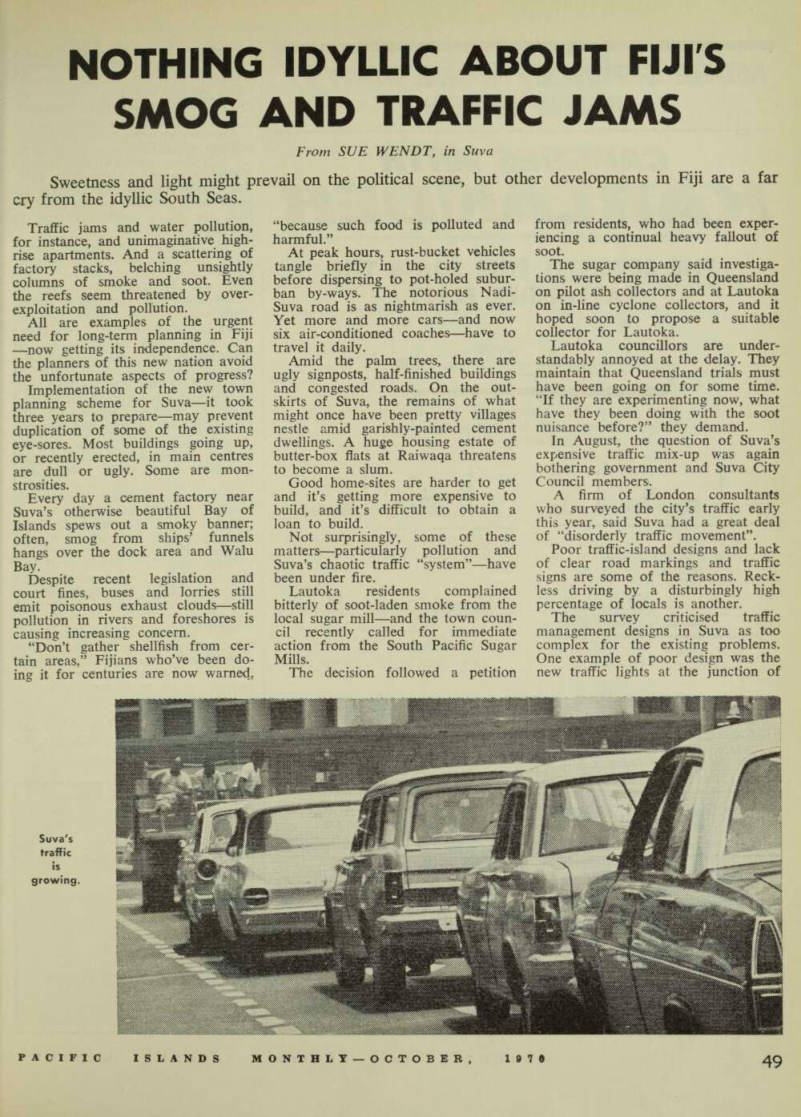
At peak hours, rust-bucket vehicles tangle briefly in the city streets before dispersing to pot-holed suburban by-ways. The notorious Nadi- Suva road is as nightmarish as ever, Yet more and more cars—and now six air-conditioned coaches—have to travel it daily.
Amid the palm trees, there are ugly signposts, half-finished buildings and congested roads. On the outskirts of Suva, the remains of what might once have been pretty villages nestle amid garishly-painted cement dwellings. A huge housing estate of butter-box flats at Raiwaqa threatens to become a slum.
Good home-sites are harder to get and it’s getting more expensive to build, and it’s difficult to obtain a loan to build.
Not surprisingly, some of these matters—particularly pollution and Suva’s chaotic traffic “system”—have been under fire.
Lautoka residents complained bitterly of soot-laden smoke from the local sugar mill—and the town council recently called for immediate action from the South Pacific Sugar Mills.
The decision followed a petition
from residents, who had been exper iencing a continual heavy fallout of soot.
The sugar company said mvestiga tions were being made in Queensland on pilot ash collectors and at Lautoka on in-line cyclone collectors, and it hoped soon to propose a suitable collector for Lautoka.
Lautoka councillors are under standably annoyed at the delay. They maintain that Queensland trials must have been going on for some time, “If they are experimenting now, what have they been doing with the soot nuisance before?” they demand, In August, the question of Suva’s expensive traffic mix-up was again bothering government and Suva City Council members.
A firm of London consultants who surveyed the city’s traffic early this year, said Suva had a great deal of “disorderly traffic movement”, Poor traffic-island designs and lack of clear road markings and traffic signs are some of the reasons. Reck less driving by a disturbingly high percentage of locals is another, The survey criticised traffic management designs in Suva as too complex for the existing problems, One example of poor design was the new traffic lights at the junction of
Suva's traffic is growing.
McArthur Street and busy Victoria Parade. The Suva City Council, which forked out $F5,453 for the light fittings and their installation, must have been pleased to hear that!
The London firm recommended a further survey—this time “in-depth”, lasting about nine months to draw up a land-use transportation plan to meet Suva’s projected needs in 1986.
The major study would also involve short-term suggestions for dealing with the city’s traffic problems in the next five years.
The 79-page preliminary report urges an urgent decision on whether native lands in the Suva-Nausori area will be made available for development by the Fiji Housing Authority.
It’s issues like this that complicate such studies and surveys in Fiji. If the land is not made available, the Housing Authority will have to develop its 1,300 acres of land west of Nausori—and this in turn could have far-reaching effects on the relative growth of Suva and Nausori.
And as to Fiji’s reefs, overseas experts have long recommended protection for them, particularly those forming the huge natural aquarium around Suva. Last year’s tourism convention decided to re commend that the areas of Suva reef be established as a natural marine park.
More recently, members of the Society of Fiji Travel Agencies voiced concern about the indiscriminate taking of fish and coral from these waters.
While aware of the need for locals to make money from the sea, tourism authorities worry that constant collection of coral, to be sold in the markets at 40 or 50 cents a basket, might eventually denude the near reefs.
And so, in Fiji, one problem sol ved opens up a new problem to be tackled.