Peruvian slave-traders
pp. 86-89 · Read in the full issue

of the Pacific
By Dr. W. G. Coppell
Among the many direct human influences which brought about the depopulation of many isolated Pacific Islands communities during the last century, none was more cruelly devastating than that of the Peruvian slave-raiders. From 1860 to 1863 several thousand people were removed from the small populations of scattered atilliers and atolls from Easter Island to the Marquesas, the Tua motus, the Cooks, Niue, the Tokelaus, ’Ata in the Tonga Group and as far west as Gilbert and Ellice Islands.
Their fate was to become slave labourers on sugar, cotton and rice plantations in Peru or to work as guano diggers on the harsh Chincha Islands off the Peruvian Coast.
Leading figures in this trade were the Englishmen I. C. Byrne and Higginson of Callao. The Rev.
William Wyatt Gill in 1863 reported that Higginson had undertaken to furnish 10,000 Pacific Islanders for work in the Peruvian mines and that 20 ships were engaged in this trade.
This slave trade was short-lived as the British and French Govern ments put pressure upon the Peruvian authorities, who in 1863 prohibited the further entry into Peru of Pacific Islanders. However, few of those un fortunate enough to have been trans ported, ever returned to their home islands.
The Rev. William Wyatt Gill in a report to the London Missionary Society in 1863 described the methods used by the slavers.
For instance when he visited Puka puka in February of that year he was surprised at the non-appearance of the fleet of canoes which had surrounded the mission vessel on his previous visit. He soon found that this was caused by the absence of many of the adults and by the fear of the remaining people.
The year before, a brig from Callao had called at the island and the Spanish speaking captain had enlisted the support of “Paddy” who was living on the island and whom Gill describes as a notoriously bad fellow. As a result of his intervention 80 Pukapukans—77 men and 3 women —left on the brig. They had been told that they would work in Callao for two years on wages and would then be returned to Pukapuka.
Eight fathoms of cloth were paid in advance to each but left with their friends and the transactions were facilitated by the giving of liberal presents to the island’s chiefs.
Among those who went was Ngati
moari, one of the mission teachers.
As Gill surmises: “He doubtless thought it to be his duty to go and take spiritual charge of them”. The effect of these visitations can be gauged from the fact that of one group of 100 Pukapukans who went to Peru, only one, the ariki or paramount chief, is known to have returned.
Other islands in the Cook Group, Rakahanga, Manihiki, Mauke and Mangaia were visited by the raiders and only the Manihikians were able to completely repel the blandishments of these nefarious visitors.
Probably the most savagely decimated of the Cook Islands was Penrhyn. In 1865 the Rev. Henry Royle reported to the London Mis sionary Society that the population had been reduced from 700 to 60 persons. This may be an exaggerated estimate as some of the people were away in Tahiti, as labourers recruited by the French Government, but there can be no discounting the overall toll of the total loss of several hundred Penrhyn people.
Unfortunately for their charges the Maori mission teachers on these islands were often totally ignorant of the real purposes of the raiders and they often helped to persuade the people to embark and also went with the ships themselves, as Gill says of Tairi, one of the teachers: “Tairi, like the other natives, had no idea whatever respecting the true character of these slavers. Herein, the Directors may perceive one serious drawback in these excellent men, our native teachers. 'Hieir sim plicity of character, their kindness to visitors, their utter ignorance of the depths of depravity and deceit in the hearts of wicked white men, render them the easy dupes of designing characters.”
The people of Manihiki were fortunate that they had wiser leaders. They were visited by three
vessels, one of which went on to Raka hanga where some of the people were enticed on board. The remaining vessels were wrecked on Manihiki without loss of life.
When the third ship returned it rescued the two crews but no Manihikians could be coerced to bDard this vessel. Later two other vessels called with many Penrhyn people aboard, including two Maori mission teachers, one of whom was brought ashore to help persuade the Manihikians to join the party.
Money and presents were also offered to the chief but despite all the enticements he remained firm and kept his people on the island. However, it was good fortune which protected the people. As Gill said, “These islanders do not appear to have suspected the true character of these men stealers. The distance and their ignorance of the place deterred them. ...”
They were the lucky ones.
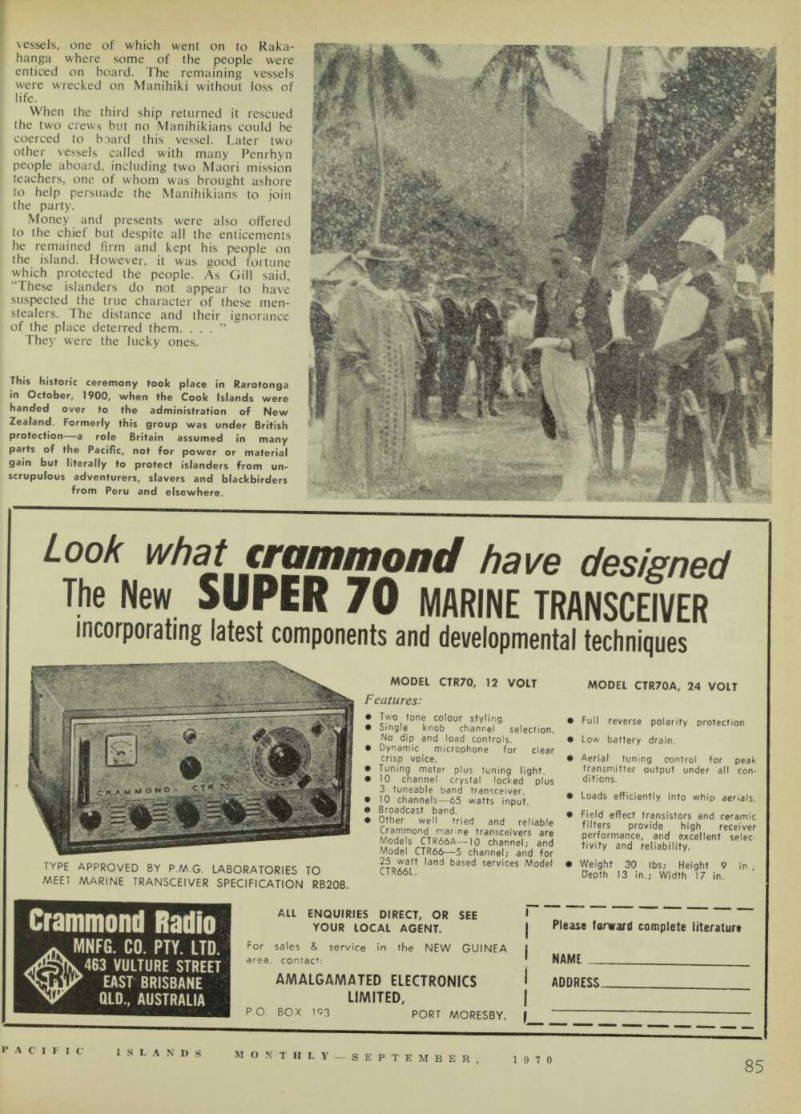
This historic ceremony took place in Rarotonga in October, 1900, when the Cook Islands were handed over to the administration of New Zealand. Formerly this group was under British protection—a role Britain assumed in many parts of the Pacific, not for power or material gain but literally to protect islanders from un scrupulous adventurers, slavers and blackbirders from Peru and elsewhere.