Yesterday
p. 85 · Read in the full issue
The death, at 82, was reported of Mr. P. A. Morris, co founder of the Pacific Islands trading firm of Morris Hedstrom Ltd.
Although American-born, he was educated in Australia and when in his early 20’s became associated with Maynard Hedstrom who was four years his junior. The two young men began trading at Levuka, Fiji, as Morris Hedstrom and Co. but subsequently moved their headquarters to Suva, on the way absorbing the firms of Miller Hedley and R. Bentley and Co. in Levuka, Arthur Joske in Suva and, some time later, Henry Marks & Co. Ltd. Mr. Morris retired from active management in 1921 to live in Sydney but remained a director of the Big Firm until his death.
Other news in PIM for September 1950, 20 years ago, included: A RNZAF Catalina was badly smashed when landing in Vila Harbour, New Hebrides. On board were the Resident Commissioner of the BSIP, Mr. H. G. Gregory Smith, Mr. L. G. Usher, Fiji Government Public Relations Officer, Mr. R. A.
Derrick, chief of technical education in Fiji and seven other passengers, none of whom was seriously injured.
Who was making huge profits out of rice exported from Australia to Papua-New Guinea, asked PIM?
Australian growers were getting £23 per ton for rice but the planter in New Guinea paid something like £7O per ton when it was landed on his plan tation. Government controls, a hang over from war-time restrictions, were blamed for the huge gap between what the producer got and what the consumer paid. It was suggested that it was all part of an Australian bureaucratic plot to make P-NG cost-of-living as expensive as possible.
Western Samoa was enjoying con :inued prosperity and even the government was doing very nicely in a financial sense. The budget that lad just been presented estimated a £60.000 surplus, plus £500,000 in its general reserve and a substantial sum n its capital development reserve.
The death, on August 22, of Mrs. lessie Fitch was reported from -ondon. She was the wife of Captain \. S. Fitch, founder of Steamships fradmg Co. Ltd., of Papua. They lad been on a world tour.
There was an unofficial conference n Sydney between representatives of ’apua-New Guinea “Big Firms” and he Australian Government as to whether copra marketing in the ter
ritory could be taken out of the hands of the Production Control Board (set up during the war) and returned to private enterprise. It was eventually agreed that no change was currently feasible and that the board should continue to market copra while a system in operation in Fiji was examined.
The new Suva market building opened for business, with some regret for passing of the open-air market beside Nubukalou Creek which was said to be “one of the Colony’s most picturesque institutions”. The new markets were built on reclaimed land behind King’s Wharf and there was
a local controversy as to whether the vacant land round the new build ings should be turned into a car park or a public park. (The car park won and was later joined by an extensive bus station).
About 90 overseas and interstate visitors, including some from the United States, South Africa, India, Mauritius, Hawaii, Java, Fiji and China, met at a sugar conference in Brisbane. Although there were no delegates from Papua-New Guinea, there was much comment on how New Guinea had helped world sugar production.
“I have great respect for the New Guinea natives as horticulturists,” said a US delegate. Dr. E. W.
Brandes. “They have simply hundreds of varieties of cane which they have developed by their catch-as-catch-can methods”. He recalled how one cane taken from New Guinea to Hawaii in 1928 had had the highest yield of any commercial cane—l3o tons to the acre. Queensland sugar techno logists intended to make further field investigations of New Guinea sugar cane in early 1951.
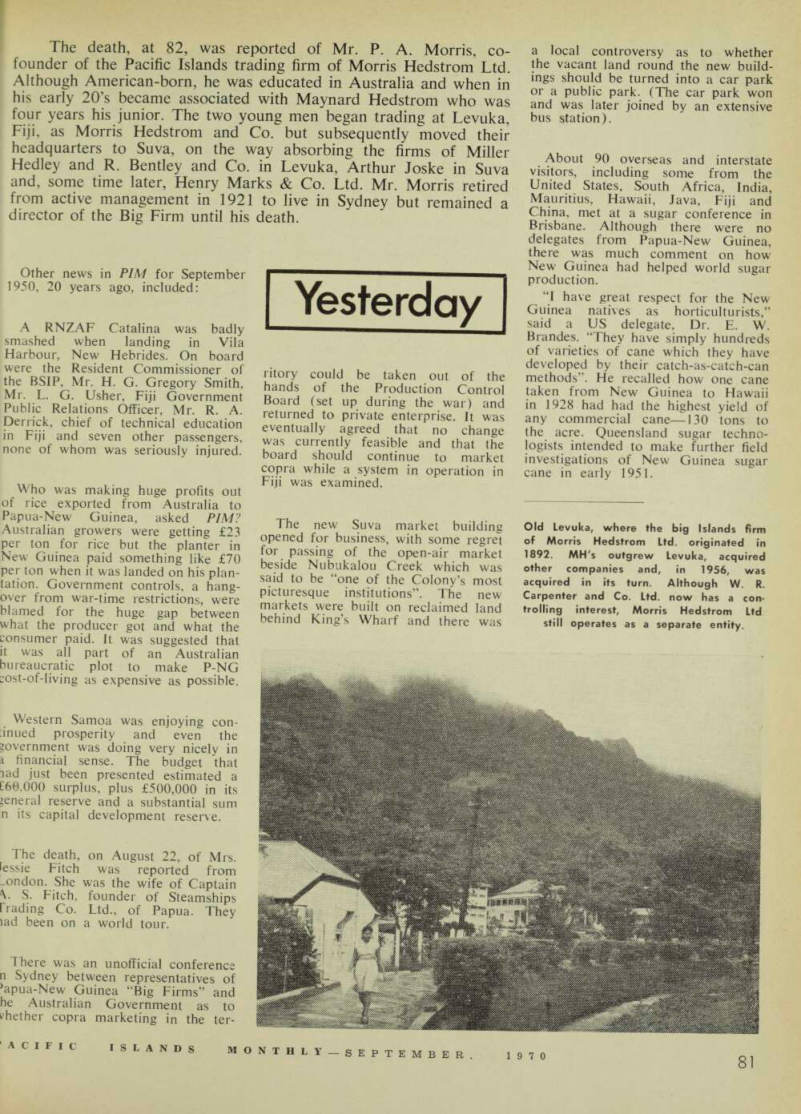
Old Levuka, where the big Islands firm of Morris Hedstrom Ltd. originated in 1892. MH's outgrew Levuka, acquired other companies and, in 1956, was acquired in its turn. Although W. R.
Carpenter and Co. Ltd. now has a con trolling interest, Morris Hedstrom Ltd still operates as a separate entity.