Headaches among hurrahs
pp. 24-25 · Read in the full issue
Fiji on eve of independence: Headaches among hurrahs
By R. W. Robson
When Prince Charles, acting for the Queen, breaks out Fiji’s new flag on October 10, the fledgling dominion will receive warm greetings and good wishes from all the nations of the four continents washed by the Pacific Ocean—and especially from its immediate neighbours, Australia and New Zealand.
Fiji was ceded by its high chiefs to the British Crown on October 10, 1874. Until about 1950, it was a remote, sugar-growing colony of three big islands, and hundreds of small ones which, like most of the islands of the Pacific, rarely made world headlines.
The winds of political change, which swept away the British Colonial Empire soon after World War 11, and turned colonies and dependencies into innumerable unprepared and fumbling “independent democracies”, were slow in reaching the South Pacific.
Then in the 1960’s the new nations of West Samoa, Nauru and Cook Islands made their bow to an indifferent world, and in June, 1970, the hitherto British-protected kingdom of Tonga moved to a higher status of independence.
Now Fiji joins the happy concourse. Papua-New Guinea and the Solomon Islands are close behind.
These are not formidable new nations. Leaving New Guinea’s two millions out, the populations of all the South Pacific Islands would not add up to half the population of Sydney.
But they have strategic, political and economic importance and they expect to enjoy steady growth and national freedom under the protection
of Britain, United States, Australia and New Zealand.
Rain or shine, the prevailing spirit at the elaborate ceremonies planned for Fiji next month will be one of friendliness and optimism, Fiji will need a full measure of both. The new nation faces some problems of peculiar complexity, There is the racial problem, arising out of the fact that the Indians (over 250,000) out-number the Fijians (some 220,000), and Indian political policy is shaped by a small, influential group which is anti-European, and land-hungry.
There is the social problem, created mostly because the popula tion growth has out-stripped the development of natural resources, There are not enough jobs for the oncoming generation, There is a finance problem because Fiji needs more and more capital from abroad to encourage or create new industries, so as to pro vide employment and food for a steadily growing population, There is a politico-economic prob lem, insofar that unless political harmony is maintained between Fijians and Indians, overseas investors will not be encouraged to enter Fiji and an inflow of overseas capital is vital to the new nation’s future, There is an extra-special economic
problem in the fact that the Colonial Sugar Company, which has conducted the country’s chief industry for 50 years, is withdrawing from Fiji in 1972; and there is no indication yet of how the industry will be carried on in the future.
There is a property problem. A very large proportion of Fiji’s land belongs “irrevocably” to the indi genous race. The immigrant race naturally seeks much greater land rights.
A very large proportion of Fiji’s industries is owned by Australian corporations. A small but vociferous group of Indian politicians insists that the operations of overseas cor porations be curtailed by govern ment action, in favour of local traders. They hope to achieve this by introducing the common roll, for the election of the parliament. A real problem lies in the fact that the common roll idea is resisted by Fijians and Europeans, for obvious reasons.
But, while the outlook is beset by headaches, it is not all gloom.
New Prime Minister will be Ratu Sir Kamisese Mara. In the last three years, as Chief Minister, Mara has disclosed an impressive degree of leadership. He has brought com promise and unity to a Fijian-Indian
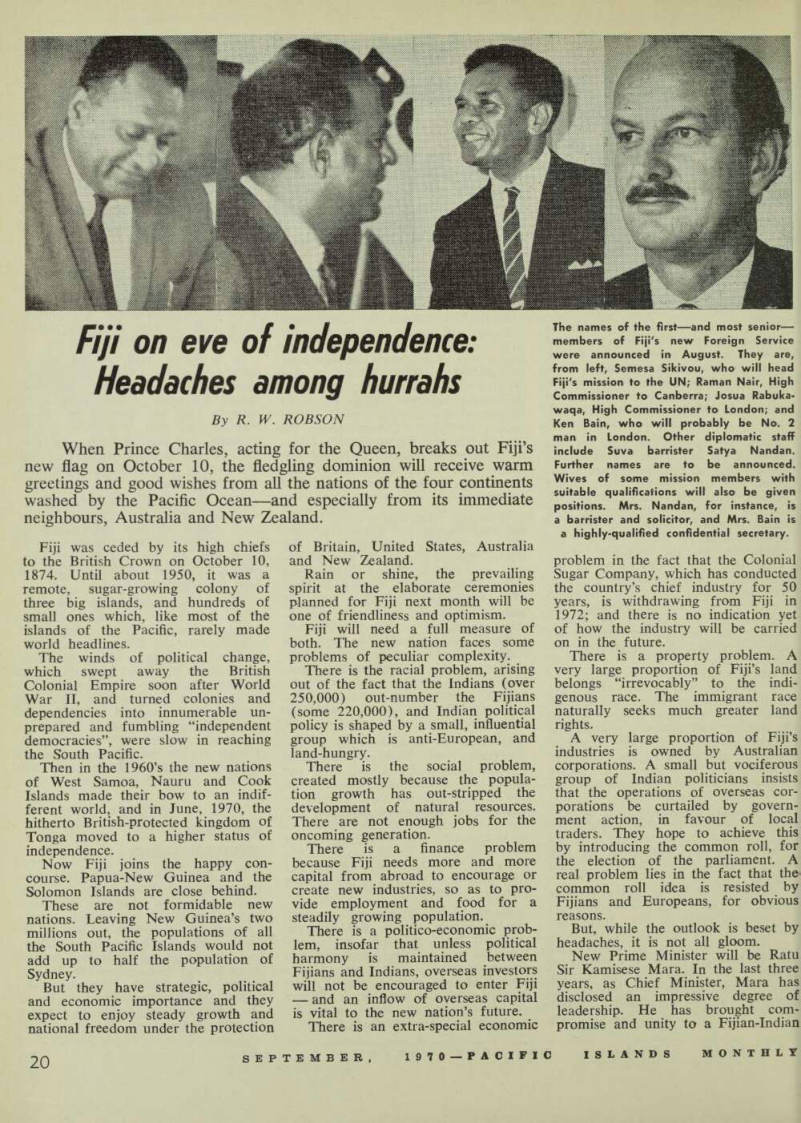
The names of the first—and most senior— members of Fiji's new Foreign Service were announced in August. They are, from left, Semesa Sikivou, who will head Fiji's mission to the UN; Raman Nair, High Commissioner to Canberra; Josua Rabuka waqa, High Commissioner to London; and Ken Bain, who will probably be No. 2 man in London. Other diplomatic staff include Suva barrister Satya Nandan.
Further names are to be announced.
Wives of some mission members with suitable qualifications will also be given positions. Mrs. Nandan, for instance, is a barrister and solicitor, and Mrs. Bain is a highly-qualified confidential secretary.
situation that seemed impossible of reconciliation, and the way in which he has attacked his young nation’s peculiar problems suggests that he has vision, and no delusions about the difficulties immediately ahead of his government. His team of ministers (European, Fijian and Indian) have been very loyal to him sometimes in awkward situations and have developed considerable talent in administration.
So long as they do not lose their heads in the rosy clouds of dominion status, they should give Fiji what it needs, in this critical time of change over.
The other factor, plainly there to comfort us, is the truly remarkable speed and volume of tourism development.
We get only vague estimates of the amount of real money that tourism is taking into Fiji, but there is no doubt that it has already ac complished a great deal. Millions of dollars have gone into Fiji in the last two or three years for the capital development (especially the construction of tourist resorts) of the tourist industry. Superficially, at any rate, Fiji is enjoying a large measure of prosperity.
If the members of Fiji’s new Administration can keep their heads, and avoid racial tensions, and adjust their outlook so that the start lingly different conditions surround ing dominion status can take care of their country’s peculiar problems, then Fiji’s future can be a happy one.
But it will need, for some little time, all the goodwill and practical help it can get from the English speaking nations with interests in the South Pacific.