Islanders feel their way in
p. 23 · Read in the full issue
the new Solomons council
From DAVID KEATING, in Honiara.
The first session of the new Governing Council in July was for just over a fortnight—sufficiently long enough to get the new con stitutional procedure under way in the Solomons. The real effect of the Governing Council will not be felt until after the next session when the various committees will have been at work hammering out matters that come before them.
The real test is therefore yet to come and it remains to be seen how the committees cope.
In the first session the committees had not, of course, got into opera tion, so the proceedings on some issues were more drawn out. But once the elected members settled in and realised that they were in control if they voted together, things began to happen. A motion was passed calling upon the High Commissioner to revoke charges for medical services to Solomon Islanders which had just come into force before the new Governing Council had commenced to operate.
With one exception all the elected members voted in favour of the motion, thereby outnumbering the Public Service members. The excep tion was William Betu, chairman of the Education and Social Welfare Committee. His committee had not been able to deal with this item as this was the first session of Governing Council. Consequently he was not obliged to take any particular stand on the motion, so one must assume that he was simply in favour of the charge scheme. In any event he certainly was not popular with the other elected members.
In view of objections to mining operations by various Solomon Islands landowners, a bill was put through by Archdeacon Peter Thomp son to pay a 5 per cent, royalty to landowners affected, instead of a 5 per cent, royalty to the respective local council. This was done in the hope that it would satisfy the objectors. Whether it will or whether they will now want a larger royalty remains to be seen.
On the Public Service side, a much needed Public Health Bill was put through. Until this bill was passed there was no local legislation covering this important social aspect. Up to now English public health law applied wherever possible; it did not of course, cover many particular problems of the Solomons.
Motions proposed by Peter Salaka were passed to make workmen’s compensation insurance compulsory in some cases and for a minimum wage rate to be fixed for some classifications of workers.
In a lighter vein, Alfred Maeke, member for West Guadalcanal, pro posed the motion that members should not need to wear suits in the council. This was rejected by elected members as well as Public Service members—perhaps because as they had already bought them they did not want to be denied the opportunity of wearing them.
On August 10, Joseph Bryan’s election petition was heard in the High Court. It was unopposed by Leone Laku, the member declared to have been elected, and the returning officer, Stuart Harbinson, for the East Guadalcanal District.
The petition stated that the votes at two polling stations had been rejected because they had been marked with the names of the voters and at one station with the voters’ registration numbers as well by the polling assistants. The petition was granted and Leone Laku’s election was declared void. A new election is now to be held, and it’s anybody’s guess at the result, even though Joseph Bryan would have won in the last election if these votes had not been rejected.
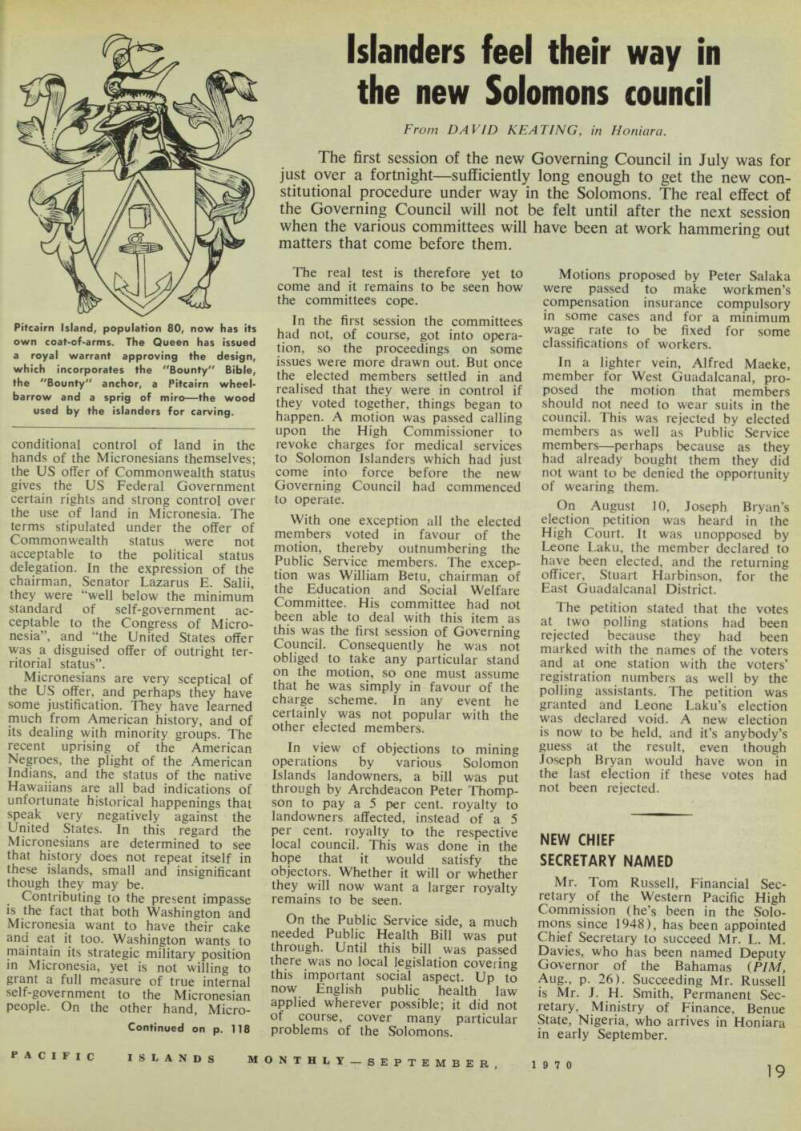
Pitcairn Island, population 80, now has its own coat-of-arms. The Queen has issued a royal warrant approving the design, which incorporates the "Bounty" Bible, the "Bounty" anchor, a Pitcairn wheel barrow and a sprig of miro—the wood used by the islanders for carving.