Pacific Shipping
pp. 117-125 · Read in the full issue
Islanders Will Meet To
Discuss Fishing Methods
From HELEN ROUSSEAU, in Noumea All varieties of Pacific fishing techniques—emphasising boats and gear—will be discussed at the next South Pacific Fisheries meeting to be held in Noumea, October 19 to 26.
All government fisheries depart ments in the South Pacific are being invited to send representatives to this meeting, which is the fourth of its kind to be arranged by the South Pacific Commission. Participants are also being invited from scientific institutes and commercial fishing companies.
Among the various island sea craft to be considered at the meeting are the Florida-type fishing skiffs from Fiji, the San Pierre dories now being constructed in American Samoa, the Western Samoan canoes used for bonito and the Hawaiian fishing sampan from Guam.
Among new designs and materials such as fibreglass and ferro-cement, study will be made of plans to build ferro-cement boats after a design taken from a New Caledonian fish ing boat.
The SPC Fisheries Officer, Mr.
Val Hinds, of Dublin, says that the Caledonian fishing cutter forms a fleet of about 35 vessels, operated by the Noumea Fishermen’s Co operative Society. This type of boat has been built for over 30 years by veteran Caledonian boat builder, Alphonse Lebert.
Last year, Australian naval architect, Arthur Swinfield, visited Noumea and made plans of the Caledonian boat. Mr. Lebert pro vided a 2i ft half-model of his craft to aid in plan drawing.
An interesting aspect of the work was the fact that Mr. Lebert had worked with Mr. Swinfield’s father, as a boy, in a Sydney shipyard.
The project was sponsored by the SPC, which now offers the sets of plans for sale at $2 or $3.
Fiji has been interested in this boat-type for the islands’ fisheries
associations. Mr. A. Sannergren, of the UN Industrial Development Grgamsation, has been working on a modified hull with a view to constructmg the Caledonian-type boat m terro-cement.
A second type of fishing craft to be considered at the October meeting
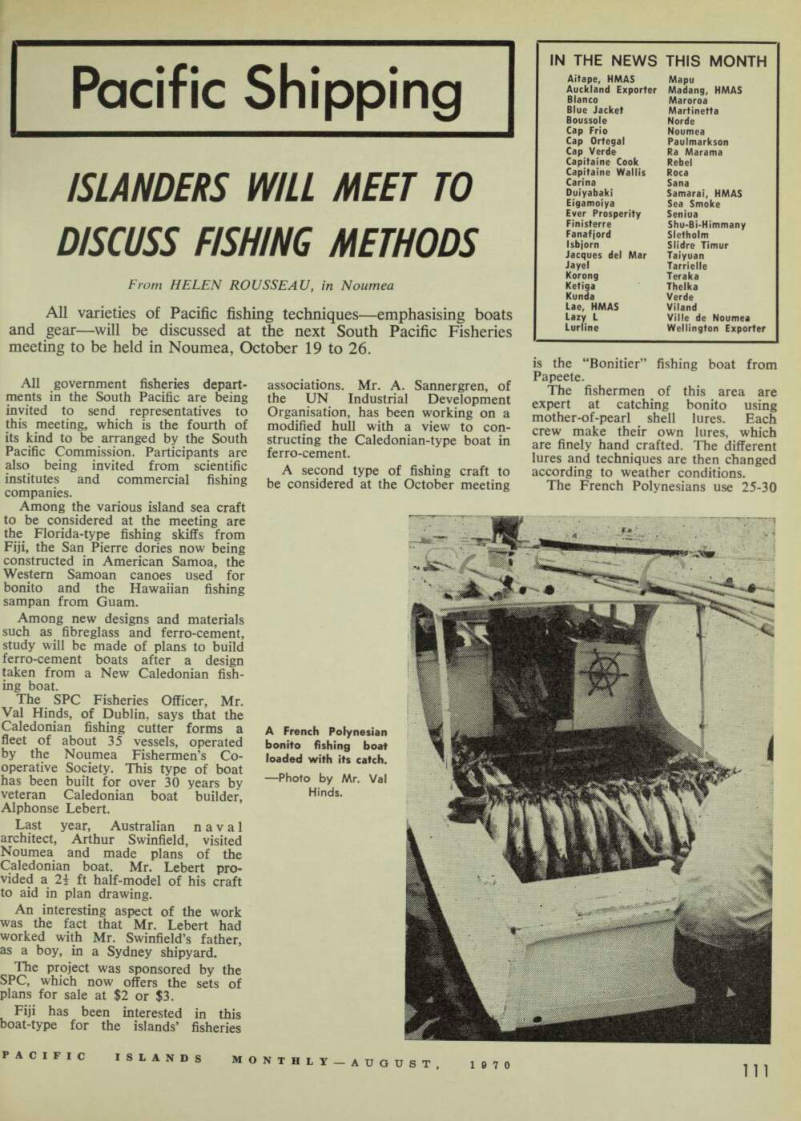
is the “Bonitier” fishing boat from 6 fishermen of this area are eX pcrt a.cThing bonito ' using mother-of-pearl shell lures. Each crew make their own lures, which are finely hand crafted. The different lures an( j techniques are then changed according to weather conditions, The French Polynesians use 25-30
A French Polynesian bonito fishing boat loaded with its catch.
Photo by Mr. Val Hinds.
ft long boats, which move at a fast 15 to 18 knots.
Mr. Hinds believes the Tahitians’ special skill could be applied else where. It’s already being taken up seriously in the Cook Islands by local fisherman and diver, Tikake Williams.
In the Cooks, boats were registering catches in excess of 100 bonito per day, last June, even with boats only doing eight knots.
It has now been suggested that SPIFDA (South Pacific Islands Fisheries Development Agency) could possibly contract Tahitian fishermen to go around the territories to instruct and demonstrate their technique. This way they could help revive an old Pacific skill of fishing for bonito with shell lures.
Other fishing techniques will of course be considered by the SPC meeting: Skipjack and inshore fish ing methods, besides reef traps and deep-line fishing.
The week long gathering is to be followed by a meeting of the fisheries consultative committee for SPIFDA, scheduled in Noumea for October 27 to 30.
Big New Moves
On Containerisation
Hamburg Sud, with three expand ing shipping runs including the Islands and a strong hand in the Gilbert and Ellice Islands’ Teraka merchant marine training scheme, will mtroduce new fully - containerised >hips to the South Pacific in April 3r May, next year.
Hamburg’s container plans for the South Pacific follow announced aims >f two competitors, Matson and Farrell, to introduce container ships vithin 16 months.
However, no plans have yet in cluded projected container calls in the islands. Suva, Fiji, is considered the nost likely for a small container complex because of its strategic and economic position. Ironically, Pago ’ago, American Samoa, with a mailer economy but a superior larbour to Suva, has been unofficially uggested by Matson for a container omplex. To Matson’s chagrin, the JS Government has not yet made a lecision on Pago Pago.
Smaller Islands’ ports, such as Nukualofa, Rarotonga, Honiara nd Vila have no chance of hosting ontainer vessels for many years.
On Australia-!apan or South-East routes, however, the New Juinea ports of Port Moresby, Lae >r Kieta, because of increasing argoes through these centres, may ee containers by the mid-1970’5.
Hamburg Sud’s three 24,400-ton ontainer vessels are currently being
built in Hamburg, north Germany, as part of Sioo million 13-ship construction programme the company has let to West German shipyards.
The container vessels will be used by Hamburg’s wholly-owned subsidiary, Columbus Line, and be christened with two names each, the prefix being “Columbus”.
The first container departure is scheduled for March next year from Hamburg, and the nine-week return route will be East Coast US, West Coast North America, NZ, Australia, West Coast US and Hamburg.
By April, 1972, the three vessels are expected to be on this run.
These vessels will cost $8 million each, carry no passengers, have 1,100 20 ft English-made containers of which 450 will be reefers (refrige rated) and travel at 22-23 knots, Turbine-powered, instead of using diesel engines, they’ll have crews of 30 each, including Islanders from Tarawa’s Teraka training school.
Their stops will include two NZ ports, Melbourne, Sydney, Port Alma (Queensland), Vancouver and Los Angeles. They may call at Honolulu; they won’t call at Townsville or Tarawa.
Much of their northbound trade will be Australasian meats for the US,
which will be housed in the reefers.
Of the other ships under construc tion in Hamburg’s $lOO million pro gramme are three 7,300-ton dwt. freighters which can take up to 250 20 ft containers. For Chicago and Mediterranean routes, they’ll be moved to the South Pacific, if needed.
Columbus’ Cap ships, familiar to the South Pacific since this company entered the area for the US meat trade in 1959, are gradually to be phased out, to allow for the con tainers.
All are currently maintaining Columbus’ North America west coast- NZ-Australia-GEIC-Hawaii-west coast route. Of the nine 15-year-old Caps, Cap Ortegal, Cap Verde and Cap Frio have been sold for about $1 million each. (They each cost $4 million to build.) Verde (German owner) and Frio (Greek) were immediately re chartered to Columbus for the Pacific and they supplement the runs of the other 6,190-tonners, Blanco, Finis terre, Vilano, Roca and Norde.
About 80 Micronesians and Poly nesians trained at Tarawa are em ployed on five of these vessels.
They are working as deckhands, engine-room helpers or assistant stewards.
Sixteen-knot Cap ships take crews of about 41, compared with the con tainer contingent of 30. The reduc tion, unfortunately for the Gilbertese, is in numbers of ordinary seamen, not officers. No plans are on to train Tarawa-recruited seamen for higher posts.
Hamburg Sud’s other Islands runs arc from Europe to Melanesia and from NZ to Melanesia (a wholly owned subsidiary, NZ Export Line, operates here).
With a gross annual income of about $5OO million, utilising 92 ships and employing 18,000 people, Ham burg Sud grew out of profits made by a baking powder salesman in the mid-1800’s.
Today all the business is in the hands of one man—Mr. Rudolf A.
Oetker, of Bierlefeldt, West Ger many.
With brewery, hotel, food and other interests, Mr. Oetker has made a couple of visits to Australasia in recent years. He may return for the inauguration of the container calls in May next year.
Meantime, he remains Germany’s biggest single shipowner and one of the republic’s wealthiest men.
Miles New Ship On
Yap, Koror Route
A new ship has been permanently assigned to MILI’s Japan-Yap and
Koror route. She is the 1,980-ton Fanafjord, scheduled to arrive in the Trust Territory from New Zealand in July, calling at Truk and Koror with a capacity load of construction materials and equipment for the new Continental Hotel projects under way in the two districts.
From Koror, she was to proceed north to Yap, Guam, Saipan, and then Japan for the start of her regular service which is Kobe, Yokohama, Saipan, Guam, Yap, Koror, Yap, Kobe. Fanafjord is to be perma nently assigned to this route, providing direct monthly services from Japan, to Yap and Koror.
MILI also expects to start a new scheduling pattern to ensure stability
and regularity in its west coast sailings in September or November.
MILI traffic manager, Mr. Tage Blytmann, announced this in July on his return to Saipan from the USA where he met the newly-appointed MILI Chief of Transportation, Wayne Thiessen, and MILI directors.
Vessels will now sail from the west coast of the USA and Hawaii through the Trust Territory to Japan, and return via Trust Territory ports directly to the USA.
MCIA# DIIKIC D r T , A#CCAI
New Runs Between
Aust. And Fiji
Nauru Pacific Shipping Lines and the China Navigation Company have
both started new services between Australia and Fiji.
Eigamoiya , the 4,426-ton NFS ship carrying general cargo and phos phates, is to run between Melbourne and Suva with calls at intermediate ports. She is one of three ships owned by NFS Lines, which is wholly owned by the Nauruan Government.
The China Navigation Company’s 7,472-ton vessel Taiyuan, is equipped for unit cargo and has first class ac commodation for 86 passengers. She is to open a three-week service from Sydney to Brisbane, Noumea, Lau toka and Suva.
The "Teraka's" Future
Is In Doubt
The future of the Gilbert and Ellice Islands’ merchant seaman training vessel Teraka is in doubt. Anchored off Betio, Tarawa, for several weeks, she has been inoperative since her breakdown in the Ellice Islands earlier this year, and subsequent tow to her Tarawa base.
A vital engine shaft, to cost about $30,000, has to be replaced, and to August no decision had been made to order one from overseas.
Colony authorities are reluctant to spend more on what already has been a massive purchase, maintenance and repair burden of about $750,000 on the Teraka of the colony’s mini budget resources.
They could well write Teraka off and give trainees experience instead on smaller inter-island vessels,
Congestion Forces
Noumea Freight Rises
Freight rates to Noumea and the nearby nickel wharf of Doniambo were scheduled to rise 15 per cent, from July 20, following the increasing congestion registered at these Cale donian wharves.
Shippers claim that vessels are taking up to three weeks to load and unload in the port. As many as 11 ships at a time may be seen waiting amid-stream to have access to the three berths in Noumea and two at Doniambo.
Congestion on the wharves has reached such a point that importers claim it takes one month to clear goods. The rapidly expanding local economy is importing such a quantity of machinery and vehicles that motor cars and trucks—up to 100 at a time—are disembarked along the bayside, stretching in a line a quarter of a mile long, away from the wharves.
Meanwhile, increasing costs and freight problems have led to Noumea agents being advised that the Welling ton Exporter and Auckland Exporter
were to be taken off the New Zealand-Noumea run in July.
The French company, Sofrana, on the other hand, introduced a second vessel in July to its New Zealand- Noumea-Fiji-Wallis islands run. The Capitaine Wallis thus joined the Capitaine Cook on this route.
Meanwhile, preparations for the construction of a new deep-water wharf have begun in Noumea, in the vicinity of the old “Quai des Volontaires” launch wharf, which will shortly be out of operation.
Lord Howe Gets
A New Service
Following the discontinuation of the Jacques del Mar stop-over at Lord Howe Island on her way from Sydney to Noumea, the Slidre Timur, owned by Karlander Australia Ltd., has undertaken to fill the vacuum, charg ing the same freight rates of $37,5 a ton.
Earlier in July, islanders of Lord Howe were seriously worried about the ending of the Jacques del Mar service. The line had indicated that it wanted an increase of freight rates if the Jacques del Mar was to con tinue to Lord Howe, and it has indi cated the same thing to Norfolk Island.
Worried at the thought of being left without a shipping service at all (they had only just won an extension of life for their failing flying-boat service to the island), the islanders approached Captain Helm of the Ville de Noumea. He agreed to take over the service to Lord Howe—but at a price of $45 per freight ton.
The islanders were clearly unhappy at that, and, according to the Signal, private citizens were even considering flying to Sydney and approaching Burns Philp or Karlander to make a cheaper offer.
Karlander, at any rate, has agreed to put in at Lord Howe—the first time on July 28. After this date it’s expected that Karlander’s Sletholm will continue the service.
There will be sighs of nostalgia for the Jacques del Mar, but there are also sighs of relief that at least some one will be delivering freight.
Volcanoes Discovered
Below The Sea
While US Navy ships were awaiting the splashdowns of successful moon missions, Apollo 11 and 12, in the vicinity of the Samoas they came up with an unexpected scientific bonus.
They made depth soundings to the floor of the Pacific and found evidence of four submerged peaks— possibly the tops of submerged, ex tinct volcanoes or part of a huge volcanic ridge.
Shipping Briefs
• Four of the Matson Line’s South Pacific voyages have been can celled because of the sale of the Matson liner, Lurline, to the Chandris Line. The voyages were cancelled to allow the Mariposa and Monterey to fill the gap on the US-Hawaii service left by the Lurline’s sale.
Normal sailings will resume in October. • Operating costs and competition on the Noumea-New Zealand ship ping run have forced the New Zea land Export Line to withdraw one of its two freighters from the Pacific Islands trade.
A director of the line, Mr. J. V.
Kean said the Auckland Exporter would be withdrawn, but the Welling ton Exporter would be retained in the Pacific trade, and the line would now concentrate on the Papua- New Guinea run. • Britain has made a grant to Fiji of £75,000 towards the purchase of a “ready to go” hydrographic survey vessel. The vessel is the 92 ft motor yacht Martinetta being bought from the Decca Navigation Company and to be sailed from Dubhai in the Persian Gulf to Fiji in September.
The grant will cover 90 per cent, of the cost. The vessel will survey areas where the accuracy of charted reefs is in doubt and for work in areas completely unsurveyed. • Tonga’s largest locally built vessel, a barge built from concrete, has been launched at Maufanga, Tonga. The barge, built by the Tongan company, Ferrocrete Pacific Ltd., will be used for crayfishing operations by Fathom Fisheries. She is 54 ft long and fitted with a freezer chamber capable of holding from 25 to 30 tons of fish and crayfish. • Orders for 21 jet-barges, worth $A681,000 from New Caledonia, Fiji, Tonga, New Guinea, New Hebrides and Australia, have been received by the New Zealand export company, Stars Jet Ltd.
The barges will be aluminium or steel and range from 26 ft to 90 ft in length; they are shallow drafted for use on swift flowing rivers and in shallow harbours. • Survey ship, the Boussole, specially built for the French navy for hydrographic work in the tropics, visited Suva early in July. Working between French Polynesia and New Caledonia, she has a cruising radius of 4,000 miles and has a crew of 35 officers and men.