The jungle
pp. 111-114 · Read in the full issue
claims it's own
(Story over page)
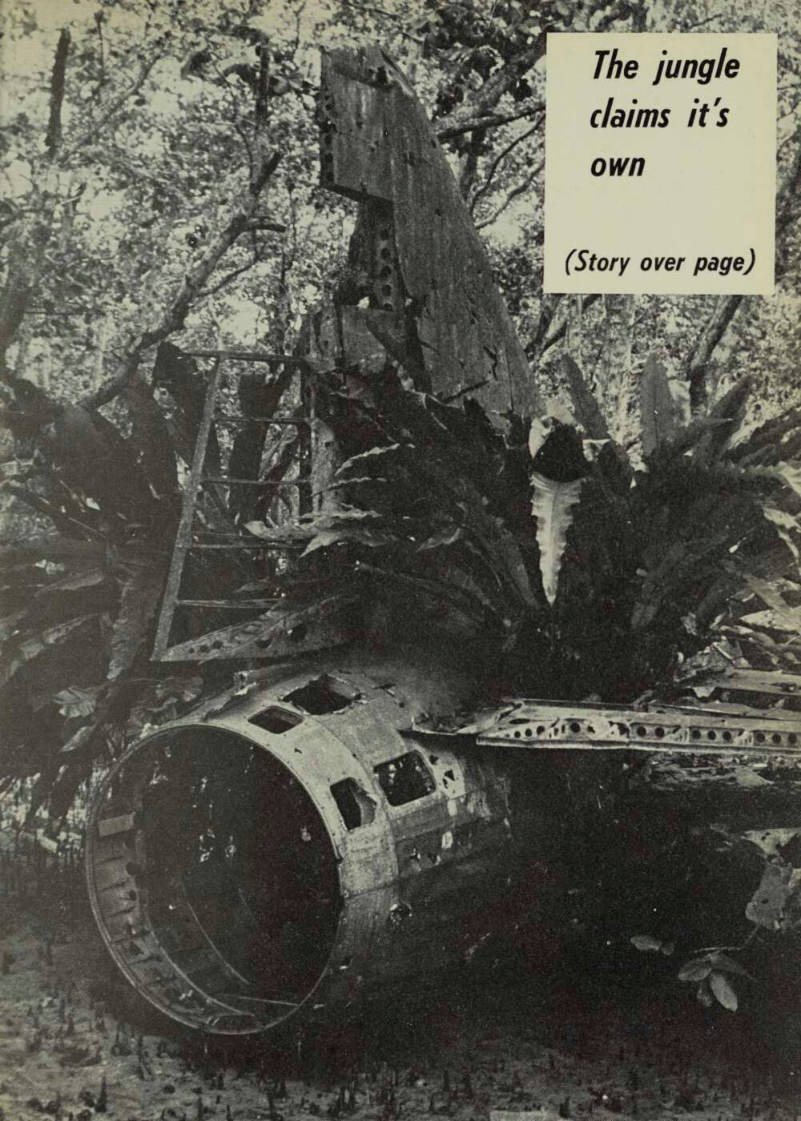
When Australian photographer, BRUCE ADAMS, made an extended trip to the South Pacific to take photographs of the wreckage left by the Pacific War for his book, he was struck by the way in which the 25-year-old debris of the fighting had taken on the textures of the surrounding jungle.
The jungle was reclaiming its own.
Vegetation was growing from the fuse lage of crashed planes, old airstrips and bomb holes had become mere geographic features in the landscape, locals had created extensions to their homes with wreckage, downed planes were the abode of fish in the warm lagoons, the list was endless.
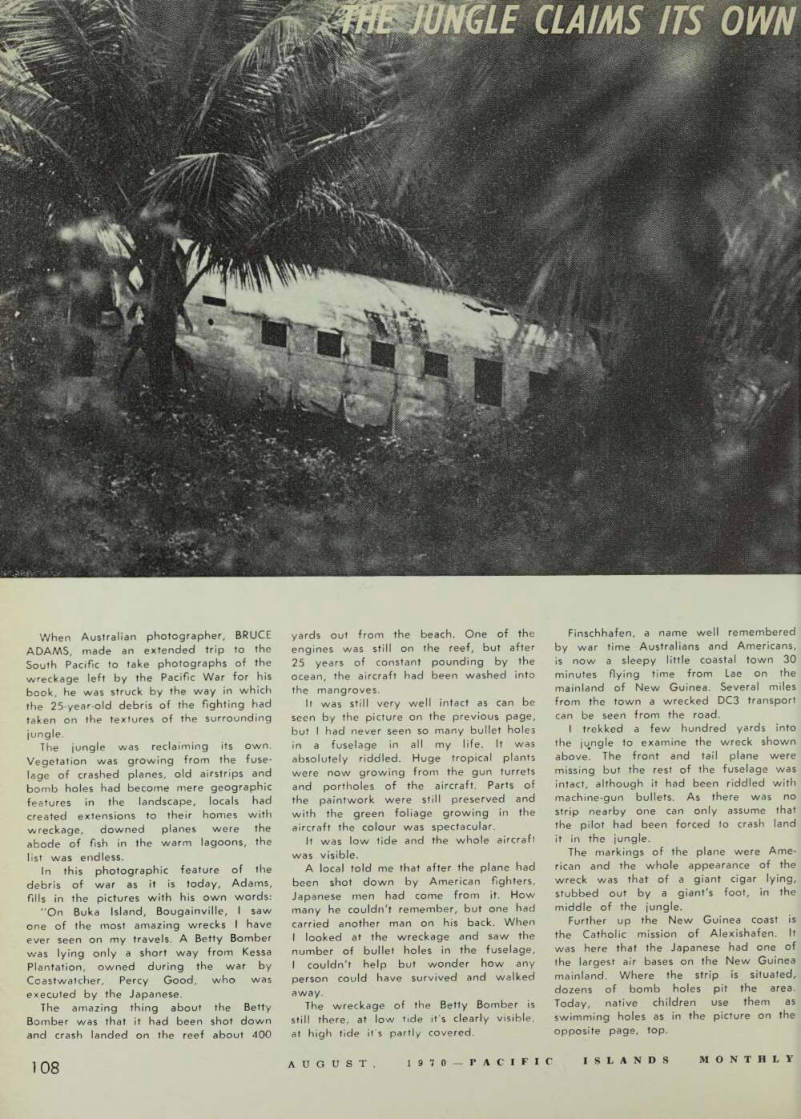
In this photographic feature of the debris of war as it is today, Adams, fills in the pictures with his own words: "On Buka Island, Bougainville, I saw one of the most amazing wrecks I have ever seen on my travels. A Betty Bomber was lying only a short way from Kessa Plantation, owned during the war by Coastwatcher, Percy Good, who was executed by the Japanese.
The amazing thing about the Betty Bomber was that it had been shot down and crash landed on the reef about 400
yards out from the beach. One of the engines was still on the reef, but after 25 years of constant pounding by the ocean, the aircraft had been washed into the mangroves.
It was still very well intact as can be seen by the picture on the previous page, but I had never seen so many bullet holes in a fuselage in all my life. It was absolutely riddled. Huge tropical plants were now growing from the gun turrets and portholes of the aircraft. Parts of the paintwork were still preserved and with the green foliage growing in the aircraft the colour was spectacular.
It was low tide and the whole aircraft was visible.
A local told me that after the plane had been shot down by American fighters, Japanese men had come from it. How many he couldn't remember, but one had carried another man on his back. When I looked at the wreckage and saw the number of bullet holes in the fuselage, I couldn't help but wonder how any person could have survived and walked away.
The wreckage of the Betty Bomber is still there, at low tide it's clearly visible, at high tide it's partly covered.
Finschhafen, a name well remembered by war time Australians and Americans, is now a sleepy little coastal town 30 minutes flying time from Lae on the mainland of New Guinea. Several miles from the town a wrecked DC3 transport can be seen from the road.
I trekked a few hundred yards into the jungle to examine the wreck shown above. The front and tail plane were missing but the rest of the fuselage was intact, although it had been riddled with machine-gun bullets. As there was no strip nearby one can only assume that the pilot had been forced to crash land it in the jungle.
The markings of the plane were Ame rican and the whole appearance of the wreck was that of a giant cigar lying, stubbed out by a giant's foot, in the middle of the jungle.
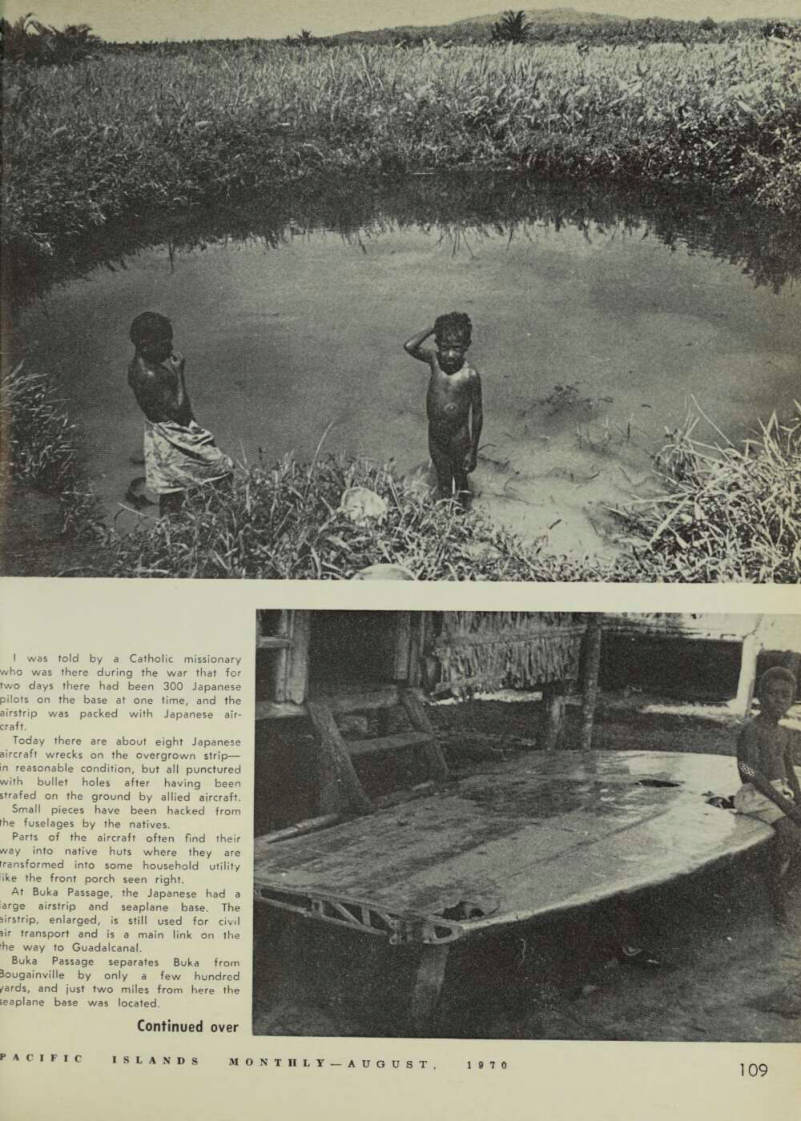
Further up the New Guinea coast is the Catholic mission of Alexishafen. It was here that the Japanese had one of the largest air bases on the New Guinea mainland. Where the strip is situated, dozens of bomb holes pit the area.
Today, native children use them as swimming holes as in the picture on the opposite page, top.
I was told by a Catholic missionary who was there during the war that for two days there had been 300 Japanese pilots on the base at one time, and the airstrip was packed with Japanese air craft.
Today there are about eight Japanese aircraft wrecks on the overgrown strip— in reasonable condition, but all punctured with bullet holes after having been strafed on the ground by allied aircraft.
Small pieces have been hacked from the fuselages by the natives.
Parts of the aircraft often find their way into native huts where they are transformed into some household utility ike the front porch seen right.
At Buka Passage, the Japanese had a arge airstrip and seaplane base. The airstrip, enlarged, is still used for civil air transport and is a main link on the the way to Guadalcanal.
Buka Passage separates Buka from 3ougainville by only a few hundred and just two miles from here the seaplane base was located.
Continued over
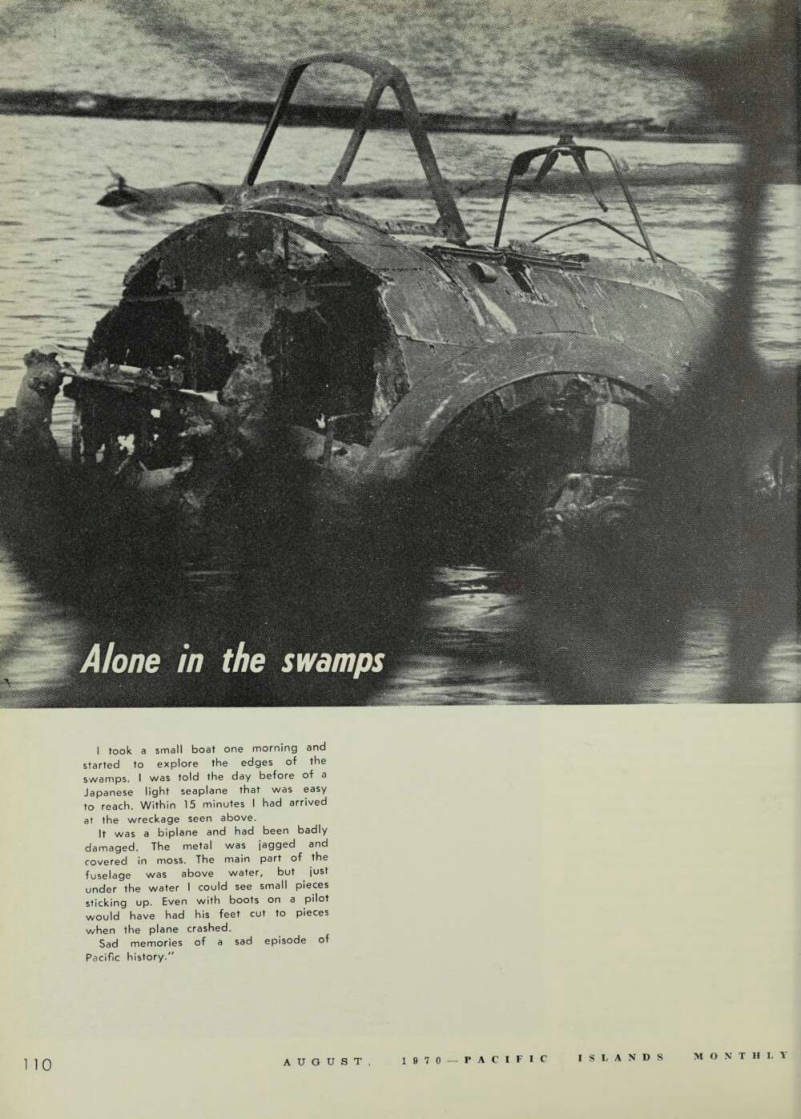
Alone in the swamps
I took a small boat one morning and started to explore the edges of the swamps. I was told the day before of a Japanese light seaplane that was easy to reach. Within 15 minutes I had arrived at the wreckage seen above.
It was a biplane and had been badly damaged. The metal was jagged and covered in moss. The main part of the fuselage was above water, but just under the water I could see small pieces sticking up. Even with boots on a pilot would have had his feet cut to pieces when the plane crashed.
Sad memories of a sad episode of Pacific history."