Our 40 years: As one leader sees us
p. 90 · Read in the full issue
one leader sees us
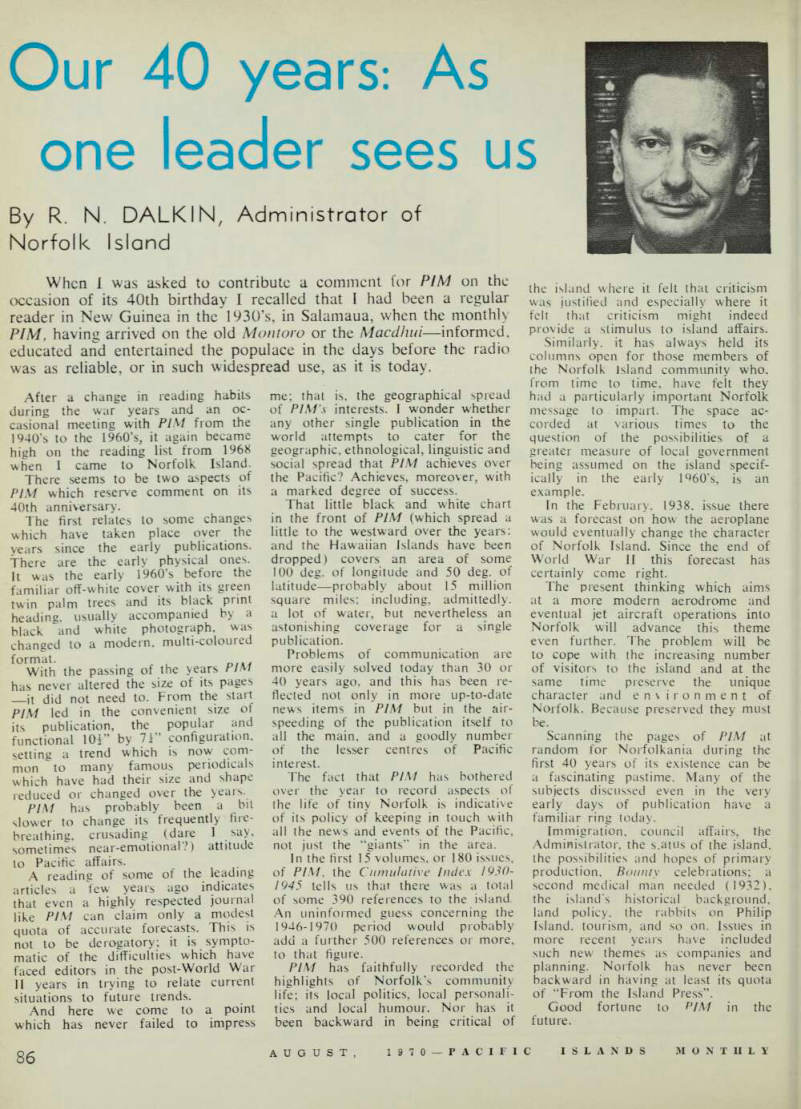
By R. N. DALKIN, Administrator of Norfolk Island
When 1 was asked to contribute a comment for PIM on the occasion of its 40th birthday I recalled that I had been a regular reader in New Guinea in the 1930’5, in Salamaua, when the monthly PIM, having arrived on the old Montoro or the Macdhid —informed, educated and entertained the populace in the days before the radio was as reliable, or in such widespread use, as it is today.
After a change in reading habits during the war years and an oc casional meeting with PIM from the 1940’s to the 1960’5, it again became high on the reading list from 1968 when I came to Norfolk Island.
There seems to be two aspects of PIM which reserve comment on its 40lh anniversary.
The first relates to some changes which have taken place over the years since the early publications.
There are the early physical ones.
It was the early 1960’s before the familiar off-white cover with its green twin palm trees and its black print heading, usually accompanied by a black and white photograph, was changed to a modern, multi-coloured f ° rmat - • r i n, A < With the passing of the years PIM has never altered the size of its pages it did not need to. From the start PIM led in the convenient size of its publication, the popular and functional lOi” by 7i” configuration, setting a trend which is now com mon to many famous periodicals which have had their size and shape reduced or changed over the years.
PIM has probably been a bit slower to change its frequently fire breathing, crusading (dare 1 say, sometimes near-emotional?) attitude to Pacific affairs.
A reading of some of the leading articles a few years ago indicates that even a highly respected journal like PIM can claim only a modest quota of accurate forecasts. This is not to be derogatory; it is sympto matic of the difficulties which have faced editors in the post-World War II years in trying to relate current situations to future trends.
And here we come to a point which has never failed to impress
me; that is, the geographical spread of PlM’s interests. I wonder whether any other single publication in the world attempts to cater for the geographic, ethnological, linguistic and social spread that PIM achieves over the Pacific? Achieves, moreover, with a marked degree of success.
That little black and white chart in the front of PIM (which spread a little to the westward over the years; and the Hawaiian Islands have been dropped) covers an area of some 100 deg. of longitude and 50 deg. of latitude—probably about 15 million square miles: including, admittedly, a lot of water, but nevertheless an astonishing coverage for a single publication.
Problems of communication are more easily solved today than 30 or 40 years ago. and this has been re flected not only in more up-to-date news items in PIM but in the air speeding of the publication itself to all the main, and a goodly number of the lesser centres of Pacific interest.
The fact that PIM has bothered over the year to record aspects of the life of tiny Norfolk is indicative of its policy of keeping in touch with all the news and events of the Pacific, not just the “giants” in the area.
In the first 15 volumes, or 180 issues, of PIM, the Cumulative Index 1930- 1945 tells us that there was a total of some 390 references to the island.
An uninformed guess concerning the 1946-1970 period would probably add a further 500 references or more, to that figure.
PIM has faithfully recorded the highlights of Norfolk’s community life; its local politics, local personali ties and local humour. Nor has it been backward in being critical of
the island where it felt that criticism was justified and especially where it felt that criticism might indeed provide a stimulus to island affairs.
Similarly, it has always held its columns open for those members of the Norfolk Island community who. from time to time, have felt they had a particularly important Norfolk message to impart. The space ac corded at various times to the question of the possibilities of a greater measure of local government being assumed on the island specif ically in the early I%o's, is an example.
In the February, 1938. issue there was a forecast on how the aeroplane would eventually change the character of Norfolk Island. Since the end of World War II this forecast has certainly come right.
The present thinking which aims at a more modern aerodrome and eventual jet aircraft operations into Norfolk will advance this theme even further. The problem will be to cope with the increasing number of visitors to the island and at the same time preserve the unique character and environment of Norfolk. Because preserved they must be.
Scanning the pages of PIM at random for Norfolkania during the first 40 years of its existence can be a fascinating pastime. Many of the subjects discussed even in the very early days of publication have a familiar ring today.
Immigration, council affairs, the Administrator, the s.atus of the island, the possibilities and hopes of primary production. Bounty celebrations; a second medical man needed (1932), the island's historical background, land policy, the rabbits on Philip Island, tourism, and so on. Issues in more recent years have included such new themes as companies and planning. Norfolk has never been backward in having at least its quota of “From the Island Press”.
Good fortune to PIM in the future.