widened our horizons
pp. 87-89 · Read in the full issue
Forty Years As A Pacific News-Magazine
Like the South Seas, we've widened our horizons
says PlM's third, and present, editor, STUART INDER Because the population of the Pacific Islands is small but widespread, distribution costs of PIM will always take up a large share of PlM's budget. Consequently, we have more friends than money.
But a reputation for friendliness, and for honest journalism, first attracted me to PIM in 1957. When 1 was invited to join its small staff, as joint editor with Judy Tudor, I was in no doubt that PIM was the kind of magazine I wanted to work for, and to help shape.
And that was a time for shaping.
The Pacific was going through yet another of its changes.
Before the two wars, the Pacific had been a planters’ Pacific. Private enterprise had done much in all the islands, and particularly in New Guinea, where I had just spent two years as ABC newsman.
Before World War 11, the govern ment there had for the most part ex plored new areas only if it felt there was some economic benefit to be gained. If there was gold in the highlands, then the Administration would go into the highlands in support of the miners, but not often otherwise.
The public service was small and undernourished; it did not have the funds to do much for the natives.
The people in the backblocks re mained without schools and health services. Those few public servants in the main centres were, often as not, regarded as bureaucrats by the planters and miners, who were practical people: who had little time for office wallahs. This attitude, 1 felt, was reflected in PIM which was the staunch supporter of private enterprise in the Islands. If private citizens had their grievances they could be guaranteed an airing in the columns of PIM. Which was as it should be, because if PIM did not give them a voice, nobody did.
But after the war metropolitan governments everywhere began to make larger and larger sums avail
able for Islands development—for schools, roads, hospitals, throughout the South Pacific. There was a sense of nationalism beginning to build, and the growing public service becoming more involved and encouraged development.
There was much public money wasted—as there still is today—but nobody could afford to sell short the work of this new breed of public servant. Generally speaking, he was practical, he was intelligent, he was hard-working and dedicated.
But he was not very vocal—he was not good at putting across to the public at large what he was attempting to do. This was his own fault, of course, because he ran for cover when the Islands Press—or what passed for the Islands’ Press
even that short while ago started to ask him questions, But if PIM was to reflect the new mood, the new pace in the Pacific obviously it had to make itself aware of government attitudes, of govern ment planning, as weli as private enterprise planning. Only then could it have sufficient facts to enable it to comment constructively when private enterprise and government came into conflict. I felt this, Furthermore. politics were obviously soon to become a force, and the key to Islands politics was the attitude of the various admini strations and metropolitan govern ments. Not one territory at that time, 1957, was politically indepen dent of the metropolitan powers, It’s been my aim in the 13 years
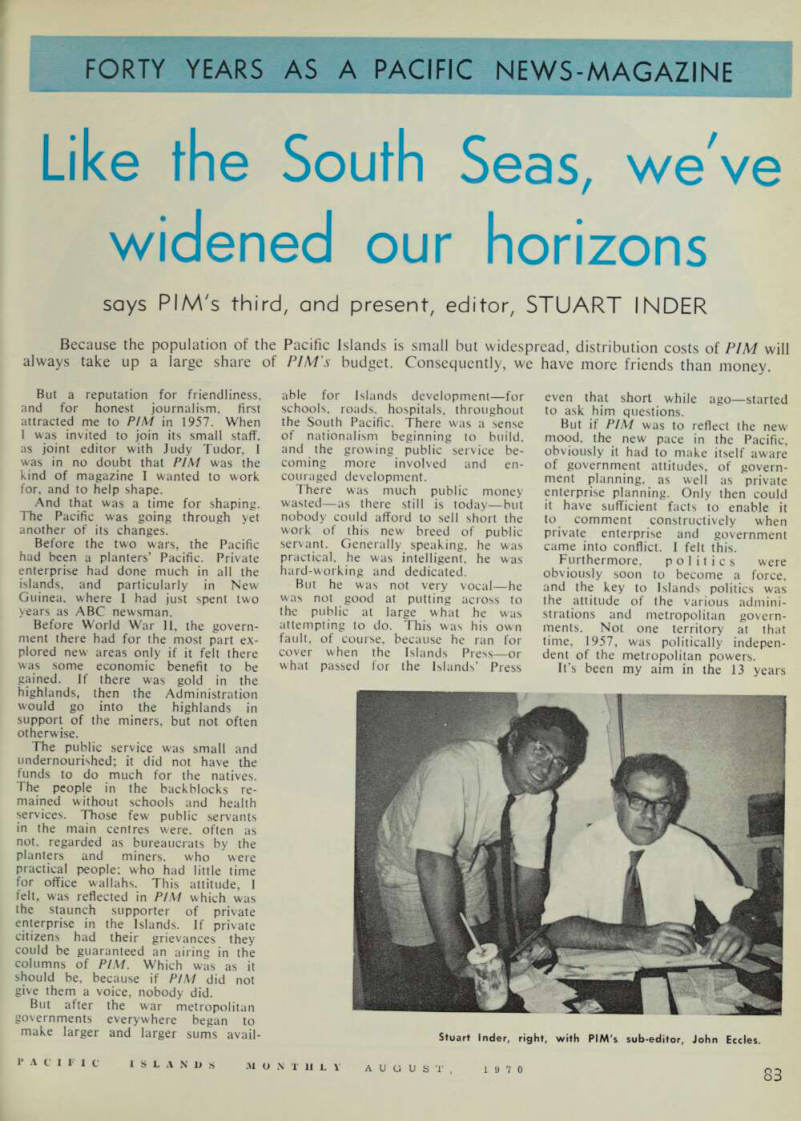
Stuart Inder, right, with PIM's sub-editor, John Eccles.
since I began editing PIM in 1957 to have PIM reflect the great new variety of opinion— to bring them all together, even if we didn’t agree with them. On many occasions, I have changed my mind on a controversial matter through reading a debate 1 myself had prompted in PiM's own columns.
That’s as it should be. While 1 admit to being a middle-of-the-roader, I don’t think one could afford to have been too dogmatic on Pacific affairs, these last 10 years, because these have been politically formative years in the Pacific.
They are a curtain raiser to what I think is to come. The real politics are ahead of us, in the next era.
The South Pacific Commission has finally developed into something worthwhile. Its very objectives are now the subject of hot debate by the Islanders themselves. Self-govern ment has come to the South Pacific —the group which is not independent is now unusual. The metropolitan powers in the Pacific are about to be drawn in to South Pacific affairs on terms laid down by the Islanders, not by themselves. Matters of commerce and immigration are already being writ large.
In my time, pressure of develop ment in the Pacific has forced me to take a wider and wider editorial view, to concentrate on the picture rather than on the detail. In the last 10 years there has been a vast increase in Islands newspapers and radio news bulletins, and millions of words of news reach us each month.
The days are gone when we can describe, in detail, local agricultural shows, and report everything said in the local advisory council, or even parliament. Now, we must select from the mass those events which display a trend. Yet the small islands, without independent news media, get a more detailed coverage than the larger groups because it is a service we owe them. We are an Islands magazine.
PIM will continue to do what it can to keep pace in the next era. and if possible even a step ahead.
But it’s a difficult business, for there is no formula for editing a magazine like PIM. It’s a personal thing. R.
W. Robson and Judy Tudor always found it so, and I have been no exception.
Everybody, in fact, who touches PIM editorially leaves some sort of personal stamp. Robert Langdon, assistant editor for five years, strengthened the reputation, whose foundations had already been laid by R. W. Robson, of PIM as a chronicler of the Pacific’s past as well as its contemporary scene. He left us so as to be able to carry his
historical researches even further— he is now the executive officer of the Pacific Manuscripts Bureau at the Australian National University—but his reports on Pacific history still appear regularly in PIM.
For eight years past, anybody who has contacted the Sydney office by phone, or who has come in, has spoken to PIM s prettiest staff mem ber. Mrs. Sandra Rayner, who is an encyclopaedia of Pacific personalities, faces, names, statistics and addresses.
Barry Badger, PiM’s circulation manager and promoter of books, is a cheerful, competent, young bachelor who started with PIM as an office boy 12 years ago. John O'Donnell,
PiM's advertising expert, started the same way 22 years ago. PiM’s first office boy, Selwyn Hughes—has long since been the general manager of the group.
It's not surprising that PIM has had only three editors in its 40 years, and that all three of them still come in to PIM s office every day—although their work is now varied.
PIM is that kind of magazine, founded by a remarkable personality, who is now 85 and operates like a man 20 years younger. It wouldn't really surprise any of us if R. W.
Robson still manages to be around another 40 years from now!