We only just survived
pp. 73-77 · Read in the full issue
the Pacific War
recalls PlM's publisher and second editor, JUDY TUDOR The first words 1 heard from RWR, who was to become my boss, were over the telephone.
'They’re taking all my men,” he howled, “and I’m rapidly going broke.”
I could believe him. It was January, 1942, in Sydney, and the Pacific was feeling the first breath of total war. 1 was staying at the Astra Hotel at Bondi; there was a field kitchen in the courtyard and a couple of army companies were erecting barbed-wire entanglements on the beach.
In the darkness of one night they had blown up the two covered-ways that, at that time, ran. like huge groins, from the men's and women’s dressing rooms right across the beach. It was thought that the enemy might use them in a landing so they had to go but, when the unannounced bang came, everyone in the hotel, including me, thought that the Japs had actually landed.
In December, 1941. and January, 1942, women and children and men who couldn’t get into the armed forces were evacuated from islands east and north of Australia and Sydney had became a dispersal point.
Pim Subscribers
Had Disappeared
In the Pacific Islands themselves, those men who were not cut off or captured by the Japanese advance were drafted into various services so that, all the way from the Solomons through New Guinea to the Gilbert and Ellice Islands. PIM subscribers had disappeared overnight. At PIM headquarters in Sydney all was chaos.
Hence, RWR's anguish.
We had met by correspondence the previous year but I did not join PIM staff immediately following that phone conversation in January, 1942.
I imagine that, at that stage, the publisher of the magazine was doubtful whether he could carry it on at all. But by mid-1942 most evacuees and those who had joined up had
relocated themselves; PIM not only again had addresses to go to but had became the medium through which former Islands residents could keep in touch with one another.
In addition to this, the American forces had bought up all the avail able copies of the company’s Pacific Islands Year Book in order to do a crash-course on the Pacific and they were calling for another edition.
Our Fortunes
At Their Lowest Ebb
1 joined Pacific Publications as a sort of general factotum in July, 1942. In terms of military effort our fortunes had sunk to their lowest ebb and this was reflected in PIM, which had shrunk to a monthly issue of 48 pages. Although the war situation was not to be so grim again, PIM shrank still further by the next year when rationing of all kinds, including newsprint, hit full blast.
Little in the way of consumer goods was being produced and, as most islands were battlegrounds or military bases, there were few people to sell anything to. Those advertisers who remained with us did so through goodwill. Advertising revenue for a long time hovered around £lOO per month—not sufficient in 1970 to pay the wages of one PIM typist.
With this background the most important ground rules were (a) that whatever you did, it shouldn't cost money; and (b) that time should not be wasted, because time was money too.
This method of operation lasted long after the war years.
Generally you wrote everything that you considered needed to be said about a month's events and then, in the space of an hour or so, fitted
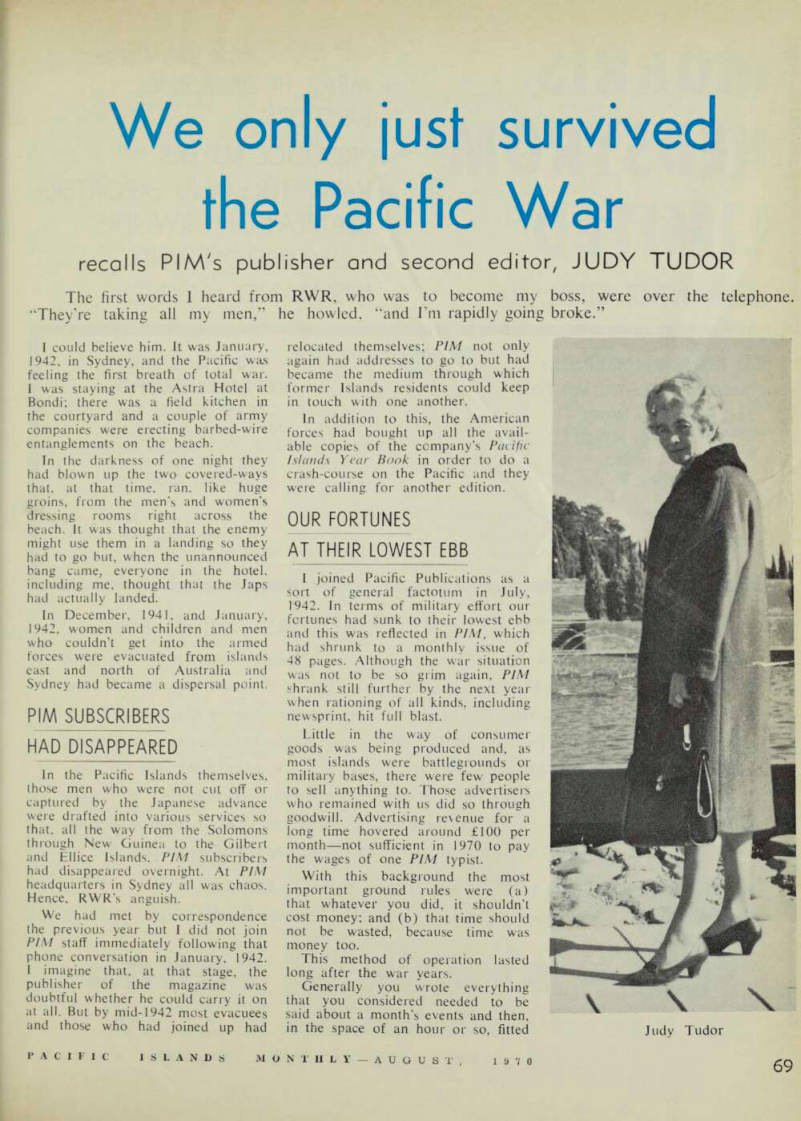
Judy Tudor
it into pages and printed it. Although PIM in those days was high in meat content, it was generally low in what might be called modern journalistic practice. When Stuart Inder joined the staff he set about doing something about this. He likes now to tell people how 1 used to go through the roof when ever he spent more than five minutes studying galley proofs before deciding how to put them into a page.
During the war we chronicled victories and reverses, made prognos tications, printed lists of killed, wounded or captured; had stories about escapes from the enemy and deeds of valour.
We supported the Islands resident, especially the evacuee, against the worst efforts of wartime bureaucracy; and the lighter side of Islands life was, of necessity, mostly in the form of nostalgic pieces about what used to be—a department of PIM to which I supplied my full quota.
The end of the war unfortunately meant only the end of fighting.
In September, 1945, we were shocked when we learned that between 200 and 300 civilian men who had been taken prisoner by the Japanese in Rabaul were not alive in prison camps in Japan, as had been thought, but had been dead since June, 1942, when their prison ship, the Montevideo Muni in which they were being transported to Japan, was torpedoed by an American sub marine.
With peace, austerities and short ages intensified i f anything, and stretched away into the fifties. The bureaucratic restrictions and regula tions that had been introduced under wartime powers were given up slowly and reluctantly by govern ments which had become used to making them at the stroke of a pen.
In some islands—parts of Papua, New Guinea, the Solomons, parts of the Gilbert and the Ellice Islands and what is now the US Trust Ter ritory—there was great devastation.
Civil admistrations, trying to get going again, were faced with housing shortages, food shortages, lack of shipping and communications, dis rupted and distraught staff, many of them recently returned from war service.
Commerce and industry were similarly placed, and faced great labour shortages as most native labour, upon which almost all industry in the Islands then depended, had with good reason gone back to the villages to re cuperate. That the devastated Islands survived the first years of peace seems, from this distance, even more
of a miracle than that they had survived active hostilities.
Total war was one thing—it was tough, but it had some organisation and purpose behind it. Total peace, starting from scratch, with the material ruins of several lifetimes around you, was something else again.
New Caledonia and the New Hebrides, although not directly in volved in the fighting, had provided giant Allied bases, and the same services, although on a smaller scale, had come from Fiji and the Samoas.
No island was untouched by the war, psychologically even more than in materialistic terms.
There had been little social tension in the old Pacific. In Polynesia, expatriate and native-born had
Suddenly, there was money for the Islands, and everyone wanted to buy
long made accommodations. In Melanesia, non-native and native Jived in quite separate worlds, each knowing his place and keeping it with little friction. Inequalities there certainly were, but of tension in the modern racial sense, virtually none.
But in developed countries, as a reaction to the destruction and lunacies of global war, idealism was running strongly in 1945. Most people wanted to make the world a better place in which to live and this feeling of goodwill flowed over to dependent peoples.
All these things were present, along with the chaos, as we stood on the threshold of peace and a post war world. But of all the factors that changed the Pacific, I think the mcst significant of all was that most gov ernments had learned—if not how to be rich—at least how not to be poor.
From the end of the war we began to enter an era of affluence that, with minor disturbances, has not ended yet. Suddenly there was money in the Islands where before handouts were given reluctantly even in times of dire crisis. Money not only for education and health services (previously left entirely to Christian missionaries) but for teaching indigenes to be traders, artisans or coffee planters; money for large capital works and even for politics.
Fiji-lndians had long been politically agile, but in 1945, with the exception of the Western Samoans who wished to be rid of New Zealand authority. Pacific Islanders were politically unaware and uninstructed. They did not know what “independence” meant and they cared less. Since then, vast sums of money and much effort have been expended in changing that, and although thousands of Islanders are still vague as to what it is about, what we are pleased to call the “political elite” have been quick to catch on.
In this golden age, Papua-New Guinea was first to benefit, initially from the proceeds of the War Damage Compensation Fund to which all Australian property-owners had been forced to contribute early in the war when it appeared likely that Japan would invade or bomb the Commonwealth.
Enemy damage to Australia was, in fact negligible but before con tributions ceased the fund amounted to about £l4 million, and this was used almost entirely for the rehabili tation of private property in Papua- New Guinea. In addition. New Guineans who had suffered as a
result of direct war damage were compensated from another fund.
As plantations and industry came back into production a long deprived and hungry world waited im patiently to buy. These were years of good prices for Islands products, and when the prices might have been expected to taper off there was the Korean war, and the United States’ preoccupation with the spread of communism, all of which required the stock-piling of strategic materials.
From the war years to the present, revolutionary changes have occurred in the Islands, especially in the realm of politics. These have included among other major events the cynical handing over of 900,000 indigenes of former Dutch New Guinea to Indonesian control.
Scarcely any important story ap pears in PIM in 1970 that has not local political overtones. Right up to the late 1950’s this would have been exceptional. Reaction against blunders of an administering authority there was in plenty, but such political stirrings as there might be among the populace were causing few ripples on local scenes.
The whole world as we had known it was in fact, changed. The old Pacific Islands dream was finished, never to be dreamed again. For one thing, Islands isolation had been shattered. Millions of foreign troops had left behind in some territories uneasiness and at times bewilderment, and in others, the beginnings of racial tension.
But new politics notwithstanding, I still think that the new affluence I spoke of has brought to the Pacific the changes that are most fundamental.
Before the war, if a territory did not produce gold or copra or phosphate or some other commodity in sufficient quantities, it was poor and could expect to stay poor. Today there are few which do not stand to benefit from world wealth; which cannot find someone to sponsor a tourist industry or cannot get a handout from an international fund.
Even territories with few visible means of support can contemplate political independence with equanim ity, sure in the knowledge that funds previously enjoyed from an administering power are unlikely to be cut off. Once given the initial push of foreign investment or even hand outs for capital development, a ter ritory can breed its own home-grown brand of affluence.
Fiji, headed for independence this year, is a good example of this, but on the whole the Pacific Islands in
The old Pacific dream was finished, never to be dreamed again
the last 25 years, have received far more from the world in the material sense than they have contributed to it.
As a result, the Islands have be come far more comfortable places in which to live, even if the Islander, forced from his old ways to compete in a commercialised world, has be come somewhat less fun.
But only when the dust of transi tion from colonialism to indepen dence has settled X-years from now, will we be able to make our final assessment of what 200 years ago somebody called “the noble savage”.
It’s my guess that then, despite many indications to the contrary now, he will be found to have retained much of his fundamental qualities—his sometimes maddening inability to take life seriously—and all those attributes that have always set the South Sea Islands apart from the rest of the world.