could exchange the news
pp. 71-72 · Read in the full issue
Forty Years As A Pacific News-Magazine
PIM was born so Islanders could exchange the news
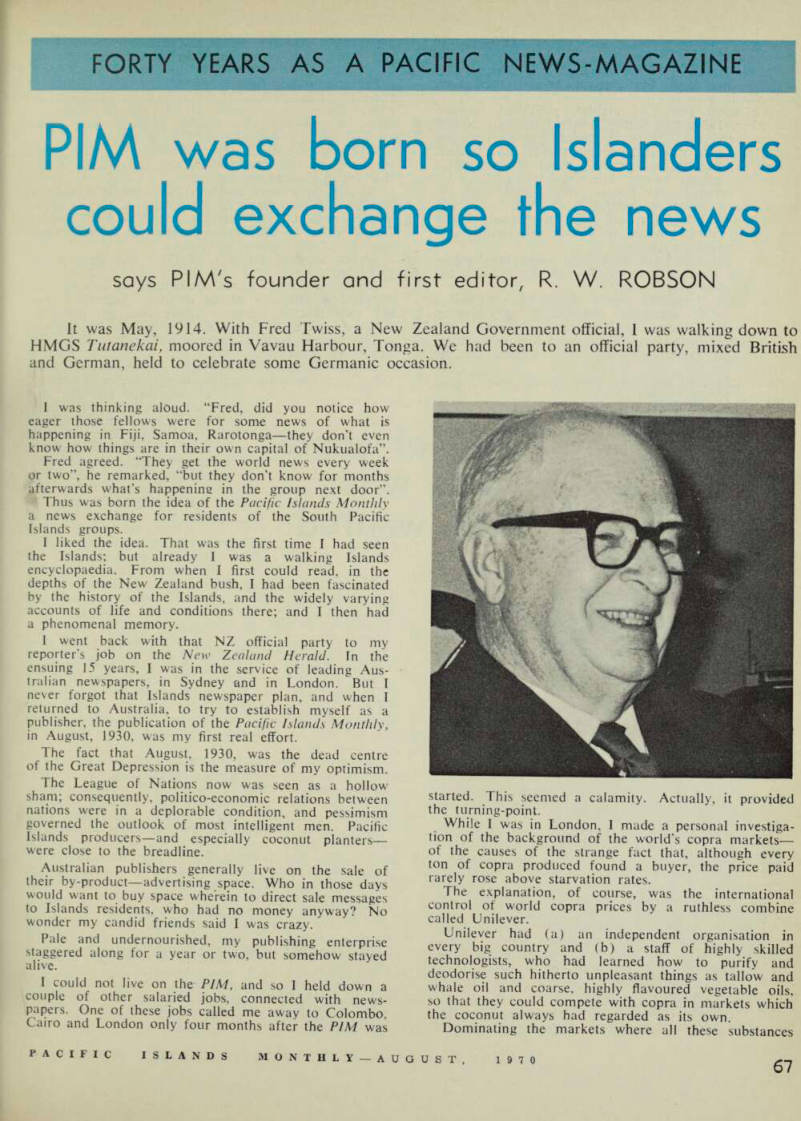
says PlM's founder and first editor, R. W, ROBSON It was May, 1914. With Fred Twiss, a New Zealand Government official, 1 was walking down to HMGS Tutanekai, moored in Vavau Harbour, Tonga. We had been to an official party, mixed British and German, held to celebrate some Germanic occasion.
1 was thinking aloud. “Fred, did you notice how eager those fellows were for some news of what is happening in Fiji, Samoa, Rarotonga—they don’t even know how things are in their own capital of Nukualofa”.
Fred agreed. “They get the world news every week or two”, he remarked, “but they don’t know for months afterwards what’s happening in the group next door”.
Thus was born the idea of the Pacific Islands Monthly a news exchange for residents of the South Pacific Islands groups.
I liked the idea. That was the first time I had seen the Islands; but already I was a walking Islands encyclopaedia. From when I first could read, in the depths of the New Zealand bush, I had been fascinated by the history of the Islands, and the widely varying accounts of life and conditions there; and I then had a phenomenal memory. 1 went back with that NZ official party to my reporter’s job on the New Zealand Herald. In the ensuing 15 years, I was in the service of leading Aus tralian newspapers, in Sydney and in London. But I never forgot that Islands newspaper plan, and when I returned to Australia, to try to establish myself as a publisher, the publication of the Pacific Islands Monthly, in August, 1930, was my first real effort.
The fact that August, 1930, was the dead centre of the Great Depression is the measure of my optimism.
The League of Nations now was seen as a hollow sham; consequently, politico-economic relations between nations were in a deplorable condition, and pessimism governed the outlook of most intelligent men. Pacific Islands producers—and especially coconut planters— were close to the breadline.
Australian publishers generally live on the sale of their by-product—advertising space. Who in those days would want to buy space wherein to direct sale messages to Islands residents, who had no money anyway? No wonder my candid friends said I was crazy.
Pale and undernourished, my publishing enterprise staggered along for a year or two, but somehow stayed alive.
I could not live on the PIM, and so I held down a couple of other salaried jobs, connected with news papers. One of these jobs called me away to Colombo, Cairo and London only four months after the PIM was
started. This seemed a calamity. Actually, it provided the turning-point.
While I was in London, 1 made a personal investiga tion of the background of the world’s copra markets— of the causes of the strange fact that, although every ton of copra produced found a buyer, the price paid rarely rose above starvation rates.
The explanation, of course, was the international control of world copra prices by a ruthless combine called Unilever.
Unilever had (a) an independent organisation in every big country and (b) a staff of highly skilled technologists, who had learned how to purify and deodorise such hitherto unpleasant things as tallow and whale oil and coarse, highly flavoured vegetable oils, so that they could compete with copra in markets which the coconut always had regarded as its own.
Dominating the markets where all these substances
were in demand, Unilever held prices just where it wanted them.
Unilever maintained its position unchallenged, as world dictator of the vegetable and animal oil markets, until World War 11.
In a short series of articles, published between December, 1930, and March, 1931. I tried to explain Unilever and the new technological processes to the half-starved and resentful coconut-growers and traders.
This, apparently, was exactly what the embattled South Seas people wanted. The circulation of the PIM bounded forward into figures which established the journal as a permanent institution.
But my real troubles had only commenced. I had not nearly enough money to finance this healthy and rapidly growing enterprise.
Cash from sales and advertising came in slowly— those were days of long credit—but my printing bill had to be paid every month.
Just when it seemed that I should have to sell a large part of the enterprise, and thus virtually give up control, a New Guinea gold-mining man whom I had known only a little while offered me a loan of a couple of thousand pounds, without any written security whatever.
With this aid, my little show made sound, solid
progress. Within two years, I had brought out the first edition of Pacific Islands Year Book (now long estab lished as the book of reference on the Pacific Islands).
By 1937, I had acquired a small interest in, and the managing - directorship of, the old-established Sydney & Melbourne Publishing Co.
Pty. Ltd., and thus had my own printing-office.
News of copra was what they wanted
By 1938 the PIM and I were doing well; but as a former newspaper foreign correspondent, interested in world developments, I was most uneasy.
The threat of war lifted the copra price substantially in the thirties, but there was little comfort in that.
Persistently, in my PIM, I published reports of Japanese penetration of the Pacific Islands and what that might mean.
The horror of a second World War came in 1939.
For two years, it did not affect us much, politically. But, while the Western nations still needed copra, sugar, cocoa, gold, and so forth, all the countries which pro duced those things still were able to produce, and the market was over-supplied.
Shrinking, also, was the manufacturers and traders’ capacity to sell to Islanders. Economically, we of the South Pacific were more and more embarrassed. We were half in and half out of the war.
All uncertainties ended at Pearl Harbour on Decem ber 7, 1941. Within a few days, we of the South Pacific were wide open to invasion by the Japanese.
All PlM’s readers in Papua, New Guinea and Solomons were scattered to the four winds. The other islands, though uninvaded, were under stern war con ditions. Normal trading virtually ceased.
Advertisers no longer wanted to buy space. Every one of my young assistants—including Selwyn Hughes who had come to me years before as an office boy— and was now my first lieutenant—was called to war duties. It seemed, early 1942, as if I must fold up the PIM, not wanted any more.
But I thought I might still give service, by telling the Pacific Islanders about their angle on the war, and
about what was happening to their thousands of men and women who were either in the services, or had been “evacuated” to Australia and New Zealand.
For some reason that 1 never understood—but valued none the less—a handful of advertisers remained in PIM. Their announcements clearly were worthless to them, in a money sense. But the payments they made allowed me to carry on PIM.
I became, for three years, a BBC and ABC com mentator on the Pacific War, and the guineas from this source allowed me to live.
No men now were available, so 1 sought a woman assistant. I discovered in Melbourne a former New Guinea woman, with literary talent, Mrs. Judy Tudor. 1 induced her to become my assistant, in Sydney. That was one of my happiest discoveries.
So we survived the war. But we had some lively problems.
Because we had Islands circulation, we enjoyed the unremitting attention of the censors. Actually I was my own strictest censor—nothing ever got past me which would in any way aid the enemy. But certain quaint people with a censor’s authority occasionally saw things otherwise.
I could write a book about the occasions when they made us delete quite harmless things. So, on a number
of occasions, just for my own satisfaction, I would put into type things which would have been of great help to the enemy; get the censor’s approval stamp on to the proofs, and then throw them out.
If Pacific Islands Monthly now was in limited demand, that could not be said of the Pacific Islands Year Book.
Every military and civil or ganisation with wartime jobs
in the Islands wanted this Islands encyclopaedia; and we tried to meet the demand. But there just was not enough paper available then to do the printing. I was compelled to sell the overseas copyright to a big American publisher; it was “pirated” before the American publisher got out the edition; and the war time sales of the Year Book, which might have returned a little fortune, provided only a most modest profit.
In 1945, with war past, our business began to return to normal. It grew rapidly, but it needed much new capital. As fast as we got additional funds, the gallop ing inflation which followed the war ran the value out of them.
We chased our tail for several years until finally, in the course of arranging our financial structure. Pacific Publications Pty. Ltd.—the modest little company I had formed in 1930 to hold PIM and the Year Book— purchased outright The Sydney and Melbourne Publishing Co. Pty. Ltd., with its other trade publications and buildings.
The next step came in 1956 when 1 formed Pacific Publications (Fiji) Ltd., to wholly own and manage the Fiji Times and Herald Limited, a company which 1 purchased from the late Sir Alport Barker.
There have been further rearrangements since and as recently as this July, the large Melbourne-based printing company, Wilkie & Co. Ltd., acquired a 40 per cent, interest in all of Pacific Publication’s magazines and papers.
But PIM was the foundation of it all. PIM is still my main love, despite the growth of 40 years—which itself stems from that conversation I had in Tonga back in 1914.