Wider horizons for Papuan Airlines
pp. 41-43 · Read in the full issue
From DENIS FISK, in Port Moresby
Papuan Airlines Pty. Ltd.,
Papua-New Guinea’s biggest
locally-owned airline, has been
sold to Ansett Transport In dustries Ltd.—owners of Ansett Airlines.
It was announced on July 27 that Papuan Airlines’ shareholders had agreed to accept 4i fully paid 50c ATI shares for each $2 fully paid share in Papuan Airlines. On that date, Ansett had accepted the offer from 95 per cent, of Patair share holders, and expected to receive the remainder.
The move means that Ansett transport Industries Ltd. will now :ontrol Patair; Stol Commuters (an ur charter company); the leading Gateway Hotel at Port Moresby; the Totel Tapini; and Airport Freestores *ty- Ltd., which operates the duty free ihop at the Port Moresby airport.
Fhe first approach was made by Patair.
The negotiations had been going
on for a considerable time, and they involved the politics of allowing “foreign” interests to take over what is likely to become New Guineas overseas national carrier come in dependence, unless a new airline is invented meanwhile.
Under the arrangements, the Ad ministration has an option to pur chase a 20 per cent, interest in Patair within the next five years.
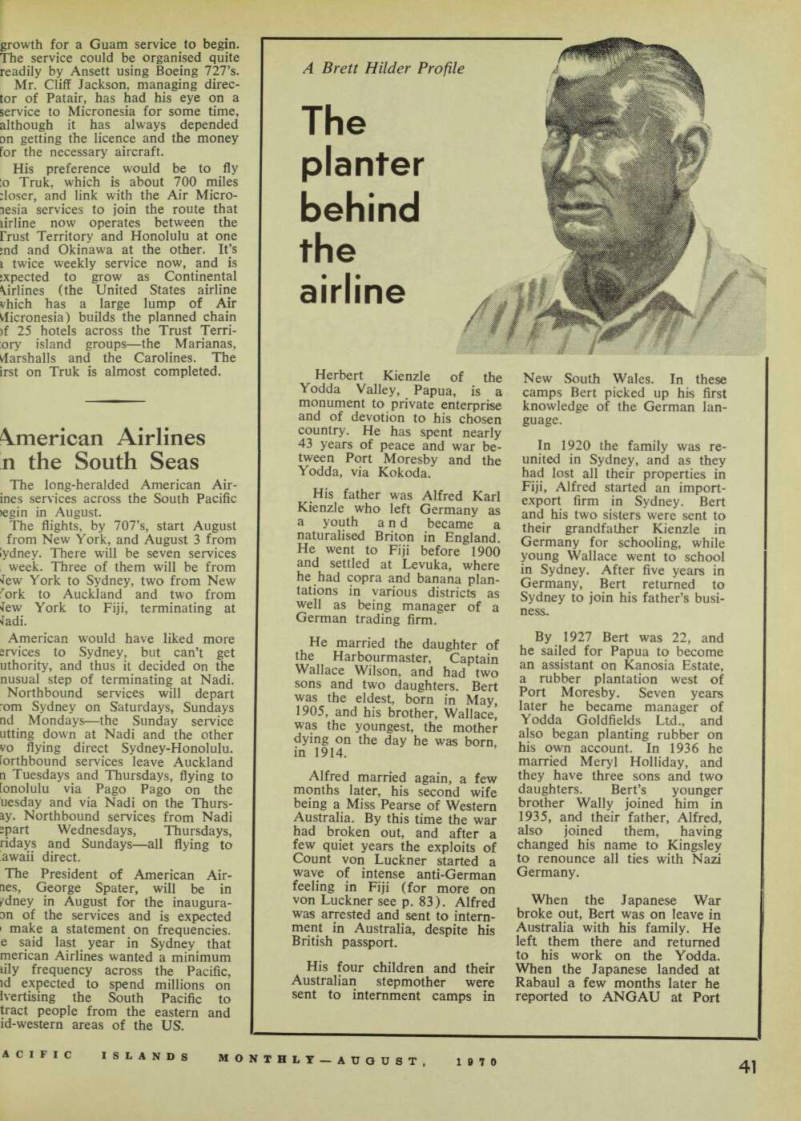
The negotiations have awakened national feelings in some parts of New Guinea, after beginning merely as a means of liquidating some money for a few of the Patair share holders, notably the planter and cattle raiser and mainstay of Patair, Mr. Bert Kienzle, of Kokoda.
On a sentimental basis, they have been reluctant to agree to see the 18-year-old airline pass out of Papuan shareholders’ hands. It has a total of 11 aircraft—three DC3’s, two Skyvan SC7’s, two PA3I Navajos, two PC6B Pilatus Porters, and two P 166 Piaggios.
But Patair is coming to the point where it must face financing new
generation aircraft to expand in keep ing with its growing services, and the prospect of becoming Papua-New Guinea’s national carrier. So Ansett’s entree could be a blessing in disguise, depending on how you look at it.
A ...
As a possible national carrier (at present Ansett-MAL really serves onl >: the New Guinea side of the J errlt o>-y). Ansett would also be, able to lay claim to an international ute ;r^ a L favourite—Australia- Por t Moresby-Guam—is sure to come ”p a Bf. m for negotiation with the Australian Government if the merger ls successful.
Papuans don’t want to see Patair go to someone outside, for fear their services will suffer. The bottom half ma * n . island in the territory 18 not especially well served with airstnps ’. and * hose services there are, are pr ? ci °us. Papua ha s been catching up with New Guinea, which had lion’s share of strips in the ’sos and early ’ 6os because of the need to impress the United Nations with the progress in the Trust Territory, and because there was more economic progress which would come as a
Political implications
result of building airstrips. Papua is much poorer in natural resources, and has fewer people (600,000 com pared with 1,700,000) also.
Patair at present serves 25 ports, including Mt. Hagen in the New Guinea Highlands, and operates 63 scheduled services weekly.
In the House of Assembly in June, Papuan member for Ijivitari, and a leading politician, Paulus Arek, asked the government to look into the possibility of the Australian Admini stration here buying Patair on behalf of the people to stop foreign interests gaining control. He said it was an opportune time to give the territory its own airline, because when in dependence came it would want one of its own.
The Assistant Administrator and senior representative of the Admini stration in the House, Mr. Tony Newman, said the negotiations were very confidential, but the Admini stration was well aware of “the pro posed share integration transaction” between Patair and Ansett. He would say only that the Administration was discussing it with the Federal Gov ernment, and “the House could be assured that the interests of the territory were being more than care fully considered”.
During the Prime Minister’s visil to the territory in early July, Mr, Arek told Mr. Gorton he had received a letter from Sir Reginald Ansett offering the future government of an independent (or self-governing perhaps) Papua-New Guinea a pro portion of control of the airline.
There’s likely to be growinj pressure for services through Papua New Guinea to be international, ir addition to the once weekly Qanta! 707 service to the Philippines.
During the June sitting, Mr. Wall} Lussick (MHA for New Ireland; put forward a motion calling for ai international service to Guam. Th< motion still has to be voted on, bu the Assistant Ministerial Member fo: Transport (minister-in-training) Mr Joseph Lue, said the Administrate regarded a Guam/Papua-New Guinei air link as essential for co-operatioi with Pacific states, in particular Fiji The Administration was raising th( matter with the Federal Government Mr. Lussick based his argument oi the fact that Guam was a crossroad for American tourists. Many couh be diverted through Papua-Nev Guinea if the service was available instead of them having to go tj Sydney first, as at present, at mud greater cost. Consequently, it wa vital to Papua-New Guinea’s touns
growth for a Guam service to begin.
The service could be organised quite readily by Ansett using Boeing 727’5.
Mr. Cliff Jackson, managing direc tor of Patair, has had his eye on a service to Micronesia for some time, although it has always depended on getting the licence and the money for the necessary aircraft.
His preference would be to fly :o Truk, which is about 700 miles :loser, and link with the Air Micro nesia services to join the route that lirline now operates between the [rust Territory and Honolulu at one ;nd and Okinawa at the other. It’s i twice weekly service now, and is sxpected to grow as Continental Virlines (the United States airline vhich has a large lump of Air Micronesia) builds the planned chain )f 25 hotels across the Trust Terri ory island groups—the Marianas, Marshalls and the Carolines. The irst on Truk is almost completed.