Footnotes
pp. 40-41 · Read in the full issue
When Australia’s Prime Minister made his after dinner “keynote” speech in Port Moresby on the evening of Monday, July 6, I was listening to him “live” for the first time, and, fortified by a well lined tummy, I was quite impressed. He is an incisive and persuasive speaker, and a great deal of what he said sounded to me like good sense.
He was right in claiming that the changes his govern ment is now proposing to make are just another step in a process of gradual advance towards self-government which has been going on during the past few years and will continue into the future.
He was right, too, in claiming that the plan he outlined is a compromise between the desire of the radicals to rush ahead and that of the conservatives to emulate the snail. It is.
But at this point of time can we afford not to move ahead a bit faster? Conservatives would do well to consider the possibility that the more slowly we move towards full self-government the more radical will be the complexion of the party which comes to power when we do get there.
The snails could win in 1972, but not, I fancy in 1976.
Mr. Gorton accused those who call for a target date of “dangerously simplifying the prob
lem”. Surely it is he himself who dangerously simplifies it by declaring that full self-government must wait until a majority of Niuginians want it.
This would be a reasonable propo sition if the ratio of those who want early self-government and those who do not was reasonably uniform throughout Niugini. But we all know that it isn’t.
A referendum on early self government would clearly produce an overwhelming “No” vote in the High lands, and, as the bulk of our popula tion is there, the Highlands vote would dominate a nation-wide poll.
In the coastal and islands areas the
voting would be much more divided, with the possibility of a “Yes” majority in some of them. Is it realistic politics to say to the people of these areas, who have been under colonial rule for nearly a century, “You want self-government, but you can’t have it until the people of the Highlands are ready for it too”?
Naturally enough, the people of the Highlands want to be satisfied that self-government, when it comes, will mean that they govern themselves, not that their white kiaps are replaced by bumptious young men from the coast.
I couldn’t sympathise with them more, just as I couldn’t sympathise more than I do with those Papuans who fear that, in a united Niugini, they will become a depressed, and possibly a repressed, minority group.
But Mr. Gorton was off target when he suggested that those who want early self-government are just power hungry self-promoters who want to lord it over their fellow countrymen. Of course there are self promoters in this country, as in all countries. They are not all radicals; I know some pretty power-hungry conservatives too. However, I have a good deal of
confidence in the ability of Niuginians to cut their big heads down to size.
It is quite unfair, I believe, to most of those who are in favour of early self-government to represent them as big-heads who want to seize power and run the whole country. Many of them have a very limited concept of “the whole country” anyway.
But they do feel that in their own areas they are ready to run their own show at a higher level than the local government level, and they want to give it a go. I repeat, that it is not realistic politics to tell them that they must wait till the Highlanders are ready too.
A placard held aloft before the Prime Minister at: Mount Hagen bore the words “We want unity before self-government”. An admirable sentiment indeed. But is it not becoming abundantly clear that a too gradual approach to self-government without even a tentative target date to spur us to preparedness is much more likely to promote disunity than unity?
Apparently Mr. Gorton himself sensed this as hisi tour proceeded. When, at the end of it, he returned: to Port Moresby, he broadcast a farewell message in which, after reiterating his rejection of a target date,, he added these significant words: “In the meantime,,
the possibility of different regional re sponsibilities for regions at different; levels of development could well be; examined”.
In my view the first step along this; trail could be taken now, without pro longed “examination”, without elaborate: organisation, and without great ex pense.
This could be done by enacting ai “Provincial Government Ordinance” oni the lines of the existing “Local Govern ment Ordinance”.
When local government was intro duced to Niugini 20 years ago, there; was no attempt to carve the whole: country into local government areas; and establish councils in all of therm
simultaneously. The ordinance was an enabling one r empowering the Administrator in Council to declare ae given area a local government area and establish as council therein.
Local government has been built up gradually oven two decades until it now covers nearly, though still not quite, the whole of Niugini. Moreover, the powers? and responsibilities of local government councils are permissive, not mandatory. The ordinance says what they may do, not what they must do; and each council] is free to bite off as much as it can chew.
As I envisage it, a Provincial Government Ordinance would be constructed on similar lines. It would not( seek to divide the whole territory willy-nilly into provinces; but it would empower the Administrator’s Executive Council to declare either a single district or a group of two or more contiguous districts a “province” and establish a provincial council therein.
As with local government councils, the powers ana responsibilities of provincial councils could be defined permissively rather than mandatorily; and provincial
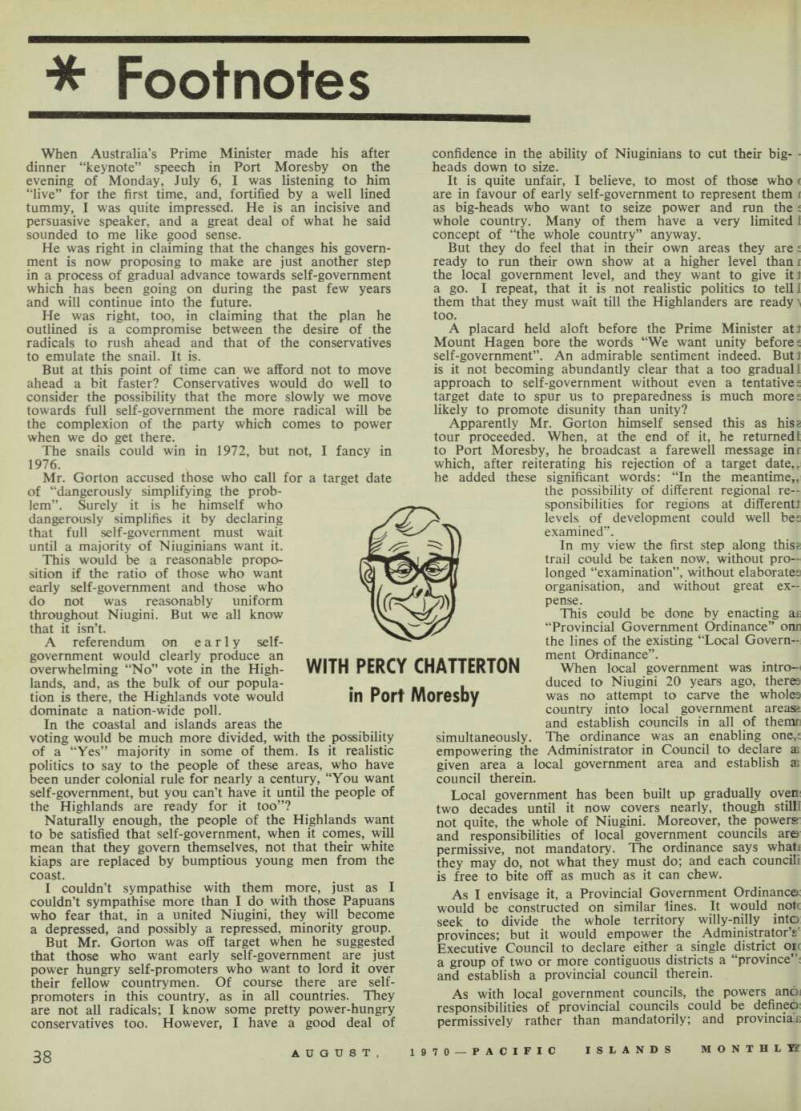
With Percy Chatterton
in Port Moresby
councils, like local government councils, could bite off as much as they could chew.
The members of a provincial council need not be, and in my opinion should not be, chosen by popular vote. The council could comprise those members of the House of Assembly whose electorates lie within the province, together with the presidents, and perhaps additional representatives, of the province’s local govern ment councils.
A council so constituted would be less likely to get at loggerheads with national government on the one hand or local government on the other than a separately elected one. Indeed it would form a much needed bridge between local and national government.
Actually bodies such as those here proposed already exist on a non-statutory basis. Local government councils periodically hold conferences at district level, to which it is customary for the district’s MHA’s to be invited. The kind of ordinance I have suggested would formalise these conferences, make them statutory bodies, and provide them with teeth and something to chew.
If Mr. Gorton is looking for gradualism, here is gradualism. If he is looking for compromise solutions, here is a compromise between his rejection of a target date and the Mataungan Association’s demand for “piecemeal self-government”.
If he wants to hold out an olive branch to Papuans tired of, and angry at, being ignored or brushed aside by visiting missions, touring politicians and supercilious planners, here it is.
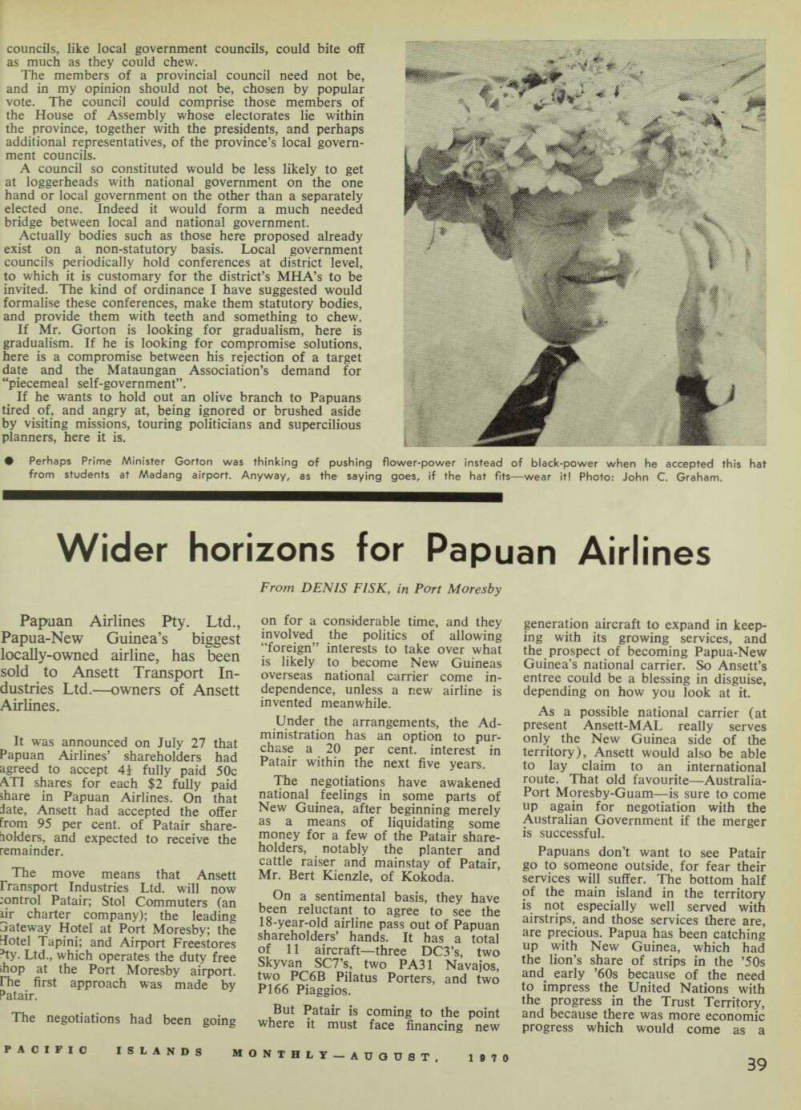
Perhaps Prime Minister Gorton was thinking of pushing flower-power instead of black-power when he accepted this hat from students at Ma dang airport. Anyway, as the saying goes, if the hat fits—wear it! Photo: John C. Graham.