Papua's West?
p. 134 · Read in the full issue
Boom Times For
• Kennecott Corporation of America in May cautiously announced further drilling expenditure on its copper find in north-western Papua, amid strong reports that the copper looks like being as good as, or better than, Conzinc Riotinto's find on Bougainville. Core samples indicate a copper average of 1 per cent, (compared with Bougain ville's 0.48 per cent.) and Kennecott is preparing to cross the border to continue the search in West Irian. What do these developments mean to the local Papuans? Here is a report to "PIM", datelined Olsobip patrol post, Papua.
In the Western District of Papua they’re calling it a “mini Bougainville”. Americans are fast stepping up explorations into extensive finds of copper ore and associated movement of supplies, etc., are having a big effect.
Any one of the native hunters returning from up river could have been excused for thinking he had somehow wound up on the Port Moresby waterfront instead of being at Kiunga, in the Western District of Papua.
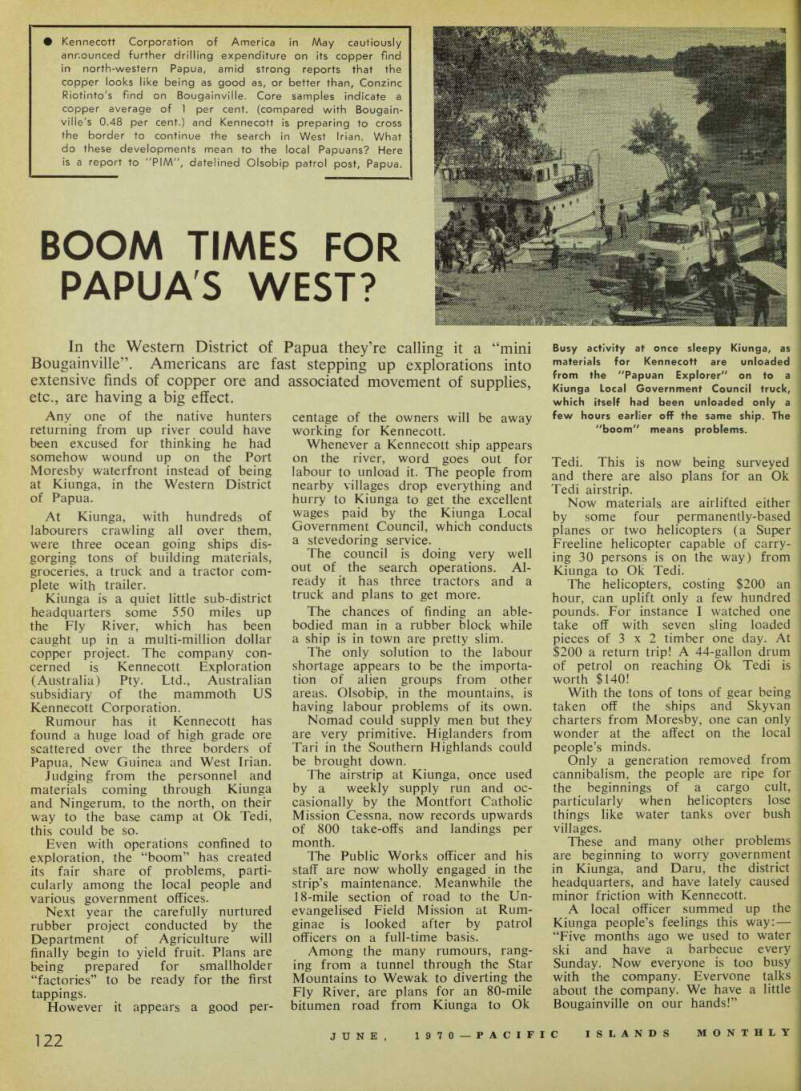
At Kiunga, with hundreds of labourers crawling all over them, were three ocean going ships disgorging tons of building materials, groceries, a truck and a tractor complete with trailer.
Kiunga is a quiet little sub-district headquarters some 550 miles up the Fly River, which has been caught up in a multi-million dollar copper project. The company concerned is Kennecott Exploration (Australia) Pty. Ltd., Australian subsidiary of the mammoth US Kennecott Corporation.
Rumour has it Kennecott has found a huge load of high grade ore scattered over the three borders of Papua, New Guinea and West Irian.
Judging from the personnel and materials coming through Kiunga and Ningerum, to the north, on their way to the base camp at Ok Tedi, this could be so.
Even with operations confined to exploration, the “boom” has created its fair share of problems, particularly among the local people and various government offices.
Next year the carefully nurtured rubber project conducted by the Department of Agriculture will finally begin to yield fruit. Plans are being prepared for smallholder “factories” to be ready for the first tappings.
However it appears a good per-
centage of the owners will be away working for Kennecott.
Whenever a Kennecott ship appears on the river, word goes out for labour to unload it. The people from nearby villages drop everything and hurry to Kiunga to get the excellent ™ a B es P aid Kiunga Local Government Council, which conducts a stevedoring service, Th e council 15 doing very well out °*. sear ch operations. Al ready it has three tractors and a truck and plans to get more, The chances of finding an able bodied man in a rubber block while a ship is in town are pretty slim, The only solution to the labour shortage appears to be the importa tion of alien groups from other areas. Olsobip, in the mountains, is having labour problems of its own.
Nomad could supply men but they are very primitive. Higlanders from Tari in the Southern Highlands could be brought down.
The airstrip at Kiunga, once used by a weekly supply run and oc casionally by the Montfort Catholic Mission Cessna, now records upwards of 800 take-offs and landings per month, The Public Works officer and his staff are now wholly engaged in the strip’s maintenance. Meanwhile the 18-mile section of road to the Un evangelised Field Mission at Rum ginae is looked after by patrol officers on a full-time basis, Among the many rumours, rang ing from a tunnel through the Star Mountains to Wewak to diverting the Fly River, are plans for an 80-mile bitumen road from Kiunga to Ok
Tedi. This is now being surveyed and there are also plans for an Ok Tedi airstrip.
Now materials are airlifted either by some four permanently-based planes or two helicopters (a Super Freeline helicopter capable of carry ing 30 persons is on the way) from Kiunga to Ok Tedi.
The helicopters, costing $2OO an hour, can uplift only a few hundred pounds. For instance I watched one take off with seven sling loaded pieces of 3 x 2 timber one day. At $2OO a return trip! A 44-gallon drum of petrol on reaching Ok Tedi is worth $140!
With the tons of tons of gear being taken off the ships and Skyvan charters from Moresby, one can only wonder at the affect on the local people’s minds.
Only a generation removed from cannibalism, the people are ripe for the beginnings of a cargo cult, particularly when helicopters lose things like water tanks over bush villages.
These and many other problems are beginning to worry government in Kiunga, and Daru, the district headquarters, and have lately caused minor friction with Kennecott.
A local officer summed up the Kiunga people’s feelings this way:— “Five months ago we used to water ski and have a barbecue every Sunday. Now everyone is too busy with the company. Evervone talks about the company. We have a little Bougainville on our hands!”
Busy activity at once sleepy Kiunga, as materials for Kennecott are unloaded from the "Papuan Explorer" on to a Kiunga Local Government Council truck, which itself had been unloaded only a few hours earlier off the same ship. The "boom" means problems.