Business and Development
pp. 127-133 · Read in the full issue
Why Businessmen Are Falling In
"Love" With New Hebrides
By Ken Mcgregor
“Today, there are anti-capitalist and openly Communist governments in North and South merica, Europe, Asia and Africa. Is there one geographical region of the world without a Communist anti-capitalist government, political party, newspaper or labour union? Yes! In the Pacific Islands.” ) says a recent prospectus, aimed at “selling” the New Hebrides as an investment area.
The prospectus adds: “In the cific Islands, in an area covering per cent, of the earth’s surface d holding one tenth of one per nt. of its population, governments y on capitalism to develop their untry and territories.”
The prospectus is produced by the la-based Investors Trust Ltd., lich would like to have Asia, Ame an and European developers base mpanies in the Pacific and parti larly in the New Hebrides. The Dspectus is another indication of 5 recent growth of interest by srseas promoters in the South cific.
Lhe US Trust Territory, New ledonia, Nauru, Norfolk Island d the New Hebrides all could ap al, or are already appealing, to anciers and others because of their v or non-existent taxes. 1 understand the British section of New Hebrides Condominium wernment is well aware of this ritory’s appeal as an incorporation d registration centre for overseas upanies.
No suspicion now
[n May, Mr. A. G. Mitchell, :retary for Financial Affairs at the tish Residency, Vila, was in rmuda and the Cayman Islands, a itish colony in the West Indies, imining ways in which the Hebrides npanies registration structure could made similar to that of these ablished tax havens.
Some American investors I have >ken to feel that the British itude on investment in the New brides has changed. Two years ) the British were suspicious but
now Britain would like to promote the New Hebrideans as a major Pacific taxation and financial haven.
That certainly is a firmly held view in some quarters, at any rate.
Investors are hopeful that by September this year New Hebrides regulations will be adjusted to encourage companies to register on the British registers in Vila, and to put in their own representatives and handle international deals.
As reported (PIM, Mar., p. 135), a major Australian firm of solicitors, Holman, Webb and Co. set up a branch office in Vila in March.
Holman had already incorporated 21 firms in the Hebrides, and another 10 were to be incorporated.
In the words of Holman’s Vila branch manager, Mr. Brian Hallett, 75 per cent, of these 31 companies were based overseas, other than Aus tralia. Holman, Mr. Hallett said, specialised in international taxation work; its New Hebrides companies would conduct business “in all spheres”. (Holman, Webb are not connected with H. Wilshire Webb Son and Doyle, solicitors, of Sydney, who have had an office in Vila for the past two years or more.) Recently, also with an office in Vila, Investors Trust Ltd., based in San Francisco, began operation. A principal of the group is Clayton B. (Cy) Wentworth, an American busi nessman with many interests, includ ing investments in the Philippines, the US Trust Territory, Nauru and New Guinea. He also deals in real estate throughout the Islands, and is known as a business promoter.
Investors’ Trust is currently “sel
ling” the Hebrides in the US, Asia, Europe and Australia as the potential “Switzerland of the Pacific”.
The Trust maintains it is qualified to conduct any type of business at any time and any place in the world.
PIM understands Investors’ Trust closely examined other potential centres in the Islands where taxation regulations were few and decided on the Hebrides after having considered Nauru and Norfolk Island closely.
Norfolk, the group felt, would eventually have its taxation advan tages diluted by the Australian Gov ernment. Nauru, because of its isola tion in the Central Pacific, has communication problems.
The Hebrides was preferable.
There is no company tax or income tax. Under the 1914 Anglo-French Protocol, the UK and France retain jurisdiction over their own subjects, but neither exercised a separate control over the group of 80 islands.
American interest
Matters requiring joint decision could take years, Investors’ Trust felt, even decades, if they must be referred back to London or Paris.
The end result was “a built-in con servatism” that made changes very difficult.
Continued freedom from com pany and income taxes was thus guaranteed in effect by the peculiar government structure.
The American interest in the Hebrides is typical of the increasing US investment in the Islands, apart from French Polynesia. Americans have put some SUS2O million at least into hotel and real estate in French Polynesia; however, now American
money is also going into the Hebrides and Fiji, in particular. Australian and New Zealand businessmen might well be surprised at the number of US dollars finding their way into these two territories, as American promoters see the possibilities.
The Japanese too, apart from their export links, are looking closely at investment propositions within the Islands—including hotels, real estate and small factories. Should they get into these businesses, it will mean they will have far more personal contact with the Islanders than most of their postwar operations have allowed them, and some big combines are currently “feeling out” local attitudes to see if additional Japanese capital will be welcome in the former battle fields.
Meanwhile, here is another land deal of interest concerning foreign buyers in Fiji . . .
Deuba land, $2 m.
to foreign buyers
An undisclosed number of Britons have paid a total of over $250,000 to buy blocks of land at Deuba, 30 miles from Suva, on Fiji’s Coral Coast area of Viti Levu.
Developers expect British buyers will pay over $2 million this year for blocks of freehold at Deuba, not counting expected additional sales to buyers in Europe and South East Asia, particularly Hong Kong.
About 4,000 potential land buyers in the UK have been mailed details of proposed developments for Deuba and extensive advertising of land in this area is continuing to potential land investors in at least a dozen countries.
Sales of the land, part of a massive 7,500-acre freehold area owned by Canadian and UK interests, began early this year and initial excavations for roads and lakes, etc. have already begun on a $2O million development project.
The sales are the first major sales of Fiji land to big numbers of over seas buyers. In half-acre, one-acre and two acre lots, the sales have been even faster than the many plan tations, small islands and business blocks in Fiji sold to overseas in vestors, mainly Americans, over the past three years.
Hog Harbour, at Santo, New Hebrides, is the only other project similiar in the Islands to the Fiji Deuba sales, where big tracts of land have been bought by one developer, sub-divided and sold to innumerable overseas residents.
At Deuba and Santo the percentage of investors who have actually seen
110 million invol
ie land they have bought would be linimal.
A third project, mooted by Aus ■alian interests at a cost of some 10 million, is proposed for the iland of Tahiti. Prices here for locks or houses and blocks together re expected to fetch up to $75,000 ach from US investors.
However, PIM understands, Tahiti lies have not yet started.
Details of the Deuba sales and lis project’s progress so far were iscussed with PIM in May by Mr. rarth Hopkins, president of Hopkins, [edlin Ltd., of Toronto, Canada, ho with Mr. Peter Munk, head of le group running the project, visited iji and Sydney on a whistle-stop Lisiness trip.
Mr. Munk was unavailable for amment.
Mr. Hopkins went to some pains ► stress that the project group was ifter a good image in Fiji”. The ay to do this, he felt, was to set up cal equity in the project and “con ibute to local social needs”. Direc ts were examining ways in which achieve these aims “as discreetly ; possible”.
Local equity could be achieved, [r. Hopkins thought, by preferably Tering shares at par to the Fiji overnment or to residents of Fiji.
Education seemed to be Fiji’s ggest social need, he said, so lancing of textbooks “was a pos aility”.
Mr. Hopkins said plans were to )at the project as a public company i the London Stock Exchange late is year or next year.
About $6.5 million would be spent i stage one of the project, which eluded 1,100 of the 7,500 acres ;ar the site of the old Beachcomber otel.
Stage one included 100 acres of tificial lakes, a series of canals, arinas, a golf course, tennis courts, least two hotels and at least one immunity centre.
American Airlines had bought one )tel site and had agreed to manage e hotel to be constructed on another :e. It might take up equity in the cond hotel as well as build its own )tel.
Holding company for the project as Canadian-registered Southern icific Properties Ltd. Southern tiolly owned Pacific Hotels and eyelopments Ltd., the Suva gistered company responsible for e project. Another group, Project
Planning Associates Ltd., was handling the project’s “master plan”.
PIM understands Southern Pacific’s shareholders include the diversified London-based “take-over conglom erate”, Slater Walker, whose Aus tralian affiliate last year made an abortive attempt to gain a major stake in Islands trader. Burns Philp and Co. Ltd. ( PIM, April, 1969, p. 117).
Slater Walker of London has about a 50 per cent, share in Southern Pacific.
The remainder of Southern’s capital is in Canadian hands, with businessmen Messrs. David Gilmour, Peter Munk and Pat Samuels, having the biggest share and financial advisors, Hopkins, Hedlin a very minor percentage.
Mr. Peter Munk, Southern’s head, was founder of Clairtone Sound Corporation of Canada, which after making colour television sets for the competitive US market, ran into financial difficulties involving some SC2O million.
Canada’s Financial Post has quoted Mr. Munk as describing the Deuba projects as “the biggest single development of this kind proposed in the South Pacific”.
Mr, Hopkins said Mr. Munk had “had a thing” about Fiji for about seven years. His firm was convinced Mr. Munk would be more successful in real estate in Fiji than he had been with TV in Canada. The back ing of a respected multi-million dollar corporation such as Slater Walker proved there was “great faith” in Mr. Munk’s leadership, he said.
Hawaii firm buys
Taveuni plantation
Mr. George E. Isaacs, president of George Isaacs (Hawaii), Ltd., Hono lulu-based land investors, developers and ranch operators, has announced the purchase, with Mr. William Hignet, of a 3,700-acre copra planta tion on Taveuni, Fiji.
The seller was the Coubrough Estates, London.
The plantation has 2\ miles of beach frontage on the leeward side, 1,100 acres planted in coconuts which produce some 200 tons of copra annually, and 500 acres in wild citrus. It also runs 250 head of cattle. It is two miles from a Travelodge hotel now under con struction, and 14 miles from the air port.
Isaacs announced no immediate plans for the land except to continue the present commercial operations in copra and cattle.
Oysters, tor the
local taste
Sacks of rock-oysters, imported from Sydney, are being tossed into the sea outside Noumea.
The oysters are being flown in each week by Qantas, from Sydney.
To Caledonian palates, accustomed to the native mangrove oysters, the Sydney variety are lacking in taste, so must be tossed into the sea—for two weeks, to take on the tangy Caledonian flavour!
And anyone who has been served a plateful of local oysters will ap preciate the difference.
Now a Caledonian settler has started the first local scientific pro duction of oysters. His first harvest came on the market last October— -7,000 dozen—sold out in a couple of months, without any sales pro motion. The local Caledonian gourmets simply rushed to the oyster farm to buy them.
But it’s been a lot of work for Georges Guerlain, who is in his sixties.
Having retired from the public service in Noumea and Vila, Mr.
Guerlain turned to what had become a passionate interest during trips to France. Three years ago he leased a sea-shore property on New Cale
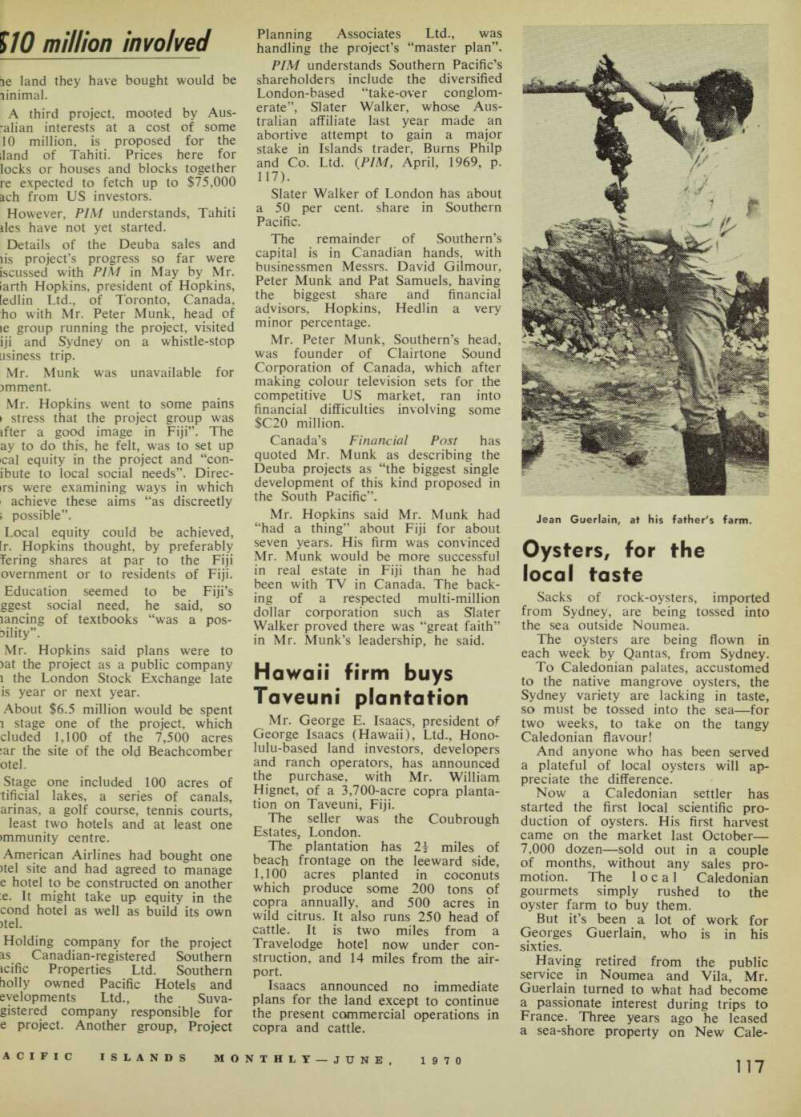
Jean Guerlain, at his father's farm.
donia’s west coast, 50 miles from Noumea.
From a rich natural bed of oysters among the mangroves, he began experimenting with cultivation on various types of support, from local stone and bricks to copper wire, iron rods and discarded shells. From a “mica schist” stone 2 by 1 ft, he claims he can collect 25 dozen young oysters, and have them ready for the table within three years.
Mr. Guerlain has carefully studied tidal patterns, sea creatures that prey on the oysters, and the degree of salinity in the river estuary waters, etc.
One problem he could not over
come, however, was the problem of cyclones. When “Brenda” attacked in February, 1968, he saw his pain staking labour ruined. An estimated 32,000 dozen oysters were lost.
Since then he has been joined by his two sons and he is also develop ing a farm in the extreme north of the island.
With an estimated 17 ton of oysters imported from Australia and New Zealand for the last Christmas- New Year season in Noumea, Georges Guerlain is confident the local product is worth developing.
The Caledonian mangrove oysters earn $1 per dozen on the local market.
$625,000 claimed
from two companies
Claims against the two companies which promoted Nauru’s abortive football pools-hotel project last year have amounted to $625,000.
These represent creditors, lenders, former employees and directors, Messrs. R. F. Hughes and G. Brooke, of the companies liquidators, Coopers and Lybrand, said in a recent state ment.
Known directors of the companies, Pacific Sporting Pools Ltd. and Central Pacific Hotels Ltd., were Messrs. Bill Mayberry, Alan New bury, Raymond Lord, of Port Moresby, and George Pearce.
Messrs. Hughes and Brooke said capital subscribed in the holding company (other than in the exchange of shares in Consolidated Football Pools Ltd.) totalled about $363,000.
The liquidators said estimates compiled from the companies’ records indicated the direct expenditure on the construction and fitting out of the hotel up to the date of cessation of building operations totalled about $564,000.
As reported, two of the creditors are the Bank of New South Wales ($114,819) and the British Phos phate Commissioners ($23,764) — PIM, Nov., 1969, p. 123.
Meantime, tenders for disposal of Nauru’s $500,000-plus half-completed hotel closed on March 31, after advertisements were placed in news papers in America, the UK, Aus tralasia and South-East Asia.
Tahiti vanilla beans
fetch top prices
With recent rises of over $1 a pound, prices for vanilla beans grown on Tahiti and Moorea are the highest for several years. Sydney buyer, Karp Tulk and Co., in May was paying $7.1 a pound for white and yellow packs and $7 a pound for green label packs.
Karp couldn’t recall when prices last went over $7 but it said returns to growers were the best since the all-time highs of $8 or $9 several years ago. Reason for the price rise was thought to be a crop shortfall in French Polynesia.
Good news for Tahiti, isn’t, how ever, necessarily glee for Tonga, the Islands’ other vanilla beans prospect.
Still in its infancy, all Tonga’s production from Vavau goes to Mel bourne buyer, Bush, Boake, Allen (Aust.) Ltd. which at last report was paying $T4.50 a pound for the beans, landed in Melbourne.
Bush, Boake is experimenting with
fonga’s unknown beans for the :ingdom’s Agriculture Department, vhose attitude is until a saleable fongan bean is developed and Tonga ;ains a name for its product no ittempt will be made to sell Tongan >eans elsewhere.
Then, Tonga feels, attempts will ic made to market Tongan beans to »ther buyers and gain a price nearer fahiti’s. Karp Tulk have already nade inquiries to Tonga without eceiving replies.
Islands share prices
Irop badly
Around-the-board falls in all prices >f shares on Australian stock ex hanges also wiped over $1 million ff Islands share prices in May. Of he 33 industrial, oil and mining bares with Islands interests, listed m PlM’s monthly price list, 26 saw heir values fall in May, as compared /ith April.
Four held their value and three Sogeri, Choiseul and Territory trewery) rose.
The big companies dropped sig ificantly. BP’s hit $3.20, Carpenters ell below the $2 at $1.94 and teamies slumped to 55 cents to give generous 9.1 yield on its 10 per ent. payout.
Placer dropped by $lO despite its mbitious exploration venture an ounced with New Guinea Gold elds, PI Mines touched 20 cents and outhland Mining, with its shares onverted to 10 cent units, sold for 1.95.
CRA shed $2.90 to $15.10 and luka Minerals, controversial NG slands would-be explorer, saw its 0 cent units fall to 5 cents.
Jouth Pacific Brewery
till confident
Malaysian-controlled South Pacific irewery Ltd., New Guinea’s sole rewer with plants at Port Moresby nd Lae, has no plans to list its ghtly-held shares on Australian tock Exchanges or offer share arcels to New Guinea residents.
The company is confident it will laintain its dominant share of the jrritory beer market, despite the roposed plans of Territory United Irewery Ltd.
As reported ( PIM, Dec., 1969, p. 17), TUB will build a third brewery 1 NG at Port Moresby, with tech ical assistance and a financial tieup dth one of the world’s major rewers, Asahi Breweries Ltd. of apan.
TUB’s 50 cent shares were listed
on Australian stock exchanges early this year and in recent weeks have consistently sold below par at 30 and 40 cent levels.
South Pacific’s attitude is that local equity in a manufacturing enterprise is not necessarily a prerequisite in a developing country approaching independence, for a good image. The NG Government could well make more out of a brewery by indirect taxes, it feels.
SP’s beer capacity is currently slightly in excess of total consumption in NG. NG’s high rate of consumption growth would overtake this capacity in two or three years and then SP would consider yet
another expansion of its Lae or Moresby plant.
The company is watching progress of TUB and feels Asahi, for a small outlay, has struck an extremely good deal with TUB (under stated arrange ments, Asahi will invest no capital in TUB, but it will help design the plant, lend “supervisors” for five years and be given options to take up a “large parcel” of TUB shares “within five years”).
South Pacific plans no big ex pansion to counter TUB incursion into the NG beer market but it is looking closely at the Solomons market for beer and the NG market for soft drinks.
Toke-over bid
for Pafair
Directors of Papuan Airlines Pty.
Ltd., NG’s biggest locally-owned airline, met in Port Moresby in late May to discuss a takeover approach from Ansett Airlines.
Headed by chairman, Mr. Cliff Jackson, Patair is anxious that its independent status be retained and that, should the takeover succeed, Patair doesn’t disappear without trace into the Ansett empire. With the Australian Government airline, TAA, Ansett operates most of major internal runs in NG and from Aus tralia to the territory. Another sub sidiary maintains runs to Lord Howe Island from Sydney.
NG residents own 90 per cent, of Patair, which operates hotels, car rentals and NG’s only duty-free shop, at Jackson’s Airstrip, Port Moresby.
Founded in 1952, Patair has ex panded considerably over the past three years and its Moresby pub, The Gateway, is one of NG’s two top hotels.
Patair recently looked for capital, or a partner, to expand the Gateway, build a new hotel at Alotau and finance new aircraft equipment. The takeover (terms undisclosed) could well tie in here.
Has Ausf. missed out
on Bougainville
The ears of Australian business men pricked up at the latest loan to finance equipment services for the $350 million—plus Bougainville cop per project. The loan was a “financial guarantee” of SUS2O.4 million from the US Export-Import Bank for American suppliers tendering for the project.
It followed last year’s arrange ment’s involving sales and loans to Japanese companies worth $1.78 bil lion, guaranteeing sales of at least $3O million of Japanese equipment and services to the project.
Contracts varying from roadwork, housing and to drilling worth up to $lOO million have so far been let for the Bougainville project and it’s no secret that while Australians and New Zealanders have collected at least some $3O million in contracts, they have been largely pipped to the real plums.
Americans, Japanese and even Germans have taken the cream.
Reasons for Australians missing out on mammoth deals virtually on this country’s doorstep are several: Some contractors have work enough on their plate inside Australia; others tendered uncompetitive prices; some
couldn’t supply the required equip ment or services and many couldn’t meet the tough and fast delivery datelines Betchel, or CRA, have set for the preparation schedules.
However, it’s also fair to add some Australians have missed out (and Mr. W, R. Carney, Australia’s former trade man, admitted this) because some construction has been a closed shop because of “tied deals” with sponsors or buyers of the cop per ore.
Why hasn’t any Australian Gov ernment body, or financial consortium such as Partnership Pacific or Newain, come to the party and offered an export loan of $2O million or $3O million to Australian ex porters to secure a bigger slice of CRA’s copper cake? Could it be complacency?
Asian Bank is
"mismanaged"
The Asian Development Bank (of which Fiji and Western Samoa are members), was “the most mis managed outfit I have ever had any thing to do with,” Mr. O. Passman, Democratic chairman of a sub-com mittee on foreign relations of the US Government’s appropriations committee, said recently.
Mr. Passman said the bank’s operation did not present “a rosy picture”. The bank had disbursed SUSB.3 million in 1967-68, yet had “administrative expenses” of $10.4 million for the same period.
He said the bank had a four-year supply of funds and should be denied an additional $17.8 million ap propriation from the US.
More cars for
New Caledonia
Caledonians have at least one car or truck for every five inhabitants (of 107,000 population, only half are Europeans), it is now estimated.
Vehicle number plates are fast nearing the 40,000 NC mark, but many of the lower registration num bers have, of course, been withdrawn from circulation.
Statistics released by the Motor Transport Department reveal that 5,733 vehicles were sold here last year, which is 54 per cent, more than in 1968 (3,646 registrations).
Of total sales, 4,078 were cars, with 1,655 trucks, vans and buses.
French vehicles led by only 75 over foreign sales.
Most popular manufacturer con tinued to be French Peugeot, 1,009, followed by Renault, 942. Italian Fiat, 801, came third, ahead of French Citroen, 402, and German Ford, 388.
Japanese manufacturers sold 119 vehicles and over 200 motor-cycles —more than one-quarter of the 799 motor-cycle market.
Steamships' hotel
plan collapses
Overseas financiers had withdrawn from backing a $4 million 12-storey notel and office block in Champion Parade, Port Moresby, with Steam ships Trading Co. Ltd., Mr. K.
Smith, Steamies’ solicitor, said in Port Moresby in May.
Steamies first announced plans for the hotel in April, 1968 ( PIM , May, ’6B, p. 120) and said it would cost
3 million. The company has never isclosed the financiers’ names, but 'IM understands many European roups were involved at various times.
Mr. Smith told a Land Board leeting that the financiers had ecided against the project “because f political instability in NG”. They r ere “concerned” at the recent un jst and violence on the Gazelle eninsula and statements made by ter tory and Australian politicians about le territory’s future.
“The lenders have told us straight ut that there are now better and ifer places than NG for long-term ivestment,” he said. “We are a üblic company and because of this e will have to take a long, hard >ok at our investment policy in the srritory in the event of overseas nance being denied us.”
No doubt Steamies itself was orrified at the amount of publicity lis statement got. The publicity srtainly didn’t improve the image f the territory as a place in which ► invest capital, and as Steamies is tie firm which merits praise for its alicy of putting all its capital into le territory, it stands to lose more om any loss of confidence in New uinea as a place for investment.
In fact, only some financiers have sen concerned at recent political Jvelopment in the territory. Steamies rst began to look for overseas ipital long before the advent of lataungan and Australian Opposition ader Whitlam on the New Guinea «ne, but high lending rates caused •oblems. Steamies negotiated un iccessfully for lower lending rates i tightening world money markets, nd finally, it now seems, nobody as interested.
Steamies’ shares on Australian ock exchanges dropped to a low of ) cents for the 50 cent unit in May, hich probably merely reflects the Tround drop in the general share iarket.
Meanwhile, Moresby residents are •eculating whether Burns Philp will >w go ahead with the 52.5 million ab it planned in opposition to eamies’ scheme, just down the street Port Moresby.
Caledonian nickel
urbs on Japan
France’s recent decision to curb ckel ore exports from New Caleto Japan could cost this ter tory’s sole nickel producer, Le ickel, a favourable SUS2OO million an from Japanese interests to lance huge new production projects Caledonia.
Nippon Yakin Kogyo KK offered e Nickel executives in Japan in May
the loan in return for a long-term contract for the supply of an unstipulated quantity of ferro-nickel, However, the French Government’s policy is to encourage Japan to buy more processed nickel products (at a greater profit to the French) rather than nickel ore. This attitude has shocked Japan. Japan buys about 90 per cent, of its nickel from Caledonia and this year intends to import about 4.5 million tons of ore. Japanese smelters have just been expanded. • A government-sponsored trade mission will leave Fiji for Tonga and Western Samoa, on June 27.
The mission will be in Tonga until July 2 and will spend the fol-
lowing week in Western Samoa, arriving back in Fiji on July 9. Mr.
Robi Wilcock, display manager with Burns Philp (SS) Co. Ltd. in Suva, is due to leave for Tonga and West ern Samoa ahead of the mission to make final arrangements for the displays. • The Australian Commissioner f or Taxation was investigating at tempts to use Norfolk Island as a base for avoiding taxation, Austra iia’s Treasurer, Mr. Bury, told parliament in May. Meantime, in corporation of companies continued on Norfolk, including the island’s first mutual growth fund, with local, Mr. Alan Payne as chairman.