labour shortage
pp. 65-71 · Read in the full issue


New Caledonian labour shortage brings exodus from the Hebrides
“Why, that’s blackbirding!” says a British resident. “Island be long me e’ ’e no got a man. Meri now picaninny that’s all ’e stop,” says an island chief. “Nous partons demain pour Noumea, ce n’est que la qu’on put gagner a vie,” says a young French mechanic.
All the various communities in the New Hebrides are talking about the same thing—everybody is leaving for Noumea. The emigration to New Caledonia has become as staple a topic of conversation as the weather in Vila and Santo.
Attitudes vary enormously; the French are anxious to help New Caledonian interests to find labour, the British are afraid that New Hebrideans may not be well treated, the young are all trying desperately to find the fare, the old wish they had the means to forbid them to leave the islands.
Noumea is the boom town of the Pacific.
There are said to be more cars per head of population in New Caledonia than in the US; there is a world shortage of nickel, New Caledonia produces something like 10 per cent, of the world’s supply.
Another nickel mine is about to open, and estimates are that New Caledonia will have to expand its work force by 20,000 people in the next five years.
It follows that there is an acute housing shortage. Often every flat in a block is rented before the founda tion stone of the building is laid.
Colons, some of them descended from the original convicts, have
From Tessa Fowler,
in Vila.
found that owning bush land is almost as good as owning a gold mine.
It is such a boom that Noumea is too small to hold it, and all her neighbours are being affected. Most affected is the New Hebrides, which New Caledonia has always regarded as a suburb. (For instance UTA flights between Noumea and Vila are considered domestic).
The French treat the two groups almost as one for administrative purposes, and so New Hebrideans and French from the New Hebrides can go to Noumea to work with only the minimum of formalities.
The only barrier is the fare, the cheapest passage being on the deck of the Polynesie for about SA32.
Not a lot of money even by New Hebridean standards.
New Hebridean unskilled labour ers, used to plantation wages of $2O a month, or town wages up to $BO a month, are now being offered jobs at $2OO and $250 a month with paid holidays, family allowances, paid sick leave, workman’s compensation and sometimes free lodging. All such advantages are rare in the New Hebrides.
Men return from Noumea with
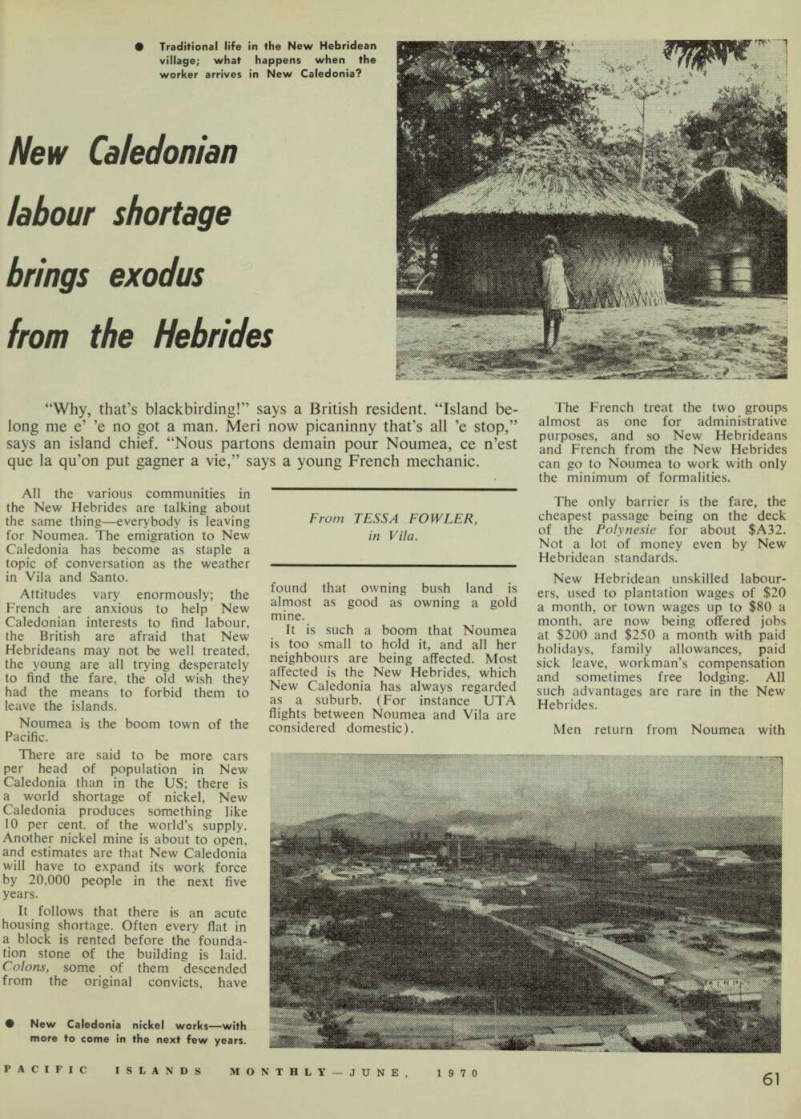
• Traditional life in the New Hebridean village; what happens when the worker arrives in New Caledonia?
• New Caledonia nickel works —with more to come in the next few years.
They save 'fortunes'
$l,OOO in savings at the end of a year; such sums are fortunes to most New Hebrideans, which enable them to set up stores, taxis, launches in their villages and be important people. And of course they can always go back to Noumea and turn the $l,OOO into $2,000.
The charge of “blackbirding” was made by that British resident be cause recruiters for New Caledonian contractors are allegedly paid a lump sum for every New Hebridean who enters New Caledonia. It may be true, but it seems unlikely, since no persuasion is necessary. Everyone is packing. The only people left out so far are the Tannese, and no doubt word will get to them eventually,
1,500 in Noumea
There were 1,500 New Hebrideans in Noumea, by last December, virtually all young men who are not accompanied by their wives or families. Perhaps double that number have been to Noumea and have already returned to the New Hebrides.
In the New Hebrides, with its tiny population, the figure is astonishingly large.
As an example, there are estimated to be some 700 New Hebrideans from Efate, its outlying islands and the Shepherd Islands in Noumea, and this figure is roughly equivalent to the entire male population aged between 20 and 40 from those islands (excluding Vila).
The people left behind do not mind very much. Many women regard their husband’s absence as a method of family planning and are grateful that there will not be another baby next year.
In the planting season the few men left behind have to work a little harder, but once that season is over it is the women who look after the gardens. There are fewer mouths to feed, smaller gardens are made, more land is left fallow another year and land hunger is appeased. Not so many coconut palms are planted, which may be all for the good of the country since most New Hebrideans already have coconut plantations too big for them to maintain or harvest.
But what is it like for the men
working in Noumea?
For Europeans, or people living European pattern, Noumea’s high wages are usually swallowed up in high prices—inflation is a problem in most of the French Pacific. But for New Hebrideans, satisfied with —or prepared to put up with—a much lower standard of living, there is plenty of opportunity to save in Noumea.
No peace, beauty
But housing is bad. The housing shortage is such that most New Hebrideans live in iron shanties in fested with rats and cockroaches; one must sleep with a stick ready to ward off the rats. Toilets are either non-existent or shared by as many as 40 people. Roofs leak, shanties are flooded every time it rains—fortunately not too often in Noumea.
New Hebrideans are finding the urban situation a considerable come down from the peace, beauty and cleanliness of the average New Hebridean village.
But Noumea is not their introduc tion to the urban situation, for housing in Vila and Santo is just as bad. In Vila, instead of an iron shanty, the home of a couple and their children may be a squatter's hut built of wood from packing cases, about four foot square.
An iron shanty in Noumea com plete with cockroaches rats and filth costs about SA4O or $5O, so with four men sharing, each pays only $lO a month, a small pro portion of a salary of $2OO. It is a
Fishermen need muscles. Now this Hebridean may be flexing his in the nickel mines of Caledonia.
Can't speak French
period of discomfort while saving for the cement house of their dreams in Vila.
Similarly, taro and yam at $1.20 a kilo are perhaps three times as expensive in Noumea as in Vila, but if wages are nearly 10 times as high, no one is complaining.
Not being able to speak French causes New Hebrideans a certain amount of difficulty. For instance, labour legislation in New Caledonia is rather favourable to the employee, but it may be difficult for a New Hebridean to find out from an un scrupulous employer about his rights to family allowances, a legal mini mum wage, sick pay, etc.
Although the British are very con cerned about this, it is impossible to say whether a significant pro portion of New Hebridean labour is the object of such abuses.
An encouraging sign is that a greater proportion of men are now leaving Vila and Santo with their contracts already signed. But even if New Hebrideans are not all getting their full legal due, the worst paid considers himself much richer than he ever dreamed of being.
They get help
The New Hebrideans in Noumea get help from two pidgin speaking members of the Bureau des Nou velles-Hebrides in the French admin istration. The Assembly of God and the Seventh-day Adventist missions have New Hebridean congregations and also give considerable help. New Hebrideans have also formed a Mutual Aid Society. Some people feel that the Presbyterian Church of the New Hebrides should do something for New Hebrideans in Noumea.
For the first time, in Noumea, New Hebrideans are acting with a certain solidarity. Although island rivalries sometimes develop into fighting, and although each islander lives and works with people from the same island or liguistic area, they are conscious at times of being New Hebrideans. Travel has given them the first idea of national conscious ness.
Very few New Hebridean women have accompanied their husbands to Noumea although they could earn salaries of $l2O to $lBO a month as servants, compared with an average of about $4O a month in Vila and less in Santo or the islands. They are kept in the New Hebrides by the orders of their fathers, uncles or
chiefs, or by their numerous children, or simply because they don‘t want to go, even when asked by their husbands. Most New Hebrideans keep in constant touch with their wives and children.
The men in Noumea seem to dis trust banks and post offices, but there is such a constant movement that there is always someone to carry money and news back to Vila and Santo.
New Hebrideans find the obliga tion to comply with exchange con trol regulations particularly difficult.
The devalued Noumea franc is worth 12i per cent, less than the New Hebrides franc. Most New Hebrideans have completed failed to understand the devaluation and think that the 12i per cent, is a commis sion that the banks are making at their expense.
The only real opposition to the emigration to New Caledonia comes from the “bigmen” in the villages; that is, any one who has reached or assumed the age of authority and who is horrified to discover that there is no one left but a few women and children on whom to exercise it.
They have no means with which to oppose the defection of their sub jects, since the condominium administration does not ratify the rulings of chiefs and does not interfere with the rights of man to free movement.
Women can t go But some chiefs have refused to allow women to go to Noumea, and all Tongariki men have been ordered to return to their island for a period in June. Another chief, in Ambrym, has reinforced his traditional authority by lending people the fare to Noumea, at interest rates which go as high as 60 per cent.
Some misgivings are also expressed by the European community in the New Hebrides who fear either that the habitual New Hebrides labour shortage will develop into a com plete absence of labour, or that local labour will demand wages com parable to those paid in New Cale donia.
The former is possible if the nickel boom continues, the latter unlikely.
New Hebrideans appear to accept the difference in wages as a fact of nature, not something which could be changed by protest. One rather naive member of the New Hebrides Advisory Council even seems to think that the higher level of wages in New Caledonia has been fixed by the Protocol, the instrument by which the condominium was established and functions.
The British, perhaps a little jealous of the economic success that is French, are constantly looking for the grey lining in the golden cloud.
On the one hand they fear labour abuses, as explained, and on the other they predict a serious drop in the price of nickel in 1975, when Australia is expected to become a major producer.
But perhaps the entire population of the New Hebrides may have managed to make a fortune before 1975.
But others strike in
the New Hebrides
Over 100 Gilbertese and several New Hebridean plantation workers were on strike in April on Norsup, a small island off the north-east coast of Malekula, in the northern Hebrides.
Their employer is the French Group, Plantations Reunies.
The strike followed a fire at the Norsup copra collection centre, where 150 tons of copra were destroyed.
The fire was alleged to have been started by five Gilbertese and five men were at Vila, the Hebrides capital, awaiting trial in April.
Reunies operates one of the Hebrides largest plantations. It has had a troubled history since the first land was cleared by Edmond Couillard in the 1920’5, with con siderable resistance from the Namba people of Malekula.
Now Reunies’ operations are so big they are run on factory lines, which implies more discipline for em
ployees than is usual on plantations in the condominium.
The Gilbertese, who came to the Hebrides as contract labour four years ago, have generally been most satisfactory. Hard-working, cheerful, immensely strong, they have made a considerable difference to the survival of plantations in the condominium.
Hebrideans virtually never take work as agricultural labour, although they often work as builders, drivers and labourers in the towns.
Several Gilbertese have married Hebridean women and will not go home.
Although the import of Gilbertese labour will certainly be a permanent factor in the Hebrides economy, it’s hoped strikes won’t be.
The Hebrides have had strikes be fore, but they’ve usually been settled within a day or two.
The relationships between em ployers and employees aren’t usually bitter ones; discussions can patch up differences. Hopes are the Norsup strike is not a precedent.