"mission in the mud"
pp. 61-63 · Read in the full issue
Wendy, 19, goes on a "mission in the mud"
Pictures and story by DENIS FISK What draws a pretty jilleroo to one of Papua-New Guinea’s most backward frontier areas to work as a pre-school teacher?
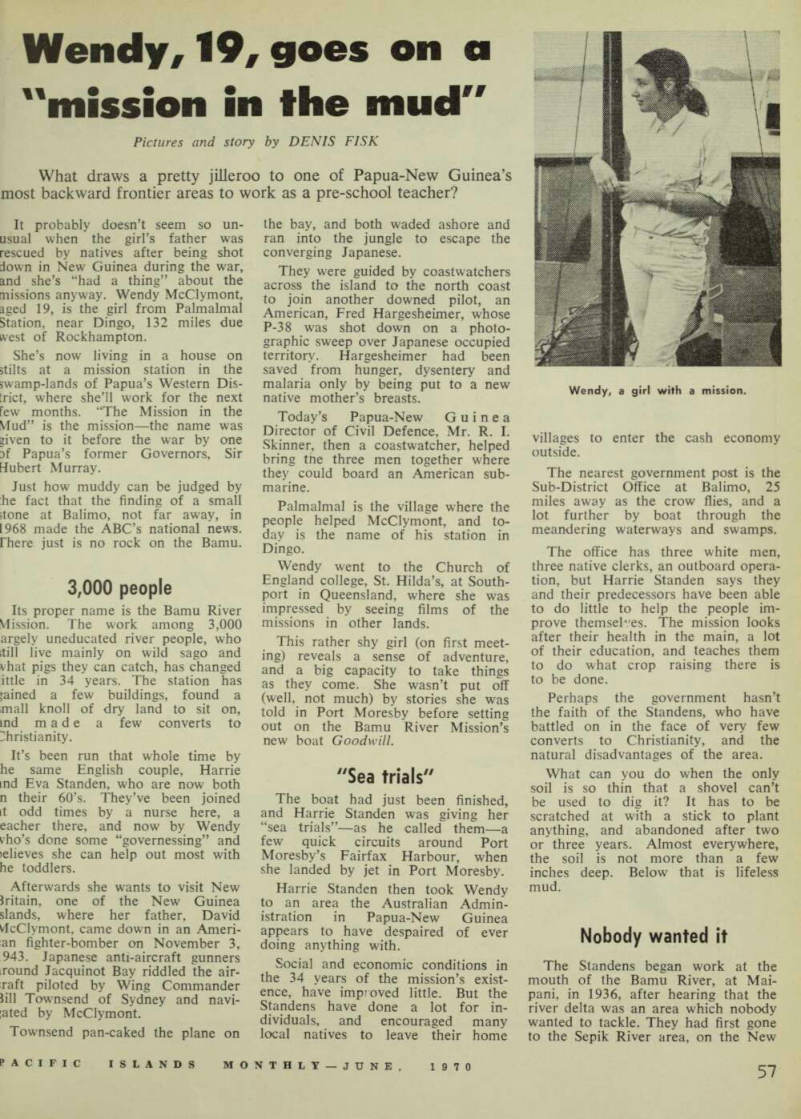
It probably doesn’t seem so un usual when the girl’s father was rescued by natives after being shot down in New Guinea during the war, and she’s “had a thing” about the missions anyway. Wendy McClymont, aged 19, is the girl from Palmalmal Station, near Dingo, 132 miles due tvest of Rockhampton.
She’s now living in a house on stilts at a mission station in the swamp-lands of Papua’s Western Dis trict, where she’ll work for the next few months. “The Mission in the Mud” is the mission—the name was ?iven to it before the war by one af Papua’s former Governors, Sir Hubert Murray.
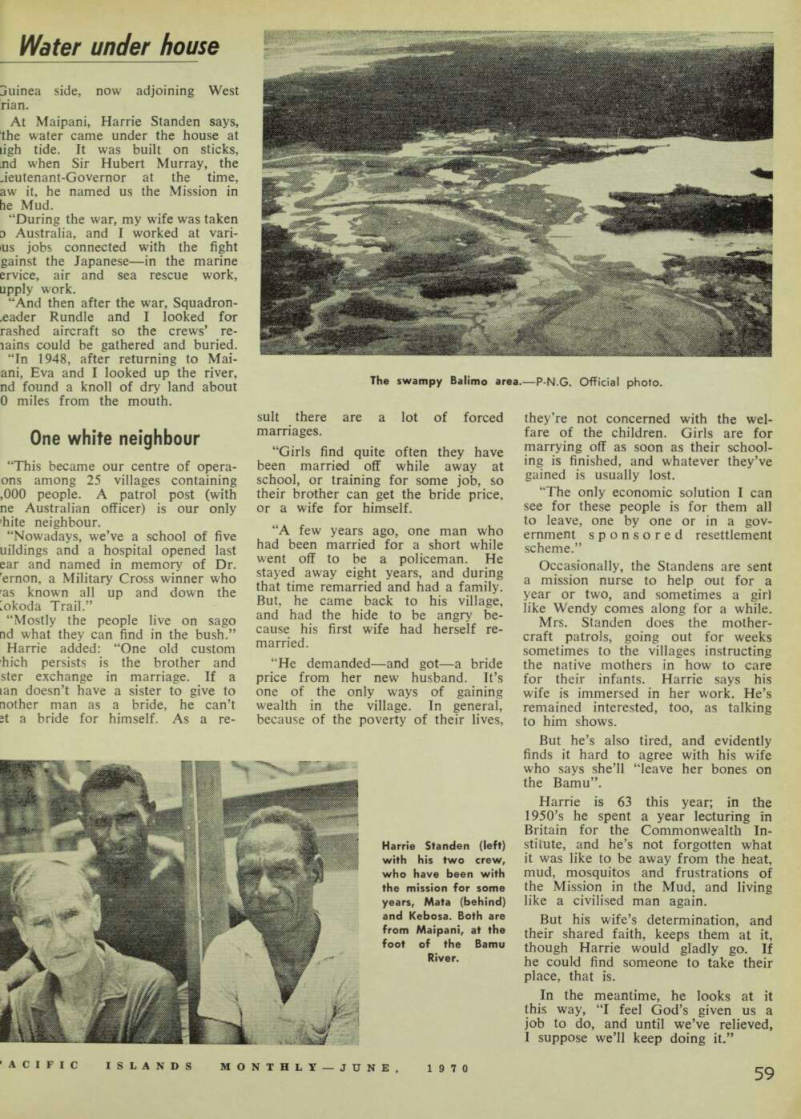
Just how muddy can be judged by he fact that the finding of a small itone at Balimo, not far away, in 1968 made the ABC’s national news.
Fhere just is no rock on the Bamu.
3,000 people
Its proper name is the Bamu River Mission. The work among 3,000 argely uneducated river people, who till live mainly on wild sago and vhat pigs they can catch, has changed ittle in 34 years. The station has gained a few buildings, found a mall knoll of dry land to sit on, md made a few converts to Christianity.
It’s been run that whole time by he same English couple, Harrie md Eva Standen, who are now both n their 60’s. They’ve been joined it odd times by a nurse here, a eacher there, and now by Wendy vho’s done some “governessing” and »elieves she can help out most with he toddlers.
Afterwards she wants to visit New Jritain, one of the New Guinea slands, where her father, David McClymont, came down in an Ameri an fighter-bomber on November 3, 943. Japanese anti-aircraft gunners iround Jacquinot Bay riddled the air raft piloted by Wing Commander Jill Townsend of Sydney and navi lated by McClymont.
Townsend pan-caked the plane on
the bay, and both waded ashore and ran into the jungle to escape the converging Japanese.
They were guided by coastwatchers across the island to the north coast to join another downed pilot, an American, Fred Hargesheimer, whose P-38 was shot down on a photo graphic sweep over Japanese occupied territory. Hargesheimer had been saved from hunger, dysentery and malaria only by being put to a new native mother’s breasts.
Today’s Papua-New Guinea Director of Civil Defence, Mr. R. I.
Skinner, then a coastwatcher, helped bring the three men together where they could board an American sub marine.
Palmalmal is the village where the people helped McClymont, and to day is the name of his station in Dingo.
Wendy went to the Church of England college, St. Hilda’s, at South port in Queensland, where she was impressed by seeing films of the missions in other lands.
This rather shy girl (on first meet ing) reveals a sense of adventure, and a big capacity to take things as they come. She wasn’t put off (well, not much) by stories she was told in Port Moresby before setting out on the Bamu River Mission’s new boat Goodwill.
"Sea trials"
The boat had just been finished, and Harrie Standen was giving her “sea trials”—as he called them—a few quick circuits around Port Moresby’s Fairfax Harbour, when she landed by jet in Port Moresby.
Harrie Standen then took Wendy to an area the Australian Admin istration in Papua-New Guinea appears to have despaired of ever doing anything with.
Social and economic conditions in the 34 years of the mission’s exist ence, have improved little. But the Standens have done a lot for in dividuals, and encouraged many local natives to leave their home
villages to enter the cash economy outside.
The nearest government post is the Sub-District Office at Balimo, 25 miles away as the crow flies, and a lot further by boat through the meandering waterways and swamps.
The office has three white men, three native clerks, an outboard opera tion, but Harrie Standen says they and their predecessors have been able to do little to help the people im prove themselves. The mission looks after their health in the main, a lot of their education, and teaches them to do what crop raising there is to be done.
Perhaps the government hasn’t the faith of the Standens, who have battled on in the face of very few converts to Christianity, and the natural disadvantages of the area.
What can you do when the only soil is so thin that a shovel can’t be used to dig it? It has to be scratched at with a stick to plant anything, and abandoned after two or three years. Almost everywhere, the soil is not more than a few inches deep. Below that is lifeless mud.
Nobody wanted it
The Standens began work at the mouth of the Bamu River, at Mai pani, in 1936, after hearing that the river delta was an area which nobody wanted to tackle. They had first gone to the Sepik River area, on the New
Wendy, a girl with a mission.
Water under house
juinea side, now adjoining West rian.
At Maipani, Harrie Standen says, the water came under the house at ligh tide. It was built on sticks, ud when Sir Hubert Murray, the Teutenant-Governor at the time, aw it, he named us the Mission in he Mud.
“During the war, my wife was taken a Australia, and I worked at vari es jobs connected with the fight gainst the Japanese—in the marine ervice, air and sea rescue work, apply work.
“And then after the war, Squadron .eader Bundle and I looked for rashed aircraft so the crews’ re lains could be gathered and buried.
“In 1948, after returning to Mai ani, Eva and I looked up the river, nd found a knoll of dry land about 0 miles from the mouth.
One white neighbour
“This became our centre of opera ons among 25 villages containing ,000 people. A patrol post (with ne Australian officer) is our only r hite neighbour.
“Nowadays, we’ve a school of five uildings and a hospital opened last ear and named in memory of Dr. r ernon, a Military Cross winner who r as known all up and down the iukoda Trail.”
“Mostly the people live on sago nd what they can find in the bush.”
Harrie added: “One old custom hich persists is the brother and ster exchange in marriage. If a tan doesn’t have a sister to give to nother man as a bride, he can’t ;t a bride for himself. As a re-
suit there are a lot of forced marriages.
“Girls find quite often they have been married off while away at school, or training for some job, so their brother can get the bride price, or a wife for himself.
“A few years ago, one man who had been married for a short while went off to be a policeman. He stayed away eight years, and during that time remarried and had a family.
But, he came back to his village, and had the hide to be angry be cause his first wife had herself re married.
“He demanded—and got—a bride price from her new husband. It’s one of the only ways of gaining wealth in the village. In general, because of the poverty of their lives.
they’re not concerned with the wel fare of the children. Girls are for marrying off as soon as their school ing is finished, and whatever they’ve gained is usually lost.
“The only economic solution I can see for these people is for them all to leave, one by one or in a gov ernment sponsored resettlement scheme.”
Occasionally, the Standens are sent a mission nurse to help out for a year or two, and sometimes a girl like Wendy comes along for a while.
Mrs. Standen does the mother craft patrols, going out for weeks sometimes to the villages instructing the native mothers in how to care for their infants. Harrie says his wife is immersed in her work. He’s remained interested, too, as talking to him shows.
But he’s also tired, and evidently finds it hard to agree with his wife who says she’ll “leave her bones on the Bamu”.
Harrie is 63 this year; in the 1950’s he spent a year lecturing in Britain for the Commonwealth In stitute, and he’s not forgotten what it was like to be away from the heat, mud, mosquitos and frustrations of the Mission in the Mud, and living like a civilised man again.
But his wife’s determination, and their shared faith, keeps them at it, though Harrie would gladly go. If he could find someone to take their place, that is.
In the meantime, he looks at it this way, “I feel God’s given us a job to do, and until we’ve relieved, I suppose we’ll keep doing it.”
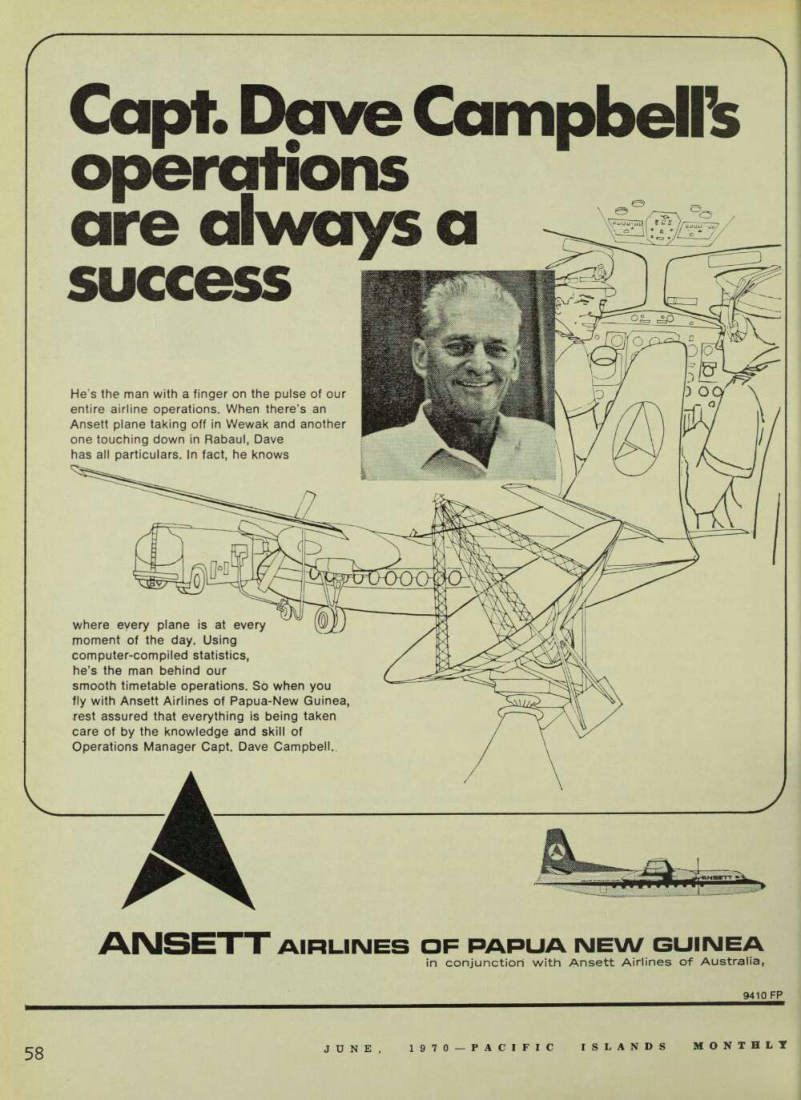
Harrie Standen (left) with his two crew, who have been with the mission for some years, Mata (behind) and Kebosa. Both are from Maipani, at the foot of the Bamu River.
The swampy Balimo area.—P-N.G. Official photo.