Fiji should be independent
pp. 26-28 · Read in the full issue
It's a 'matter of self respect' that Fiji should be independent
“Can you explain in a nutshell, sir, what Fiji will achieve with independence?” The Chief Minister’s reply to a reporter’s question at the Suva news conference on independence came quickly:
“Self respect!”
Asked whether Fiji had not had self-respect in the past, Ratu Sir Kamisese Mara voiced a feeling which could be considered the kernel of his own political and personal
philosophy:
“Not when you are ruled by people sent from another country, whose ideas are different from yours, who tell you what to do and who you have to follow. I think if you have anyone coming into your home to tell you what to do, you would not like it.”
On October 10 this year, 96 years
after Cession to Britain, Fiji will fly its own flag, the design for which has yet to be decided.
Thought too will be given to a new national anthem although, in the words of the Chief Minister, it might be “very difficult to find one which sounds better than the present one.
People might feel we should keep it for the time being.”
Fiji will seek entry into the United Nations, make its own defence ar rangements and international agree ments, solicit its own overseas aid.
As the politicians like to put it, Fiji
will guide its own destiny.
Few Fiji people understand the full implications of the decision taken in late April and early May at the constitutional conference at Marl borough House, London. In the public bars and round the grog bowl, it translates as “October 10! Then we be boss!” Ask a group—any group —about independence and perhaps half will say “I don’t know. Maybe it’s too soon,”
Some maintain that the only way for Fiji to know its own problems and learn how to tackle them is to
No asking the people
stand on its own feet. Others say “Our leaders know best,” and leave it at that. A small number say nothing at all but make quiet arrange ments to leave the country. At one sailing in May, close to 100 Indians and Chinese departed for Canada and the US, following a pattern that’s become noticeable over the past two years.
It would be logical to hold mass public— not political party—meetings all over Fiji, particularly in the villages and outer islands, where those who attended the conference could place themselves open to the sort of questions the ordinary man wants to know. But by mid-May, there was no announcement of any such plan.
While the average man seems fairly apathetic about Fiji’s new status, un doubtedly because he doesn’t under stand it, none can deny that it was achieved in the best possible atmos phere. By all reports both Alliance and National Federation Party mem bers worked hard to prevent insoluble clashes over policy. There was a spirit of compromise, where compro mise had seemed barely possible.
The deadlock over the vital issue of representation and method of election was the closest thing to disaster at the conference but even this, after much hard-talking was smoothed over, with neither party bitter at losing out.
As Alliance adviser and editor of the party’s news-magazine, Nation, David Seidler saw it: “The Alliance realised that the NFP was firmly rommitted to the immediate intro luction of common roll but at the •ame time had no desire for chaos.
Phe NFP understood the depth of eeling on the part of the Alliance hat the untimely imposition of :ommon roll would be disastrous.”
During the intensive discussions )etween the Chief Minister, the .eader of the Opposition, Mr. S. M.
Coya and Lord Shepherd, who pre ided over the conference in his apacity as British Minister of State or Foreign and Commonwealth Affairs, proposals and counter pro osals for election methods were hrashed out. At times, agreement joked uncertain.
Finally, it was agreed that by )ctober, 1971, an election will be eld for a new 52 member House of Representatives. Twelve Fijians, 12 radians and three general electors rail be elected by common roll. By at *°. l ?. r °M (same as cross voting) 0 Fijians, 10 Indians and five general lectors will be elected.
Finance, of course, was another
matter uppermost in the minds of Fiji’s delegation to London.
Britain made it clear that an inde pendent Fiji couldn’t expect generous free grants of development funds.
Colonies received grants but an inde pendent country must expect only interest-bearing loans.
After discussion the UK Govern ment agreed to extend its existing grants committments to Fiji beyond October 10. The UK Minister for Overseas Development, Mrs. Judith Hart, gave an assurance that the grants for schemes for 1970 and 1971 would remain in effect.
Technical assistance and the over seas service aid scheme would con tinue on the same terms as in the past.
The unexpended balance of colonial development and welfare scheme money—involving about $4.8 million —approved to March 31 this year would continue to be available as a grant.
Colonial development and welfare grants for higher education—for the development of the University of the South Pacific—would also remain in force. The unexpended balance of these grants after October 10 would be about $2 million.
At his return-home news con ference, the Chief Minister pointed
oat t ‘ iat an ac *ded a nd unexpected windfall was the offer of assistance to University of the South Pacific
(Continued over page)
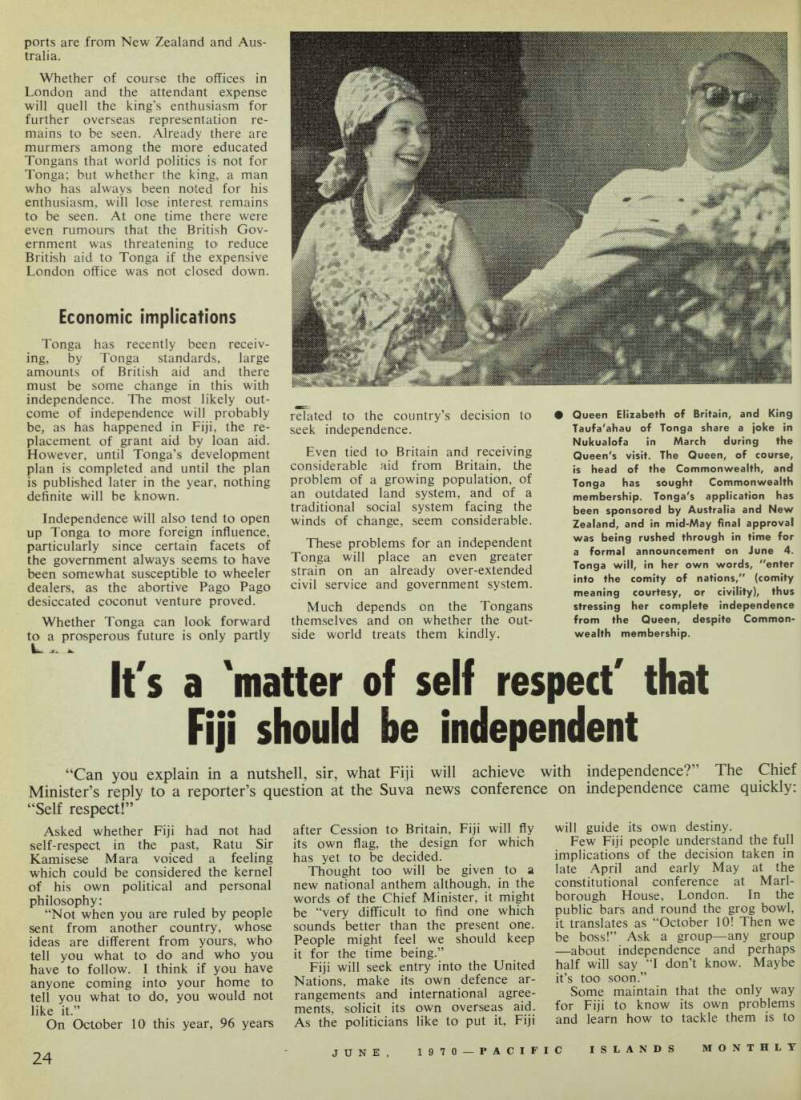
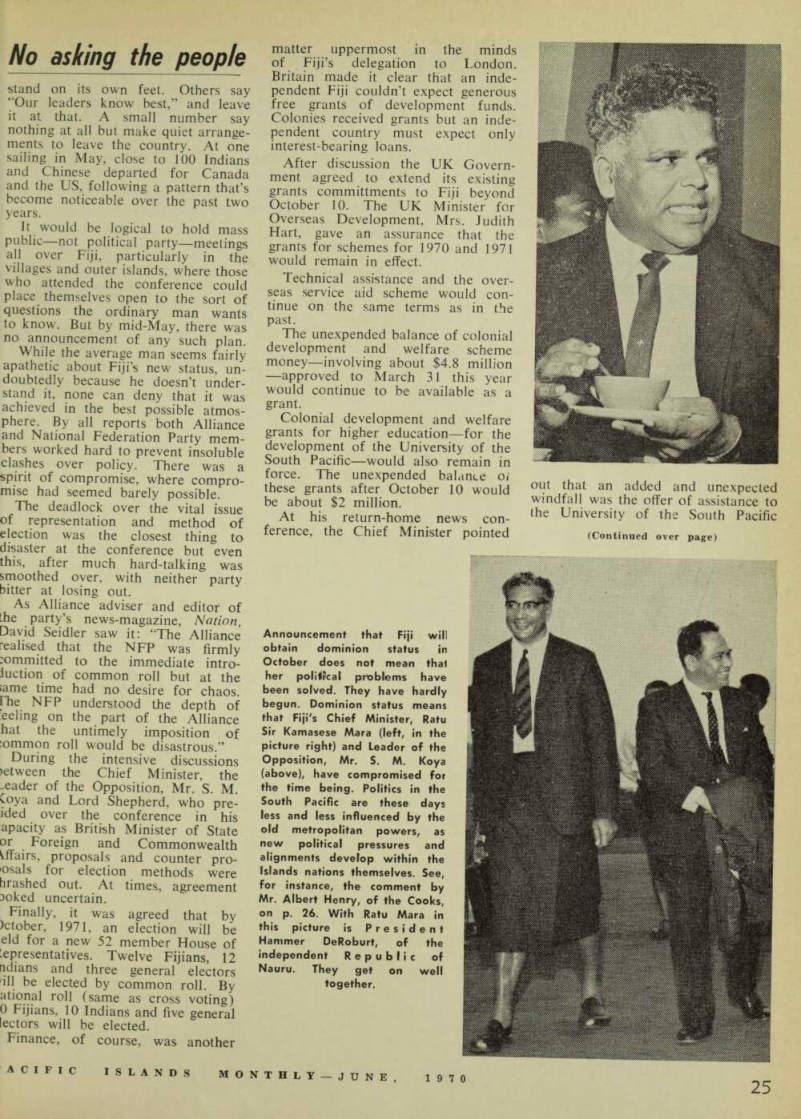
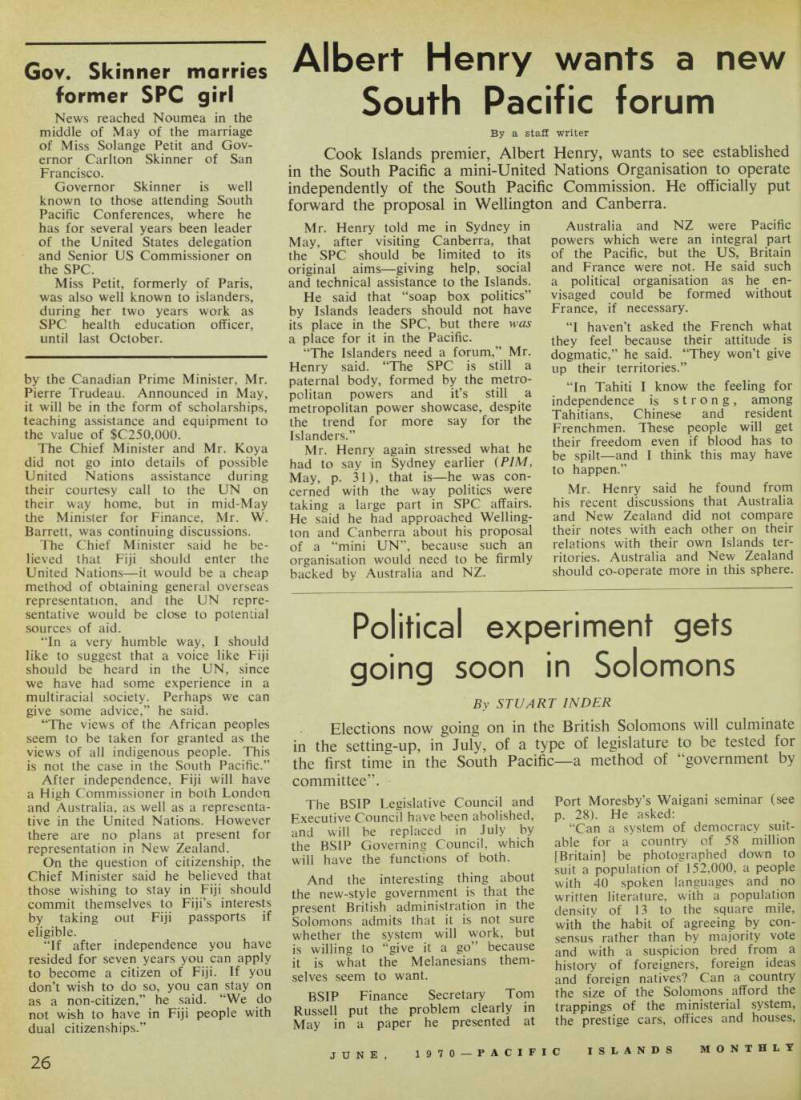
Announcement that Fiji will obtain dominion status in October does not mean that her political problems have been solved. They have hardly begun. Dominion status means that Fiji's Chief Minister, Ratu Sir Kamasese Mara (left, in the picture right) and Leader of the Opposition, Mr. S. M. Koya (above), have compromised for the time being. Politics in the South Pacific are these days less and less influenced by the old metropolitan powers, as new political pressures and alignments develop within the Islands nations themselves. See, for instance, the comment by Mr. Albert Henry, of the Cooks, on p. 26. With Ratu Mara in this picture is President Hammer DeRoburt, of the independent Republic of Nauru. They get on well together.
by the Canadian Prime Minister, Mr.
Pierre Trudeau. Announced in May, it will be in the form of scholarships, teaching assistance and equipment to the value of $C250,000.
The Chief Minister and Mr. Koya did not go into details of possible United Nations assistance during their courtesy call to the UN on their way home, but in mid-May the Minister for Finance, Mr. W.
Barrett, was continuing discussions.
The Chief Minister said he be lieved that Fiji should enter the United Nations—it would be a cheap method of obtaining general overseas representation, and the UN repre sentative would be close to potential sources of aid.
“In a very humble way, I should like to suggest that a voice like Fiji should be heard in the UN, since we have had some experience in a multiracial society. Perhaps we can give some advice,” he said.
“The views of the African peoples seem to be taken for granted as the views of all indigenous people. This is not the case in the South Pacific.”
After independence, Fiji will have a High Commissioner in both London and Australia, as well as a representa tive in the United Nations. However there are no plans at present for representation in New Zealand.
On the question of citizenship, the Chief Minister said he believed that those wishing to stay in Fiji should commit themselves to Fiji’s interests by taking out Fiji passports if eligible.
“If after independence you have resided for seven years you can apply to become a citizen of Fiji. If you don’t wish to do so, you can stay on as a non-citizen,” he said. “We do not wish to have in Fiji people with dual citizenships.”