Pacific Islands Monthly
pp. 24-26 · Read in the full issue
And What Does Independence
Mean For The Last Kingdom?'
• Tonga becomes fully independent on June 4, and will gain Commonwealth membership. Fiji becomes a full Commonwealth dominion on October 10. "PIM" writers in Nukualofa and Suva survey the reactions.
From a Nukualofa correspondent Tonga, last remaining kingdom in the Pacific, forsakes the sheltering umbrella of British protec tion on June 4 and becomes another of the Pacific’s independent mini-nations. With an area of only 259 square miles, divided between some 200 islands, and people by 83,500 Tongans, the future of the country seems conjectural, to say the least.
Politically, Tonga is a constitu tional monarchy with King Taufa’ahau Tupou IV on the throne. The present king is the fourth ruling monarch since the establishment of the monarchy in its present form on December 4, 1845.
Tonga has been a British protected State since May 18, 1900. The pre sent relations between Britain and Tonga are set out in the Treaty of Friendship of 1958, which is the consolidation of a series of treaties and agreements dating from 1879.
Whereas former treaties gave the British Agent or Consul quite exten sive powers, the revised Treaty of Friendship in force until June 4 is very much a toothless treaty. Pre viously the British Government, through its agent and consul, was responsible for judicial, fiscal and other matters. The present treaty only covers foreign affairs and security, and even in that field the Tonga Government appears free to act virtually at will. After June 4 it will certainly be free to act at will.
Limited presence
Today in Tonga the British pre sence is limited to a commissioner and consul, Mr. A, C. Reid, and an assistant. There are also a number of British expatriates occupying some of the senior civil service posts, to gether with other Britishers working as experts or advisers attached to various government departments.
In recent years Britain has been of very considerable financial assist ance to Tonga, and the Tonga Chronicle has stated that more than a half of all expenditure on the 1965- 1970 development plan has been provided by Britain. There seems little doubt in government circles that
British aid will continue in the future, although neither government has yet announced the likely level of future aid.
With Britain handling foreign affairs, Tonga has been able to bene fit from a worldwide network of British diplomatic offices at no cost to itself. Both internal and external security is, until June 4, a joint con cern of Britain and Tonga and in the case of any external interference or for internal disorders, the assistance of Britain would be taken for granted.
Little to be gained?
To all effects and purposes it ap pears that Tonga is already indepen dent. There would seem to be little to be gained by cutting Tonga’s mooring rope and letting so frail a craft sail in the dangerous deeps which all small independent nations must face.
Already the sharks are gathering and the pessimists might say that the country will either be taken over by pirates, will face a mutiny of the crew or will merely succumb to the ravages of time and slide beneath the waves.
Why, then, has Tonga moved to a position of independence—what are the forces that moved it there?
These questions have been asked in Tonga over the past year or so by tourists, visiting businessmen, expat riate civil servants and, most im portant of all, by the ordinary Tongan citizen. There are no simple answers.
What does the average Tongan think of independence? The answer is, “very little indeed”. The average Tongan, if we dare assume that such a man exists, has generally a very low level of political awareness, par ticularly where external relations are
concerned. Frequently his horizons are limited to the local church and to the noble of his area.
The government to him is a some what alien phenomenon found largely in the capital of Nukualofa. His everyday life is little affected by the government and he is unlikely to see a government minister unless he goes to the capital, for ministers are not renowned for their fact-finding tours of the countryside.
To much of the population, inde pendence is a strange and little understood concept. Many Tongans seem to have been under the mis apprehension that their country was already independent! Others won dered why the government wanted to be independent when, with Britain acting as a fairy godmother, things already seemed quite satisfactory.
Some Tongans, particularly the more aware ones, are quite naturally very proud that their small country is to attain its manhood and their feelings are certainly well justified.
No oppression
It is interesting to note though that some government ministers have had a rough time in explaining indepen dence to their people. For while the relationship between many metro politan powers and the various de veloping countries within their sphere of influence has frequently been one of oppression or exploitation, this has most certainly not been the pattern as far as Britain and Tonga are concerned.
Rather Britain has in recent years been a benefactor of some generosity and many Tongans see little point in ending this relationship. It must also be emphasised that many
Tongans consider issues such as independence to be a matter solely for government concern. This is not apathy, it is merely the natural reaction of a people long accustomed to playing no active role in the determination of their country’s affairs.
If the government and the king announce that Tonga is to seek independence, what right thinking Tongan wou.d question such an edict.
Who supports independence?
Who, one might ask, are the advocates and supporters of Tonga’s move to independence? They are certainly not the people, nor the neonle’s renresentatives in narlia with internal politics and with an inner power struggle. The main supporters and initiators of independence are obviously the government, or more specifically the Privy Council which comprises the king together with his ministers.
Of this body the king appears to be the main instigator of independence. His motives are not at all easy to identify but appear to be largely personal. For the king is a man who has played a long and active role in the development of Tonga and who, like many other national leaders, desires a place in history. And to go down in history as the king who regained Tonga’s
independence appears to appeal to the king’s sense of history.
Other commentators might say that the king has great nation aspirations for Tonga. For many years there have been rumours of Tongan repre sentation at the United Nations and obviously independence is a necessary precondition for such representation.
Whether Tonga could afford “a man a, the United US and other countries are taking steps to exclude “mini-states” from membership of this prestigious inter national club.
W™** Since late 1969, doubtless in antici pation of independence, Tonga has had representatives in the UK. In charge of the London office is Vaea, a noble from the island of Tonga tapu. He is assisted by David Tupou, a young barrister with excellent qualifications.
What exactly these two very personable Tongans do in London remains a mystery. The Tonga Chronicle describes them as attending social functions and generally ap pearing on show. From absolutely no fault of their own, there appears to be virtually no work for them in London.
The expenses of the London office
Our Cover
The Kingdom of Tonga be comes fully independent in June, and our cover pays tribute to the kingdom and its ruler, His Majesty King Taufa’ahau Tupou IV. The inscription on the coat of arms, Koe Otua mo Toga Ko hoku Tofi’a, means: “My in heritance consists of God and Tonga”. The Tongan colours, red and white, stand for liberty and peace through the Christian religion. The cover is the work of Captain Brett Hilder, long time contributor to P1M, who sketched the king by special per mission at his country residence on Tongatapu. The king remarked that it was the first time he had been sketched. The original is in watercolour.
must, by Tongan standards, be very high. Occasionally one hears mutters about the expense of it all, but apart from that nobody seems to have any idea of the cost, Meanwhile, Tongans resident in New Zealand and Australia wonder why representation offices were not first opened in Sydney or Auckland, Certainly such an office would be invaluable as far as developing trade contacts, particularly since Tonga’s banana crop goes to New Zealand and most of the country’s food im-
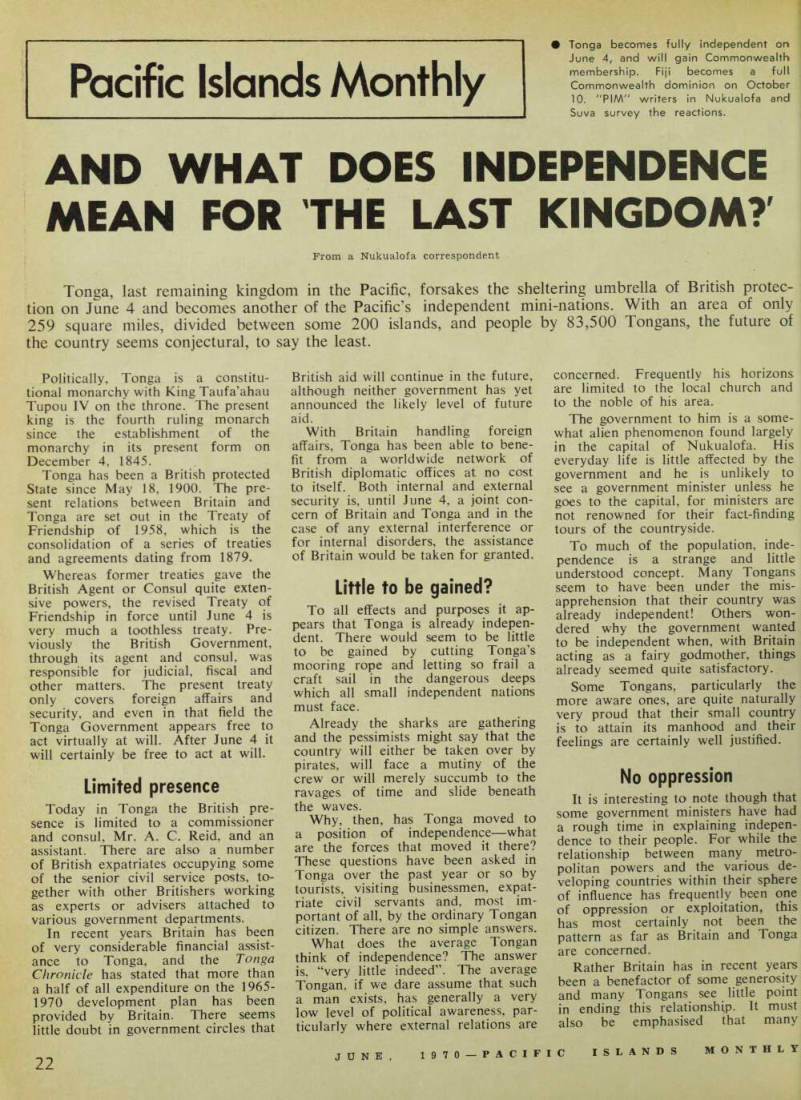
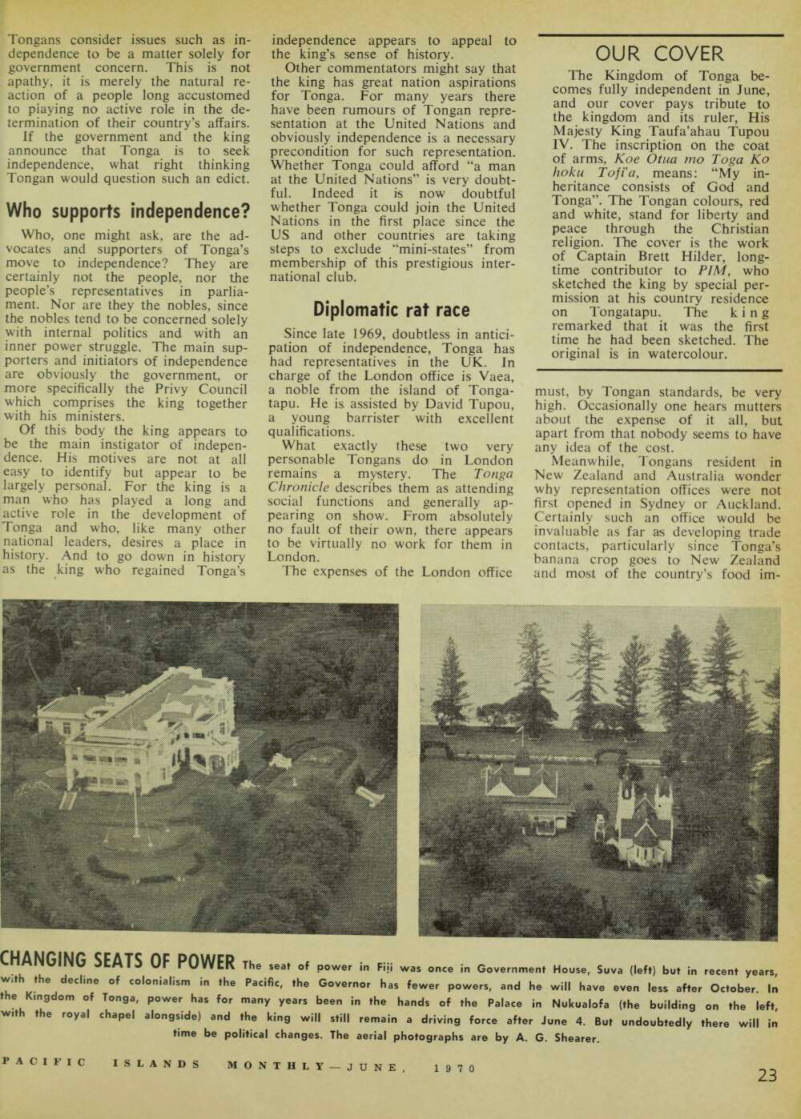
CHANGING SEATS OF POWER The seat of power in Fiji was once in Government House, Suva (left) but in recent years, with the decline of colonialism in the Pacific, the Governor has fewer powers, and he will have even less after October. In the Kingdom of Tonga, power has for many years been in the hands of the Palace in Nukualofa (the building on the left, with the royal chapel alongside) and the king will still remain a driving force after June 4. But undoubtedly there will in time be political changes. The aerial photographs are by A. G. Shearer.
ports are from New Zealand and Aus tralia.
Whether of course the offices in London and the attendant expense will quell the king’s enthusiasm for further overseas representation re mains to be seen. Already there are murmers among the more educated Tongans that world politics is not for Tonga; but whether the king, a man who has always been noted for his enthusiasm, will lose interest remains to be seen. At one time there were even rumours that the British Gov ernment was threatening to* reduce British aid to Tonga if the expensive London office was not closed down.
Economic implications
Tonga has recently been receiv ing, by Tonga standards, large amounts of British aid and there must be some change in this with independence. The most likely out come of independence will probably be, as has happened in Fiji, the re placement of grant aid by loan aid.
However, until Tonga’s development plan is completed and until the plan is published later in the year, nothing definite will be known.
Independence will also tend to open up Tonga to more foreign influence, particularly since certain facets of the government always seems to have been somewhat susceptible to wheeler dealers, as the abortive Pago Pago desiccated coconut venture proved.
Whether Tonga can look forward to a prosperous future is only partly
related to the country’s decision to seek independence.
Even tied to Britain and receiving considerable aid from Britain, the problem of a growing population, of an outdated land system, and of a traditional social system facing the winds of change, seem considerable.
These problems for an independent Tonga will place an even greater strain on an already over-extended civil service and government system.
Much depends on the Tongans themselves and on whether the out side world treats them kindly.
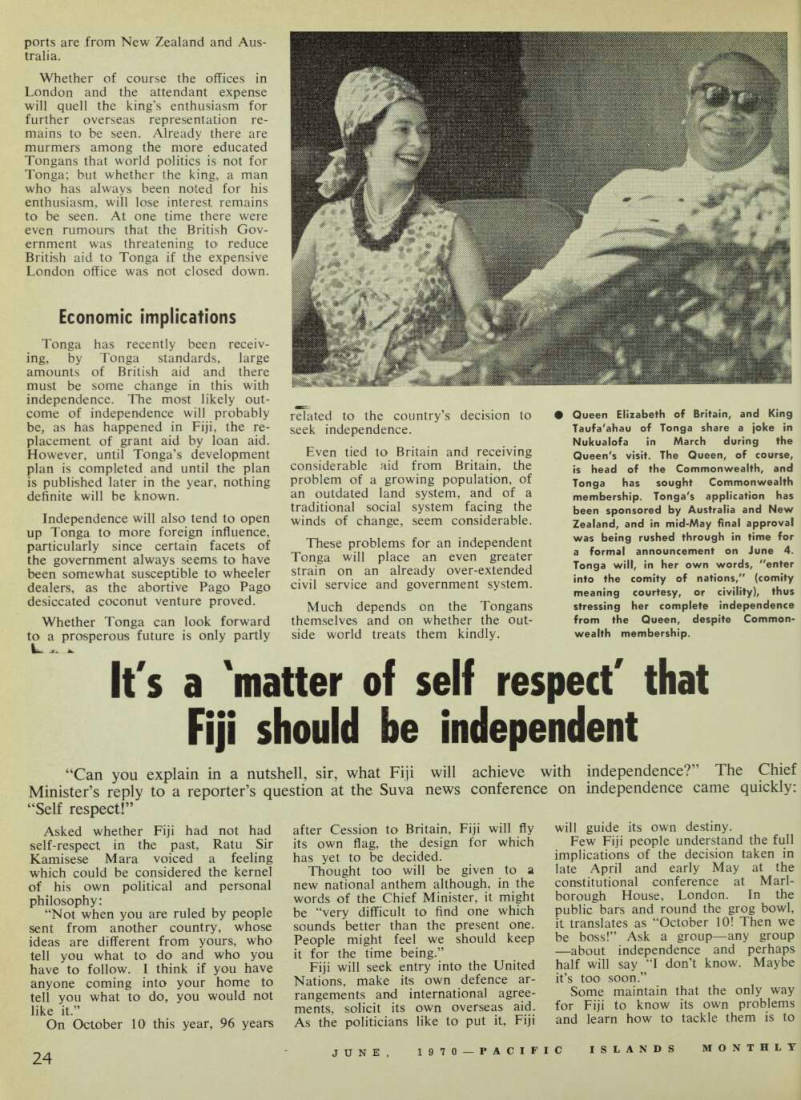
• Queen Elizabeth of Britain, and King Taufa'ahau of Tonga share a joke in Nukualofa in March during the Queen's visit. The Queen, of course, is head of the Commonwealth, and Tonga has sought Commonwealth membership. Tonga's application has been sponsored by Australia and New Zealand, and in mid-May final approval was being rushed through in time for a formal announcement on June 4.
Tonga will, in her own words, "enter into the comity of nations," (comity meaning courtesy, or civility), thus stressing her complete independence from the Queen, despite Common
wealth membership.