Book Reviews
pp. 97-98 · Read in the full issue
Nauru: Independence And
Triumph, Now What?
The Republic of Nauru has its problems. Having attained independence in 1968 after a campaign conducted with great skill and great speed in David and Goliath fashion, the architects of victory have yet to consolidate.
The Nauruans are short of able, local administrators and the turn over in key expatriate staff in the last 12 months has pointed up the fact that there are pitfalls in buying your own experts.
But two years is not a long time— certainly too short a time for any body to know what sort of fist the Nauruans are likely to make of independence. Meanwhile, in Nauru: Phosphate and Political Progress , we have a timely record of the back ground to independence, and an interesting study of how European influences have helped mould the Nauruan character so far.
'Big brother 7
H. E. Maude, in a foreword, says that on the whole it is “not a picture in which Australia can take an un mixed pride”. And he continues, “The Administration, both in Canberra and Nauru, exhibited the typical syndrome of colonialism: ‘Big brother knows best; while at the same time being clearly unwilling to subordinate Aus tralian interests to Nauruan. A few Administrators, such as General Griffiths, were prepared to stand up for the islanders vis-a-vis the British Phosphate Commissioners, but others were more concerned with the public recognition of their personal status.
It was paternalism at best and a quarterdeck autocracy at worst; while the Phosphate Commissioners, like
monopolists the world over, main tained a complacent taciturnity which not even the United Nations could penetrate.”
Mr. Maude in fact is far more outspoken in his views than is the author, Nancy Viviani, who is a research assistant in the Department of Economics of the Research School of Pacific Studies at the Australian National University. Her writing ap proach is probably too academic for the book to attract the casual reader, although, at times, snatches of her material can be of absorbing interest.
Miss Viviani lived on Nauru for a time while gathering the facts, and as a result has been able to make use of many first-hand accounts of events. As for instance her account of the founding of the Nauru Co operative Society, which is based
almost entirely on the evidence of present-day Nauruans, including Pre sident Deßoburt (whose father was a leading exponent), Jacob Aroi and Buraro Detudamo, whose father was gaoled for his part in the foundation.
When the Boston Board of Mis sions Church on Nauru was taken over by the LMS in 1917, the celebrated missionary, the Rev. P. A.
Delaporte, went back to the USA, taking with him a young Nauruan, Timothy Detudamo, to help him complete his Nauruan translations.
Four years in America impressed Detudamo with the example of free enterprise and on his return he urged Nauruans to start their own store so that the British Phosphate Com missioners’ trading monopoly would be broken and the price of goods reduced.
The BPC and the Administrator, then Mr. Smith-Rewse, found the Nauruans intention to found a store “unbelievable and intolerable”. When
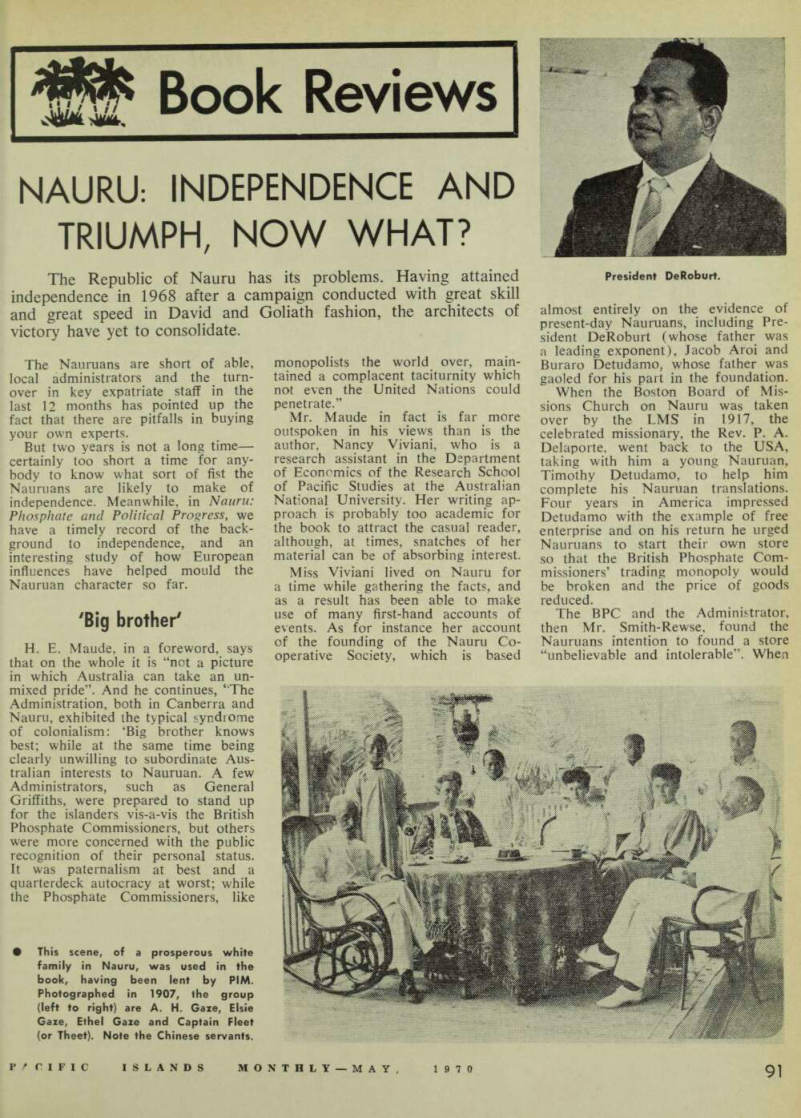
This scene, of a prosperous white family in Nauru, was used in the book, having been lent by PIM.
Photographed in 1907, the group (left to right) are A. H. Gaze, Elsie Gaze, Ethel Gaze and Captain Fleet (or Theet). Note the Chinese servants.
President DeRoburt.
Gaoled for two years
the Nauruans insisted, Detudamo was charged with disturbing the peace and was gaoled for two years. Other chiefs were also charged in court.
The situation was resolved only by the arrival of Administrator Griffiths (1921-1927) who gave the Nauruans permission to start the co operative and the store, which was done in 1922, with £BOO subscribed by the Nauruans.
The author has also made good use of local informants in re-creating the picture of World War 11, during which the Japanese deported, to Truk, 1,201 Nauruans, and would have deported the rest had not the ship intended for the task been torpedoed.
The men were put to work build ing an airstrip but the food situation grew very difficult and, in 1944 and 1945, 463 Nuruans died—or more than one-third of all Nauruans on Truk. Every family lost at least one member.
One of two priests. Father Kayser, died as a result of ill treatment and malnutrition (the other. Father Clivas, still lives an active life on Nauru) and some Nauruans were killed and injured by air raids by Allied planes operating from Tarawa.
The deportation of two-thirds of the Nauruans and the death of nearly 500, mostly the old and the young, left the society, after the war, with a gap in generations and a disrup tion of family life. The Nauruan population had fallen well below the 1,500 level which the Nauruans them selves regarded as a minimum for survival.
Turning point
Writes Miss Viviani: “The remain ing Nauruans greeted the return of the Australian Administration with joy, and yet this was a turning point for them. For half a century, secure in their social separation they had endured German and British oc cupation with a kind of indifference, but the wartime upheaval in their economic and social life forced them for the first time to look outwards as a people.”
Her book helps show that the fight for control of the phosphate, and eventual independence, were in evitable from that time, but the process was speeded up once De- Roburt was elected Head Chief in 1955. He was keenly aware of the changes wrought by the war and already saw the future welfare of
the Nauruan people as a problem that must be faced as soon as
possible.
“Deßoburt,” she says, “shares the genial nature and pleasant manners of his people, but he has a shrewdness and strength-of-purpose that has enabled him to swing the, at times, apathetic Nauruans behind him in the struggle with the BPC and the Administration. His strength as a leader and as a negotiator is based firmly on the Nauruan people’s trust.”
It was Deßoburt, who as far back as 1963 set a pattern of negotiating which was extraordinarily successful.
When at the conference table BPC or Canberra would reject a Nauruan proposal, the Nauruans would reply, not by compromising, but by raising their demands.
The details of those long series of negotiations are very well documented here and the book also has an ap pendix of useful facts and figures, copious notes, a bibliography and index.—Sl.
T Nauru: Phosphate And Political
PROGRESS. Australian National Univer sity Press. $5.00).
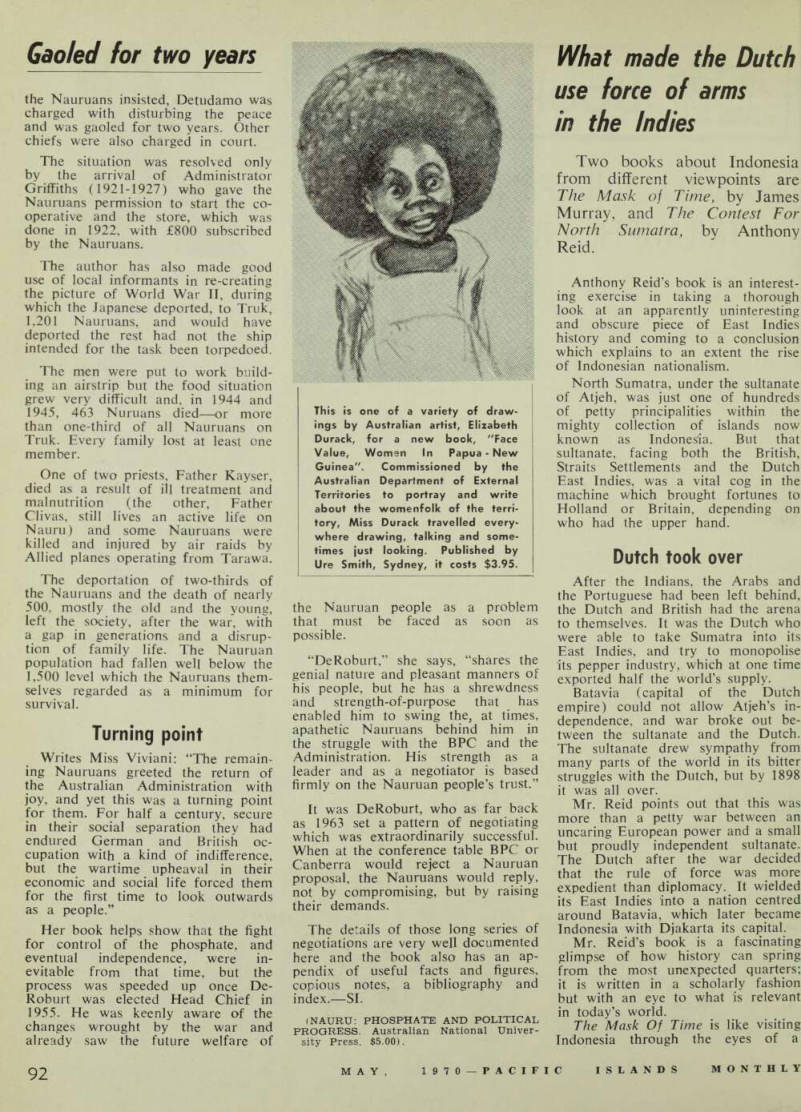
This is one of a variety of draw ings by Australian artist, Elizabeth Durack, for a new book, "Face Value, Women In Papua - New Guinea". Commissioned by the Australian Department of External Territories to portray and write about the womenfolk of the terri tory, Miss Durack travelled every where drawing, talking and some times just looking. Published by Ure Smith, Sydney, it costs $3.95.