(via Cook) found
p. 94 · Read in the full issue
How Pacific treasure (via Cook) found its way to Russia
When the “Resolution” and the “Discovery” were on their way to try and force a northern passage back to England during Captain Cook’s third, fateful, voyage round the world, they put in to the Russian port of Petropavlovsk-on-Kamchatka for provisions and repairs. In ap preciation of their kindness, the new commander of the expedition (follow ing Cook’s death in Hawaii) Clerke, gave the Russians a number of presents from the Pacific.
The Russian port was to become better known not long after. In January, 1780, the London Gazette announced that Captain Clerke had reached the harbour of St. Peter and St. Paul, Kamtschatka, and had reported to the Admiralty the sad news of Cook’s death.
Captain Clerke also gave a letter of gratitude, a gold medal and a silver cup, in thanks to the Russian Empress, Catherine 11, and the Kamchatka Governor, Magnus Bern.
The two ships failed in their attempt to pass from the Bering Straits through a north passage and returned to Kamchatka bearing the body of Captain Clerke, who died of consumption, and was buried there.
The Russians were well pleased with their gifts from the Pacific and from Kamchatka the collection was taken to the capital St. Petersburg (now Leningrad) and placed in Peter I’s curio chamber. After two centuries it still rests in the curio chamber, now re-named the Museum of Anthropology and Ethnography, and the Russians—in Cook’s bi-centenary year—have been reminding the world of their own close connection with
the great navigator.
There are several rare Hawaiian capes in the Leningrad collection and Polynesian headpieces made of fine twigs overset by feathers. The Russians were surprised at the resemblance of the headpieces to those used by the ancient Greeks.
A recent news report from Russia describing the items says an honoured piece in the collection is a bracelet, given to Cook by a Hawaiian chief, made of two rows of boar teeth. As Cook understood it, the bracelet had been handed down through many generations before arriving on this chiefs wrist; it was only worn while dancing.
From Tonga there are lace-like mats decorated with triangular patterns and combs made of sharp sticks. The collection also includes the breast-plate of a Hawaiian Giva, a costume used during burial ceremonies. The breast-plate is made of thin, narrow, mother-of-pearl plates, formed so well that they seem solid, but displaying great variety of colours when moving.
There is also a large fan made of the tail feathers of the frigate bird, a fan covered with several layers of greyish tapa, a dancing rod in the form of a stick with a white dog-tail spread on it, a sleeping mat, a double weave bag made of rope and a light bench used as a pillow in Tonga.
Among weapons in the collection are a dagger with a rope noose, to fasten round the hand allowing a warrior to strike with great precision, and a wooden instrument lined with sharks’ teeth, for disembowelling an opponent.
The Leningrad collection is highly prized by scholars outside Russia, as well as within.
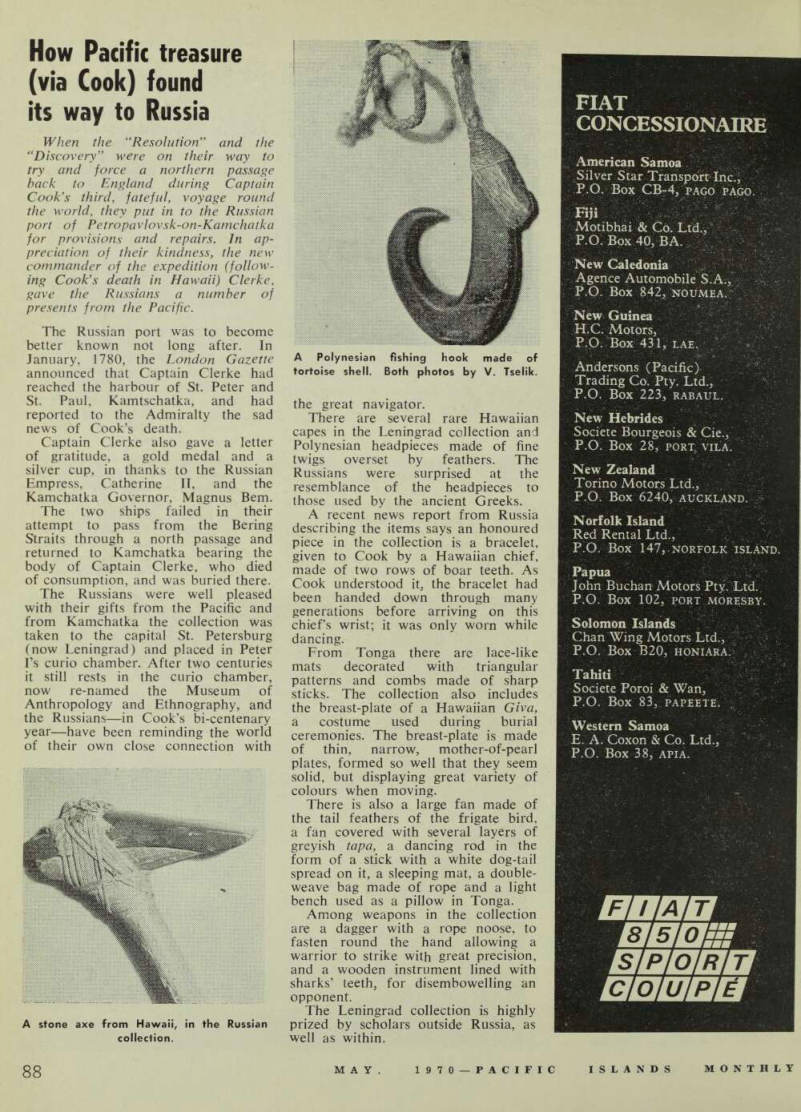
A stone axe from Hawaii, in the Russian collection.
A Polynesian fishing hook made of tortoise shell. Both photos by V. Tselik.