The Editor's Mailbag
pp. 37-39 · Read in the full issue
Communication
From Tahiti
Sir, —Following the publication in your magazine dated January, 1970, p. 14, of an article entitled “Up Front With The Editor”, the 30 members of the Territorial Assembly of French Polynesia have been unanimous in expressing their sur prise that such an article could have been published. In fact, they are absolutely certain that this letter could not have come from one of them.
They have thus asked me to re quest you to be kind enough to send me a photocopy of this letter that you claim having received from a Territorial councillor and which was the focal point of the article published by your magazine.
To enable you to meet this re quest, you will find hereafter, to gether with their signatures, a list of the Territorial councillors of French Polynesia.
Should you be unable to grant this request, I shall be obliged to resort to other means, so that full light may be shed upon this affair.
John Teariki.
President of the Territorial Assembly, French Polynesia.
Papeete, April 6, • Mr. TearikVs letter to PIM, the general text of which was published in the Tahiti newspapers in early February, bears the signatures of the 30 members of the Territorial As sembly. Now the assembly’s letter has been received we have taken action on it, and have written to Mr.
Teariki, commenting on the points raised. We have asked him what the assembly considers untrue in the original letter as published in PIM, and to supply us with corrections.
Original text of Mr. Teariki’s letter is in French.
Coconut Milk
Sir, —Several points in your article on the production of substitute milk and milk by-products in Pacific Islands should be clarified (PIM, Feb., p. 118). The heading of your article “Coconut milk co. favours Nauru” will certainly be most mis leading to Island residents, to whom coconut milk clearly means the liquid
in green coconuts. There never has been any intent to produce and market such an item.
The milk, ice cream, and other products will use coconut oil in place of butter-fat, but the balance of the ingredients will be from non-coconut sources, so that the end product could hardly be correctly classed as coconut milk. The food item, especially the sweetened condensed milk, ice cream, and margarine, will be virtually indistinguishable from those made from cow’s milk.
Tonga was mentioned in the prospectus because officials there have exhibited an early interest in the production of margarine in the kingdom.
Since it is universally known that the shares of new enterprises are not traded on stock exchanges, any in ferences drawn from the statement, “No stock exchange listing is men tioned for Cocomilk’s shares” in the article should be ignored.
A. Hansvold
Uncle Sam Agency, Seattle, US • As "PIM” said (Feb., p. 119), the main source for Cocomilk Ltd.’s produce would be “dairy-type produc tion”', possibly in Tonga. It was not stated the milk would come from the liquid of green coconuts. Our state ment regarding stock exchange listing was made in the light of the 900 per cent, premium, Islanders are being offered for Cocomilk’s shares and its initial underwriting expenses of SUSIS,OOO. Ifs news to us that “the shares of new enterprises are not traded on stock exchangesthere’s been at least a dozen exceptions in Australia in recent years.
Magisi In Reply
Sir, —Re Betty Sanft’s letter (PIM, Apr., p. 42) concerning my article on Tonga in February PIM.
The sentence on trial—“ The nobles today are losing the respect of many, and that includes the king”—simply means that the king and nobles are losing the respect of many Tongans.
Anyone with healthy ears and eyes can see this after a brief stay in Tonga.
She says I should count my blessings, but how can I count my
blessings, when I see homeless youths curled up in sleep in a Nukualofa arcade; when several high-ranking people in the government operate lucrative sideline businesses despite civil service regulations prohibiting this; when several civil servants confide that they share my views, but they have to toe the line or possibly lose their jobs.
If I can’t count my blessings, I can try her other proposal, that I “stir up the soil under the banana palms”. But then I remember I have no land allotment although I’ve been eligible for many years and have faithfully kept up poll tax payments.
So I can only add that in all my writings on Tongan social changes, I have spoken from the heart, without being frightened of telling the truth.
This was the major reason for the Tongan Cabinet firing me last year from my job as incoming editor of the government-owned newspaper.
I write as I do because I love my people, my country and my king.
Through my writings I have hoped to make people a little more aware of the true state of the kingdom.
For the rest, I bow to Betty Sanft’s “more discerning” eye, her obviously pure sense of loyalty, and, most importantly, to her superior intellect.
Sio Magist
Nukualofa, Tonga • Young Tongan journalist Sio Magisi, some of whose articles in “PIM” have brought a strong reaction in Tonga, in April left Nukualofa for the United States, where he expects to live for several years.
“PIM” regrets his departure, Magisi has the impetuosity and impatience of youth, and hasn’t let learned that more flies are caught with honey than with vinegar. But that isn’t a fault, and we hope that meanwhile Tonga will develop other honest, construe live critics to fill his place. We wish Magisi the best of luck, and trust that he does not put aside his pen.
The "Letchi" Bears Fruit
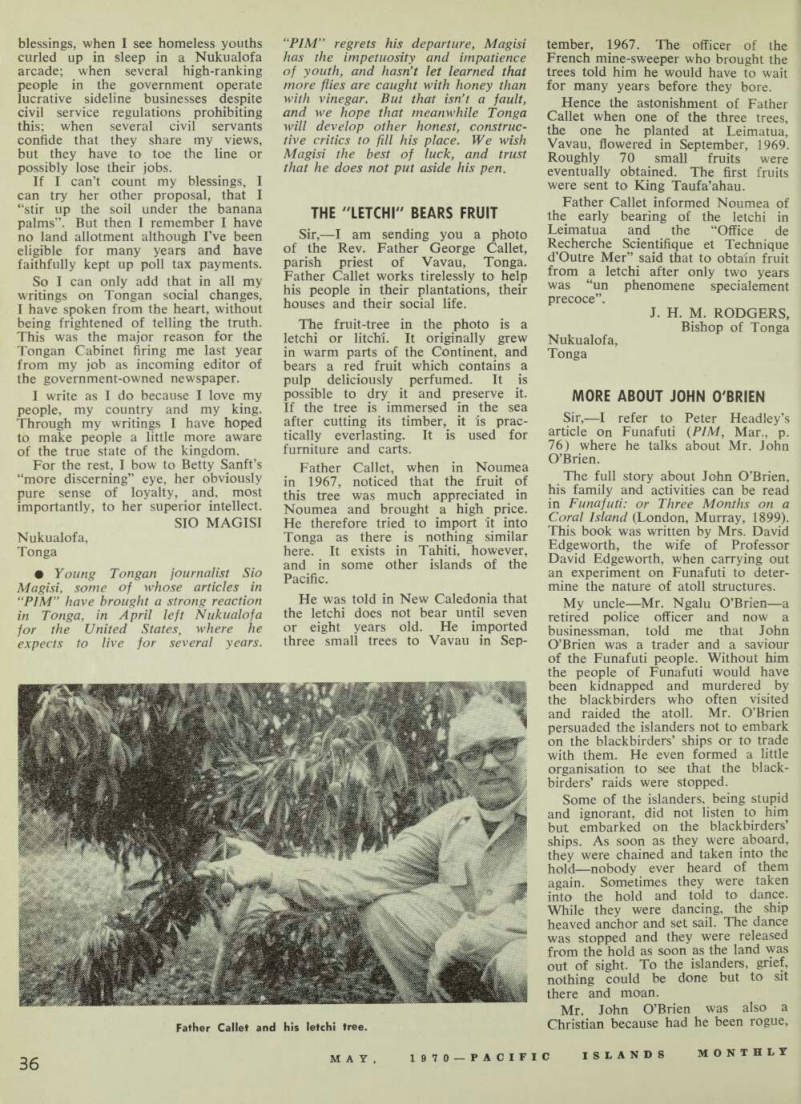
Sir,—l am sending you a photo of the Rev. Father George Callet, parish priest of Vavau, Tonga. £ ather pallet works tirelessly to help bls P eo Pl e in their plantations, their houses and thelr social llfe - The fruit-tree in the photo is a letchi or litch'i. It originally grew in warm parts of the Continent, and bears a red fruit which contains a pulp deliciously perfumed. It is possible to dry it and preserve it.
If the tree is immersed in the sea after cutting its timber, it is prac tically everlasting. It is used for furniture and carts.
Father Callet, when in Noumea j n 1957 , noticed that the fruit of this tree was much appreciated in Noumea and brought a high price.
He therefore tried to import it into Tonga as there is nothing similar here. It exists in Tahiti, however, and in some other islands of the p ac jfi c He was told in New Caledonia that the letchi does not bear until seven or eight years old. He imported three small trees to Vavau in Sep-
tember, 1967. The officer of the French mine-sweeper who brought the trees told him he would have to wait for many years before they bore.
Hence the astonishment of Father Callet when one of the three trees, the one he planted at Leimatua, Vavau, flowered in September, 1969.
Roughly 70 small fruits were eventually obtained. The first fruits were sent to King Taufa’ahau.
Father Callet informed Noumea of the early bearing of the letchi in Leimatua and the “Office de Recherche Scientifique et Technique d’Outre Mer” said that to obtain fruit from a letchi after only two years was “un phenomene specialement precoce”.
J. H. M. Rodgers,
Bishop of Tonga Nukualofa, Tonga
More About John O'brien
Sir, —I refer to Peter Headley’s article on Funafuti ( PIM , Mar., p. 76) where he talks about Mr. John O’Brien.
The full story about John O’Brien, his family and activities can be read in Funafuti: or Three Months on a Coral Island (London, Murray, 1899).
This book was written by Mrs. David Edgeworth, the wife of Professor David Edgeworth, when carrying out an experiment on Funafuti to deter mine the nature of atoll structures.
My uncle—Mr. Ngalu O’Brien—a retired police officer and now a businessman, told me that John O’Brien was a trader and a saviour of the Funafuti people. Without him the people of Funafuti would have been kidnapped and murdered by the blackbirders who often visited and raided the atoll. Mr. O’Brien persuaded the islanders not to embark on the blackbirders’ ships or to trade with them. He even formed a little organisation to see that the black birders’ raids were stopped.
Some of the islanders, being stupid and ignorant, did not listen to him but embarked on the blackbirders’ ships. As soon as they were aboard, they were chained and taken into the hold—nobody ever heard of them again. Sometimes they were taken into the hold and told to dance.
While they were dancing, the ship heaved anchor and set sail. The dance was stopped and they were released from the hold as soon as the land was out of sight. To the islanders, grief, nothing could be done but to sit there and moan.
Mr. John O’Brien was also a Christian because had he been rogue,
Father Callet and his letchi tree.
Letters
he would have driven off and killed all the Funafuti people with his guns and muskets and claimed the atoll for himself. However, he didn’t do anything of that sort but introduced Christian principles, and also tried to implement the good and noble ways of the “white man”.
I am glad that Mr, Headley men tioned something about my ancestor because, at the moment, I am doing a little research on the various and complicated pedigrees of the O’Brien family on Funafuti.
Neemia O’Brien
Bikenibeu, Tarawa,
Geic.
'Tm All Right, Jack!"
Sir, —A most unusual change has been creeping slowly across Fiji’s mental life during the past six months. Chaps in the coumry areas have started to wake up, while fellows in the towns seem, more or less, to have fallen asleep.
The big shot-in-the-arm for the rustics was the launching of the current rural development campaign.
Government, having realised that the country populace is not recruited exclusively from nincompoops, chose to grant them a say in affairs. This benign and noble procedure is form ally defined as “listening in to the grass roots”.
It may not be everyone who has the brain-power to discover the exact strength of the compliment, in being likened to a lump of grass. However, let that go. What happens now if the grass roots say something that the government doesn’t wish them to say? (Not very polite of them, of course, but it could happen.) In that case the right governmental adage jogs along, I summise, roughly as follows: “We like to listen to grass roots— but only as, and when, it suits.”
Unfair? The good old question of roads on the isle of Vanua Levu should serve as a very apt thermo meter for taking the temperature of official interest in the feelings of grass roots.
Government, at this juncture, seems pretty well determined to bestow extremely expensive priority on a zig zagging highway linking Labasa with Savusavu. Mind you, this would be a notably pleasing road, scenic, and so forth, a road for happy characters who already have roads, who like
driving in different directions. In military diction you would call it, probably, the “I’m all right Jack” road. Very nice.
Yes, but how now about the poor blighters in Savusavu West, that totally roadless domain? Something like 3,000 people are wilting away across there like Communists carted off to Siberia. Their dilapidated track, which passes, not over, but right through the frequent rivers, might be labelled the “I’m nothing like all right, Jack” track.
Commentators could expand: “I am pushing ahead just in my under pants, Jack . . . There’s five feet of river water tickling my chin, Jack . . . Gosh, Jack, they’re a couple of sharks sniffing my knees . . . Any chance of a bit of a helping hand somewhere? Otherwise, I’ve just about had it, Jack.”
That strikes me as the gist of a recent boiled-down bulletin from the Savusavu West grass roots. This grass, by the way, is not just sensitive grass. It doesn’t simply collapse when squashed. But it could sting, too, a trifle—at some strange future date: let us say somewhere roughly round about the time of Fiji’s next general election.
M. E. Basden.
Savusavu, Fiji.
"Educate The Expatriates"
Sir, —During a stop over at Port Moresby recently 1 witnessed an incident in an hotel which makes me ask whether we should not be educat ing the expatriate rather than the indigene.
On the entrance door to a bar is a printed notice reminding gentlemen that the dress after 6.30 p.m. is slacks, shirt, tie, etc. At approximately 6.40 p.m. on March 14, among others drinking, were four Australians attired in day dress of shorts, etc., when an Asian, similarly attired, and incidentally who had just ar rived at the hotel, entered the bar and ordered a drink.
The barmaid politely informed him he was incorrectly dressed to be served in that bar at that hour of the day. He questioned this state ment and pointed to the other in correctly attired drinkers, whereupon one of these gentlemen informed him that he was not being refused service on account of his colour, but on account of his dress, and also that as long as a drink was ordered before 6.30 p.m. it was all right to finish the drink off. The notice cer tainly did not state this.
Three of the incorrectly attired gentlemen then left the bar at 6.45 p.m. suggesting to the fourth person
he do the same, but, as no doubt he was one of the educated expatriates and could interpret the true meaning of the notice, he stayed on till 6.58 p.m.
Surely an incident such as this does nothing but harm when we are striving to show there is no discrimi nation against coloured races.
I can well imagine how this Asian as he travels the world will tell his educated friends how Australians not only discriminate against the indigenes of New Guinea, but also against any coloured person.
R. Vickers.
Kirrawee, Sydney.
Study Of Japan And U.S.
Sir, —I am making a study of the relationship between the United States and Japan in the period im mediately prior to World War 11.
I have heard and read that reports exist of hostilities between American and Japanese naval vessels having occurred before December 7, 1941, but do not have any specific in formation.
I do not have reference to the Panay incident. If any of your readers are aware of any hostilities between US and Japanese naval vessels be fore December 7, 1941, I would be very grateful for any specific in formation.
J. W. Marchildon.
PO Box 16123, Phoenix, Arizonia 85011, US.
In Search Of Photographs
Sir, —We are gathering material for a book on New Guinea history.
This is to be published by Jacaranda Press of Brisbane and is to take the form of a text illustrated by maps and photographs.
We would be grateful for any help which your readers could give in letting us take copies of photo graphs in their possession. As far as possible we wish to use hitherto unpublished material. Photographs of historical events, of people, build ings, towns, ships, and industrial enterprise, would be of interest to us.
Any material lent to us would be carefully handled and returned promptly. Acknowledgement would be made in the publication of any material used according to the direc tions of the owner.
N. Gash, J. Whittaker,
Lecturers in History.
Australian School of Pacific Administration, Middle Head, Mosman, NSW 2088.