Studies in black and white
pp. 36-37 · Read in the full issue
From a Canberra correspondent
An unusual collection of 48 drawings, which show what New Guinean teenagers think of Europeans, is to be exhibited at various centres in New Guinea over the next three months.
The drawings, which sometimes show marked hostility towards Euro peans, are part of a larger collection of more than 200 gathered by Mrs.
Ruth Finney in the course of a study of motivation in New Guinea.
Mrs. Finney, an American, is a psychological anthropologist with the New Guinea Research Unit of the Australian National University.
Specifically, she has been investigating whether New Guineans in several districts of varying degrees of economic development are different psychologically in wanting to be businessmen or not.
14-18 Age Group
Mrs. Finney’s drawings were col lected at secondary schools in four centres —Manus, Mt. Hagen, Goroka and East New Britain. All were done by boys in the 14-18 age group.
The boys, who did not know they were participants in a survey, were asked by their teachers to draw pictures of at least one New Guinean and one European “doing anything, doing nothing, thinking anything,
thinking nothing”. Afterwards, they were asked to write brief stories explaining their drawings.
Mrs. Finney has since divided the pictures and their accompanying stories into three groups—those emphasising co-operation between New Guineans and Europeans, those emphasising conflict, and those not expressing either view.
This analysis has revealed that 64 per cent, of the young New Guinean artists saw Europeans and New Guineans as working in co-operation, although most of them portrayed the Europeans as dominant—e.g., issuing orders or sitting down while the New Guineans listened or laboured physically.
AAore co-operation
Another feature of the pictures is that those drawn by students from well-developed areas portray the co operation theme more frequently than those from poorly developed areas.
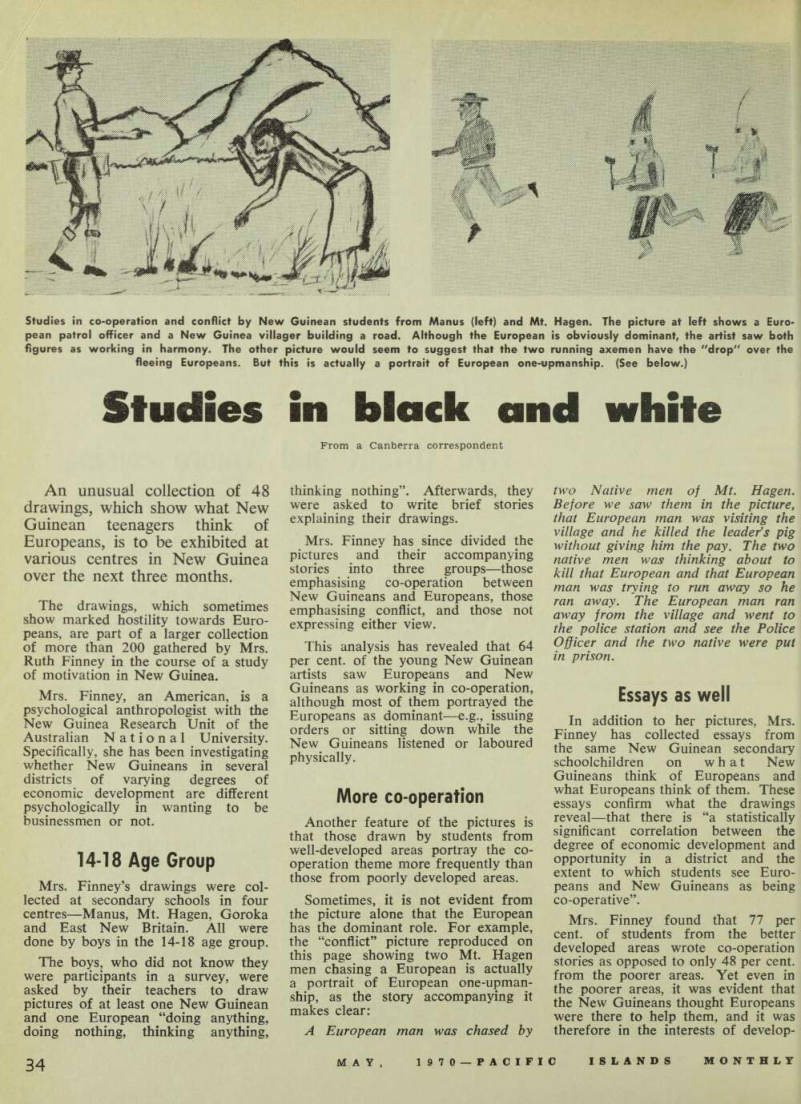
Sometimes, it is not evident from the picture alone that the European has the dominant role. For example, the “conflict” picture reproduced on this page showing two Mt. Hagen men chasing a European is actually a portrait of European one-upman ship, as the story accompanying it makes clear: A European man was chased by
two Native men of Mt. Hagen.
Before we saw them in the picture, that European man was visiting the village and he killed the leader’s pig without giving him the pay. The two native men was thinking about to kill that European and that European man was trying to run away so he ran away. The European man ran away from the village and went to the police station and see the Police Officer and the two native were put in prison.
Essays as well
In addition to her pictures, Mrs.
Finney has collected essays from the same New Guinean secondary schoolchildren on what New Guineans think of Europeans and what Europeans think of them. These essays confirm what the drawings reveal—that there is “a statistically significant correlation between the degree of economic development and opportunity in a district and the extent to which students see Euro peans and New Guineans as being co-operative”.
Mrs. Finney found that 77 per cent, of students from the better developed areas wrote co-operation stories as. opposed to only 48 per cent, from the poorer areas. Yet even in the poorer areas, it was evident that the New Guineans thought Europeans were there to help them, and it was therefore in the interests of develop-
Studies in co-operation and conflict by New Guinean students from Manus (left) and Mt. Hagen. The picture at left shows a Euro pean patrol officer and a New Guinea villager building a road. Although the European is obviously dominant, the artist saw both figures as working in harmony. The other picture would seem to suggest that the two running axemen have the "drop" over the fleeing Europeans. But this is actually a portrait of European one-upmanship. (See below.)
“Basically,” Mrs. Finney says, “the New Guinean people have a lot of goodwill towards Europeans. They have very high expectations of what Europeans are going to do . . . and they are sharply disappointed when their hopes are not met.”
Mrs. Finney adds that the New Guineans’ chief complaint about Europeans is their attitude of superiority. The second concerns their motive for being in New Guinea, for whereas the New Guinean students feel that Europeans should be in their country to help them, they note that many Europeans come to their country specifically with the idea of making more money than they would at home.
More results
Mrs. Finney’s investigations have produced a heavy crop of other in teresting findings, all of which are to be published soon in a New Guinea Research Bulletin, As for the 48 drawings that are to be exhibited in New Guinea in the next three months, they will first be displayed at the University of Papua and New Guinea in Port Moresby during a seminar on “The Politics of Melanesia” beginning on May 11.
They will then go to Lae, Goroka, Mt. Hagen, Madang, Wew a k, Lorengau, Kavieng and Rabaul. • The Western Samoa Amateur Sports Federation is to ask the Samoan Government to offer Apia to the South Pacific Games Council, as venue for the 1978 South Pacific Games.
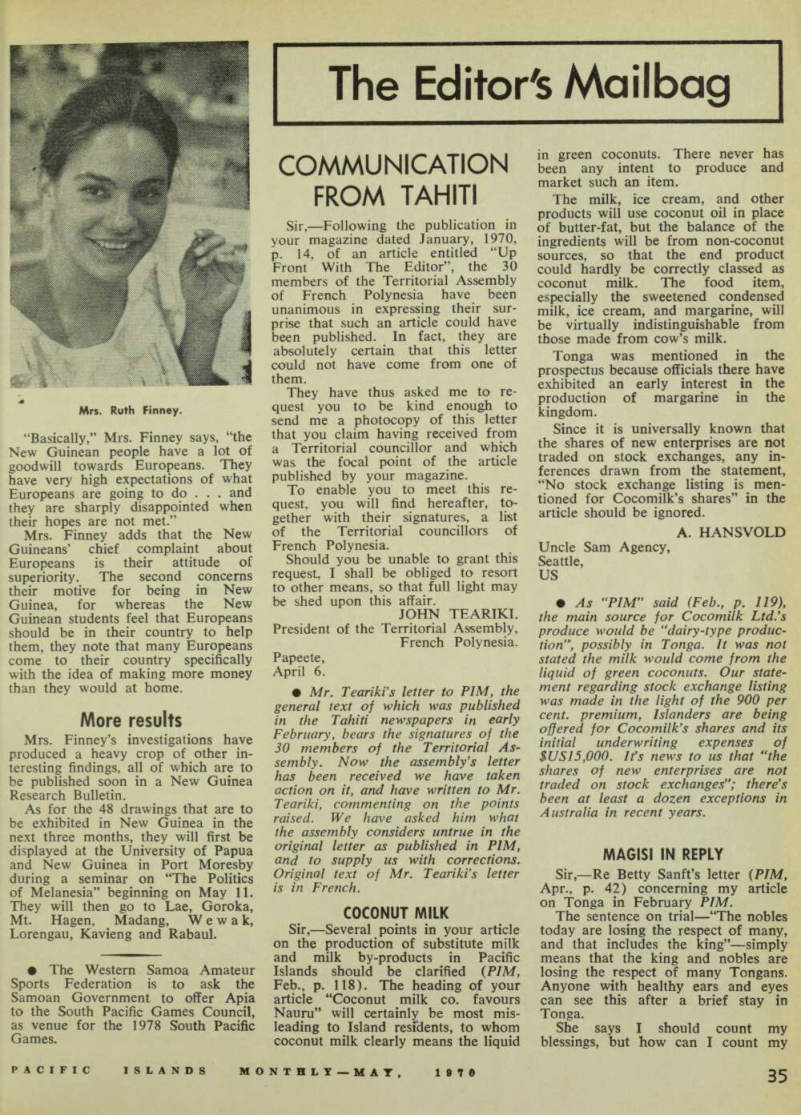
Mrs. Ruth Finney.