But There's No Urgency In
p. 26 · Read in the full issue
Prejudiced' New Guinea
From a Port Moresby correspondent Localisation in Papua-New Guinea is a vexed question and the true picture of how it is going is blurred by self interest, prejudice and politics. But two things emerge: there is no overall plan, and localisation is not occurring very speedily.
The government is committed to seeing New Guineans in every public service job where it is reasonable to put them, but the emphasis is on the “reasonable” part. Administration spokesmen on the subject don’t like it thought that there is going to be any window-dressing in Papua-New Guinea and they insist that appointees should “maintain performance”. But this doesn’t take into account the fact that the Administration, through pressures, will be forced to localise far more quickly than it thinks.
The Administration’s view appears to be that New Guineans in the public service should work their way up from the bottom.
And there is an incapacity among some Australian public servants to believe that a New Guinean can think sufficiently well to take over his job one day. They complain about his “lack of sense of responsibility”, which is another way of saying that the New Guinean perhaps doesn’t think like Australians.
Short of educated
What New Guinea is seriously short of, and what prevents localisa tion from being the force it ought to be at this stage of New Guinea’s development, is educated New Guineans. An educated New Guinean, of course, won’t be expected to think like an Australian if it suits him not to. And an educated New Guinean, in a really top job, will see to it that the lower echelons are filled by more New Guineans.
Few top Administration personnel really know how serious this shortage of educated people is to any localisa tion drive. It’s vital that there be faster training for the top jobs.
The Public Service Training Centre in Port Moresby, the Higher Institute of Technology in Lae and the Uni versity of Papua-New Guinea are all filled with students—but none of those institutions existed until a few years ago, and it’s a case of too little too late.
Some government departments have localised more speedily than others, and the kind of man you have as a departmental head is mostly responsible for this. The Health Department, for instance, has four regional medical and dental officers who are local people.. The Department of Posts and Telegraphs has also been moving quickly in that direction, with Serei Pitoi recently acting as Director of Posts and Telegraphs in the director’s absence.
Paulius Matane has recently acted as Director of Lands. These two, together with Alkan Tololo (a former teacher and one of the first two New Guinean district inspectors ap pointed by the Education Depart ment) are members or, in Tololo’s case, an acting member, of the Public Service Board. But there are too few men in these key positions.
The Administration cleared the decks, in theory, for localisation, when in 1964 it introduced a contract system for any newly employed expatriate officers—granting a mini mum two-year contract to those in jobs which could be quickly localised, and about five years in the case of professional people. The Assistant Administrator, Mr. Les lohnson, who left New Guinea for another job in April, was on a five-year contract.
He left a year ahead of his time.
The P-NG Public Service Associa tion continues to be a great champion of expatriates who are overtaken, or threatened to be overtaken, by localisation. The PSA often attacks
the government over the vagueness of its policy—with good reason. It points out that because expatriates don’t know where they stand, there has been poor morale in the public service.
In the public service today there are 14,000 local officers and 6,800 overseas officers. Since 1964 they have all been part of an integrated public service. Until then, New Guineans comprised an auxiliary service. But of course most of the overseas officers hold the key positions.
Private enterprise slow
Meanwhile, although it certainly hasn’t got its own house in order, the Administration does a fair amount towards encouraging localisa tion in private enterprise. It operates an indigenous training incentive scheme, and it is continually attempt ing to encourage a private sector to accept greater responsibility for training its own people. Too many firms excuse the fact that they have not more native employees by claim ing, “We can’t compete for the educated ones . . . they can’t learn what we want to teach them anyway, because it takes years for them to get that kind of experience”.
There are only a handful or two of New Guineans who run sub stantial businesses of their own. After that, native commerce is mainly co operative, or small-time trade stores and trucking businesses.
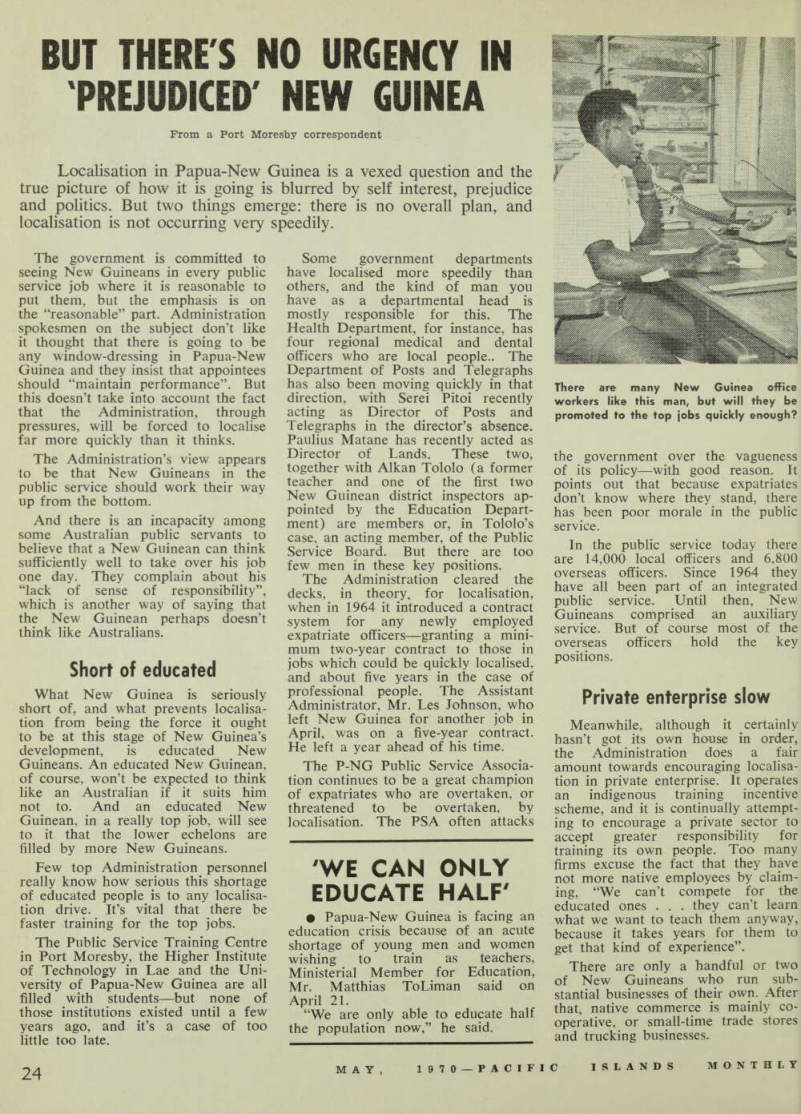
There are many New Guinea office workers like this man, but will they be promoted to the top jobs quickly enough?