Pacific Islands Monthly
pp. 24-25 · Read in the full issue
They're Localising About
As Fast As They Can Go'
Prom a Suva correspondent “Inefficiency is one of the prices you have to pay for localisa tion. You have to make sacrifices.”
So said the deputy director of one of Fiji’s government departments during a recent conversation. He was quite ready to admit that localisa tion was having some fairly severe teething troubles—but he wouldn’t be named, because nobody much wants to be pronounced an expert on localisation in Fiji.
It’s one of the touchy questions of the day. The problem isn’t only one of replacing an expatriate work force with locals, some of them relatively untrained and certainly inexperienced.
There’s a question too of maintaining a racial balance, which is a compli cated factor in Fiji. Will your staff be Fijian or Indian?
Mostly the urge in Fiji is to localise as fast as possible, and there are in fact very few complaints about the speed of localisation here—which appears to be faster than in the Solomons or New Guinea.
Pace steps up
And the Chief Minister, Ratu Sir Kamisese Mara, wants the pace stepped up now that independence is looming close. There are even those in the government who say they would like to see the disappearance of all Europeans after independence, but this is not a view which is likely to be accepted. General view is that a small corps of overseas experts will be needed in an advisory capacity for a long time to come.
The bottom of the public service in Fiji is now entirely localised.
The top posts are being localised very rapidly—everybody agrees that rapidly is the right word—with not a paleface to be seen in the top ranks of several departments.
The middle group of posts still
has a substantial sprinkling of ex patriates, because one problem in Fiji is the lack of middle-rank profes sional men.
Although there is no specific blue print for localisation of the Fiji civil service, the colony has been working to some guide lines—unlike some other territories. Main guide line is Sir Richard Ramage’s report, “Localisation of the Civil Service”, which was published in May, 1968.
The man in the hot seat, with the task of implementing the programme, has been Mr. John Williams, a care ful veteran of the colonial service, who spent 12 years as an adminis trative officer in Sarawak before com ing to Fiji 2i years ago.
In Sarawak he was in charge of
"Localisation", "indigenis ation", there are several ugly words for the process of giving Islands' people control of their own affairs by seeing to it that they fill the important positions in the public service—and in commerce, too. How quickly is it happening? PIAA corres pondents in Fiji, Papua- New Guinea and the British Solomons give us the re ports on the next five pages.
It's not an entirely pleasing picture, except perhaps in Fiji, where the problem has been tackled with more per spicacity.
the management of the civil service, working closely with the localisation programme. In Fiji in 1967 he took the title of Director of Localisation and Training.
Mr. Williams, who leaves Fiji in May, stresses that he didn’t instigate today’s localisation programme, which has been going on slowly for 10 years. But certainly since his advent there has been a great leap forward.
With his departure, the 14-man Department of Localisation will con tinue for some time to come, although it may be reorganised. The depart ment isn’t responsible for actual ap pointments, but for training.
Mr. Williams says, “I don’t believe in sticking rigidly to a plan for localisation because you have to be flexible where the human factor is involved. But the Ramage report, which deals with each department, has served as a foundation.”
Policy began in 1956
Sir Richard Ramage’s definition of localisation is the employment on local terms of anybody permanently resident in the Fiji group, regardless of race or origin. But in practice localisation in Fiji has leant towards anybody born and resident in Fiji.
A policy of localisation of the public service was accepted as far back as 1956, but systematic recruit ment of locals actually dated only from the establishment of the Public Service Commission in 1960.
Of the 416 local graduates or diplomates at the time of the Ramage report, 60 were known to be over seas; 193 were in the civil service (including 100 in the Education De partment) and 163 were outside the service.
Priority has been given to attract ing as many of these “outsiders” as possible into the service, but still there are too few professional men
available. And those that are, lack experience.
The programme will receive a boost in September when the University of the South Pacific provides a course lasting two or three months for about 20 senior administrators, who will acquire additional skills to help with positions they will take up after inde pendence. Practical rather than academic aspects will be emphasised.
A group of overseas administration experts was in Suva in March dis cussing arrangements for the seminar, which will be directed by Mr. lan Nicholson, a Senior Lecturer in Public Administration at the Uni versity of Queensland.
Any conversation on localisation in Fiji tends to harken back to an article on “Fijian Power” which ap peared not long ago in the Alliance backed Fiji Nation Newsmagazine, and caused great tongue-clicking among the conservatives.
Have-nots
The term itself sounded disturbing but its real meaning was in the economic and educational sense. The article tried to say there would have to be discrimination for, not against, Fijians so they should no longer be the “have-nots” of the community.
A certain Fijian faction feels that a big percentage of jobs, scholarships and new business licences will have to be reserved for Fijians, even if they are not as qualified as members af other races.
The Ramage report recommended that the racial balance within civil service should be considered on an averall basis: any narrower interpre tation (i.e., department by depart ment) would be entirely contrary to the interests of efficiency. This recommendation is being followed.
Inevitably, there has been a slow ing down in the service. But Mr.
Williams contends that this doesn’t necessarily denote less efficiency.
“When someone is pitchforked into a post with high responsibilities, it’ll take him longer to do it properly if he hasn’t had the advantages of ex perience,” he said.
“There may be a short period of a year or two after independence when things will go a bit slowly, but I
wouldn’t say there’ll be a drop in standards.”
There are many who complain that localisation has meant a definite drop in efficiency in many spheres, but the real situation could be that the de partments in question were not very efficient in the first place. And many people confuse “inefficiency” with “frustration”—which is the hallmark of government departments every where.
One of the fastest-localising de partments in Fiji is the police force.
Since January 1, 1969, one local officer has been promoted to the rank of senior superintendent, three to superintendents, seven to assistant superintendents. Three were ap pointed as supernumerary (tem porary) superintendents and two as supernumerary assistant superinten dents.
Because of the promotions, six ex patriate officers have been offered premature retirements and of these six, three have gone overseas.
In March this year, there were only 20 expatriate officers remaining in the force. The Commissioner of Police, Mr. R. T. H. Henry, said it was the government’s plan to localise the whole force—including his own post.
The Bureau of Statistics was the first to be fully localised, with highly-qualified Mr. Mohammed Ali Sahib taking over from Mr. Michael Ward as Government Statistician when Mr. Ward left Fiji at the end of October after completing his contract.
There are now six local heads
of departments and more are pre dicted for 1970.
In 1965 there were 195 expatriates in the civil service on a permanent basis and 273 on contract or second ment. Last year there were 128 permanents and 299 on contract or secondment.
If expatriates who’ve been retired early feel any resentment about it, they haven’t aired their grouches publicly.
In general, they’re pretty satisfied with the “golden handshake” they’ve received, and they can’t complain that they haven’t seen the situation com ing. For several years now, the political atmosphere has given no alternative to localisation at the earliest date.
No target date
Mr. Williams told PIM that there was no real target date. The object was simply to localise the service without making a mess of it. “If we’ve got the trained people, we can localise. If we haven’t, we can’t,” he said.
“We’re all very much aware that Fiji people want to run their own show, and we’re helping them do it as fast as we can.”
With Mr. Williams’ departure (he says he is going back to Wales to find a nice quiet job in a university) he will have localised his own job.
The Department of Localisation will be headed by a Rotuman, Mr. A. F.
Varea, who is the assistant director. • Next page: The picture in P-NG.
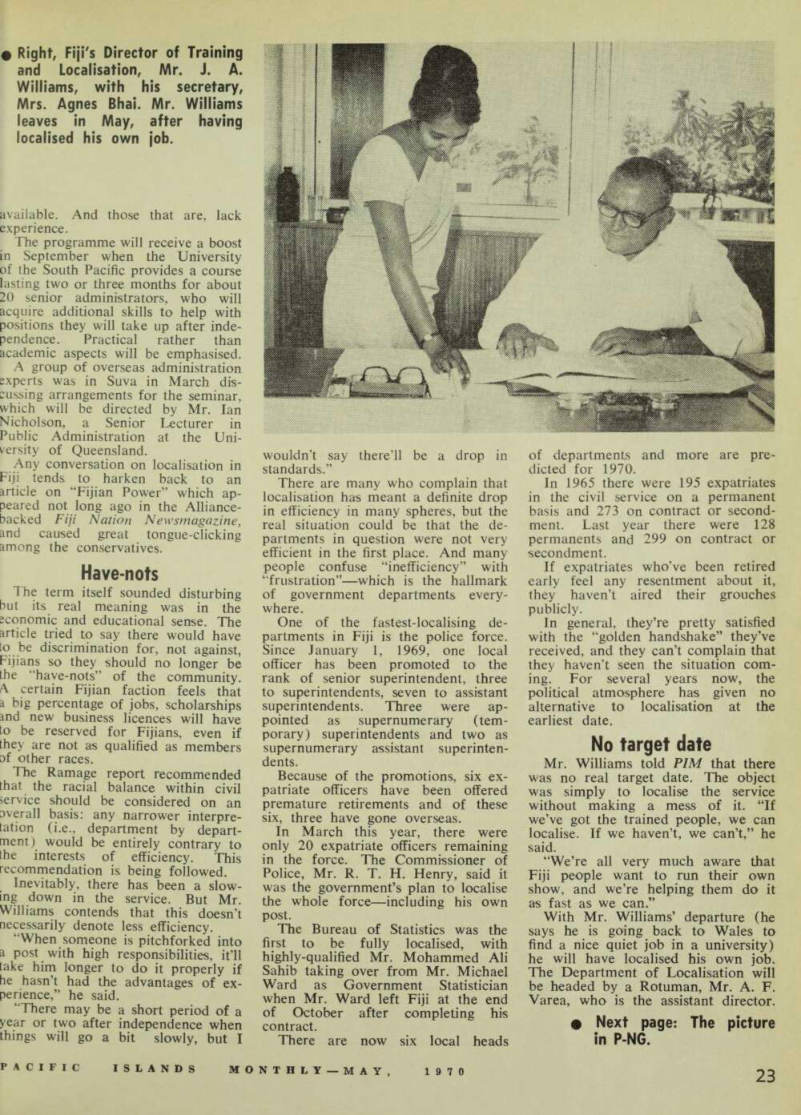
Right, Fiji's Director of Training and Localisation, Mr. J. A.
Williams, with his secretary, Mrs. Agnes Bhai. Mr. Williams leaves in May, after having localised his own job.